About This Article
Zoom Health has supplied home health products and test kits to UK customers for nearly 20 years. This article is for general information only and does not constitute medical advice. Any abnormal test results should be discussed with your GP promptly. Always consult a qualified healthcare professional before making changes to your diet, medication or lifestyle based on a home test result. Home health tests are screening tools and are not a substitute for clinical testing.
One in four people in the UK will experience an allergy at some point in their lives. That is not a niche statistic – it means that in virtually every family, at least one person is dealing with symptoms that could be allergic in origin. And yet, in my experience running Zoom Health, allergy is one of the most under-investigated health issues there is. People put up with a permanently blocked nose, itchy eyes through summer, or skin that flares up after certain meals, and simply assume it is just the way things are for them. Often, it is not. Often, there is a specific trigger – and identifying it changes everything.
The challenge with allergy testing is that there is no single “allergy test.” The right test depends on what you are trying to find out. Are you looking for a general screen to confirm whether an allergy is involved at all? Do you suspect a specific trigger like cat hair or dust mites? Are you worried about a food allergy? Each of those questions points toward a different kit. In this guide, I want to explain how home allergy tests work, walk through the range we stock at Zoom Health, and help you decide which test matches your situation.
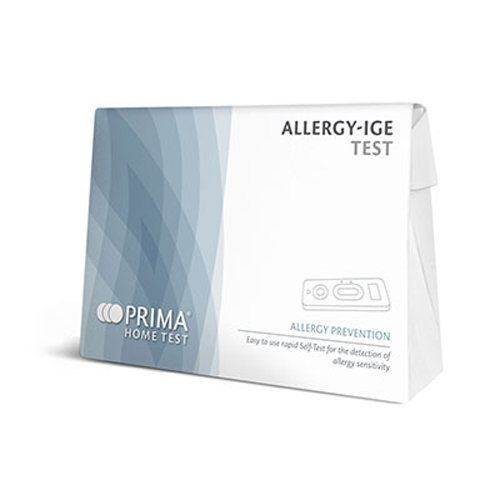
Prima Home Allergy Test Kit
Broad IgE screen covering dog and cat hair, pollen, hay fever and food intolerance. Results in 10 minutes. Rated 5.00/5. On sale from £12.99.
Why allergy is so often misdiagnosed or missed entirely
Allergies are difficult to pin down because they mimic so many other conditions. Rhinitis – a persistently blocked or runny nose – is commonly treated as a recurring cold or sinusitis. Eczema gets treated with steroid creams without anyone investigating whether a dietary or environmental allergen is driving the flare-ups. Chronic fatigue, headaches, and digestive problems can all have allergic components that are never explored because no one thinks to test for them.
The immune system’s role in all of this is central. When your body encounters an allergen, it produces a specific type of antibody called immunoglobulin E – IgE. In people without allergies, IgE levels are low. In people with allergies, IgE levels rise in response to exposure to the triggering allergen. This is the biological mechanism that all home allergy blood tests are designed to detect.
The number of people in the UK affected by allergies grows by around 5% every year, according to Allergy UK. Children are particularly susceptible, though allergies can develop at any age – including in adults who have previously shown no sensitivity at all. If you or someone in your family has been dealing with unexplained symptoms for months or years, a home IgE test is a logical and affordable first step.
How home allergy blood tests work
All of the blood-based home allergy tests we stock operate on the same fundamental principle: a small blood sample, taken via a finger prick, is applied to a test device that detects the presence and level of IgE antibodies. Elevated IgE indicates that the immune system has been sensitised to one or more allergens – that is, it has encountered them before and mounted a response.
The key difference between the various kits is specificity. A general allergy screen tells you whether your total IgE is elevated, which suggests an allergic response is likely but does not identify which specific allergen is responsible. A targeted test – for cat hair, dust mites, or milk, for example – checks whether your IgE levels are elevated specifically in response to that allergen.
For most people, I recommend starting with a general screen if you are unsure whether allergy is involved at all, then moving to a specific test if the general screen is positive and you want to identify the trigger. If you already have a strong suspicion about a specific allergen – you always seem to react around cats, or your symptoms started when you moved into a carpeted flat – it is reasonable to go straight to the targeted test.
One important point: a positive IgE test confirms sensitisation, meaning your immune system has reacted to that allergen. It does not automatically mean your symptoms are being caused by that allergen. Sensitisation and clinical allergy are related but not identical. A positive result is a prompt to discuss findings with your GP, not a standalone diagnosis.
Prima Home Allergy Test Kit: the best starting point for most people
If you are new to allergy testing and want to understand whether allergy is at the root of your symptoms, the Prima Home Allergy Test Kit is where I would start. At £9.99, it is the most affordable test in our range and covers a broad sweep of common allergens including dog and cat hair, pollen, hay fever triggers and food intolerance IgE. Results come in around 10 minutes from a single finger-prick blood sample.
The test is manufactured by Prima Lab SA, the Swiss diagnostics company also behind our thyroid test kit. Their home tests have a strong track record for accuracy, and this kit has a perfect 5.00/5 rating from our customers. It is suitable for adults and children over 6 years old.
What the Prima kit gives you is a binary answer: is your total IgE elevated, yes or no? If the result is positive, you know that an allergic process is likely involved, and you have grounds to request further investigation from your GP or an NHS allergy clinic. If it is negative but you still have persistent symptoms, other causes are worth exploring – and again, your GP is the right next step.
Broad IgE screen. Dog/cat hair, pollen, hay fever, food intolerance. Results in 10 minutes.
View product
Imutest Allergy Check Kit: hospital-equivalent accuracy at home
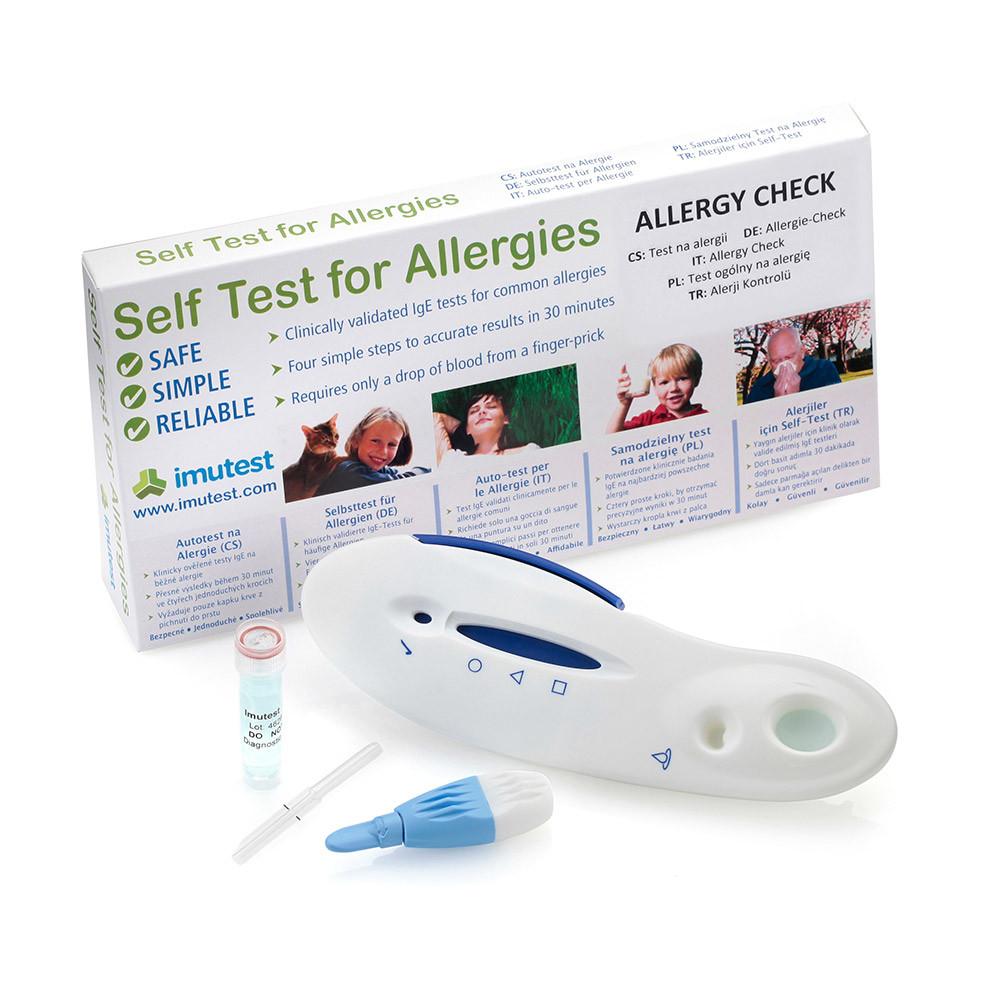
The Imutest Allergy Check Kit is a step up in both breadth and clinical rigour. It has been independently validated to be as accurate as allergy tests performed in hospitals, which is a meaningful claim – and one that has been demonstrated in clinical trials. Like the Prima kit, it uses a finger-prick blood sample and delivers results at home in around 30 minutes, following six clearly laid out steps.
The kit comes with a detailed information guide that helps you interpret which specific allergy is contributing if your result is positive. At £28.99 it represents a more significant investment than the Prima screen, but it is still a fraction of what a private allergy consultation would cost – and it can be done on your own schedule, at home, with no waiting room.
I would recommend this kit for anyone who has already had a positive general screen and wants a more authoritative home result before going to their GP, or for anyone who wants maximum confidence in their home test result from the outset. It is also suitable for the whole family and can be used regardless of whether the person being tested is on antihistamines or other allergy medication – the results are not affected by medication.
Hospital-equivalent IgE test. Results in 30 minutes. Medication does not affect results.
View product
Airborne Allergy Screen Kit: three tests in one for the most common triggers
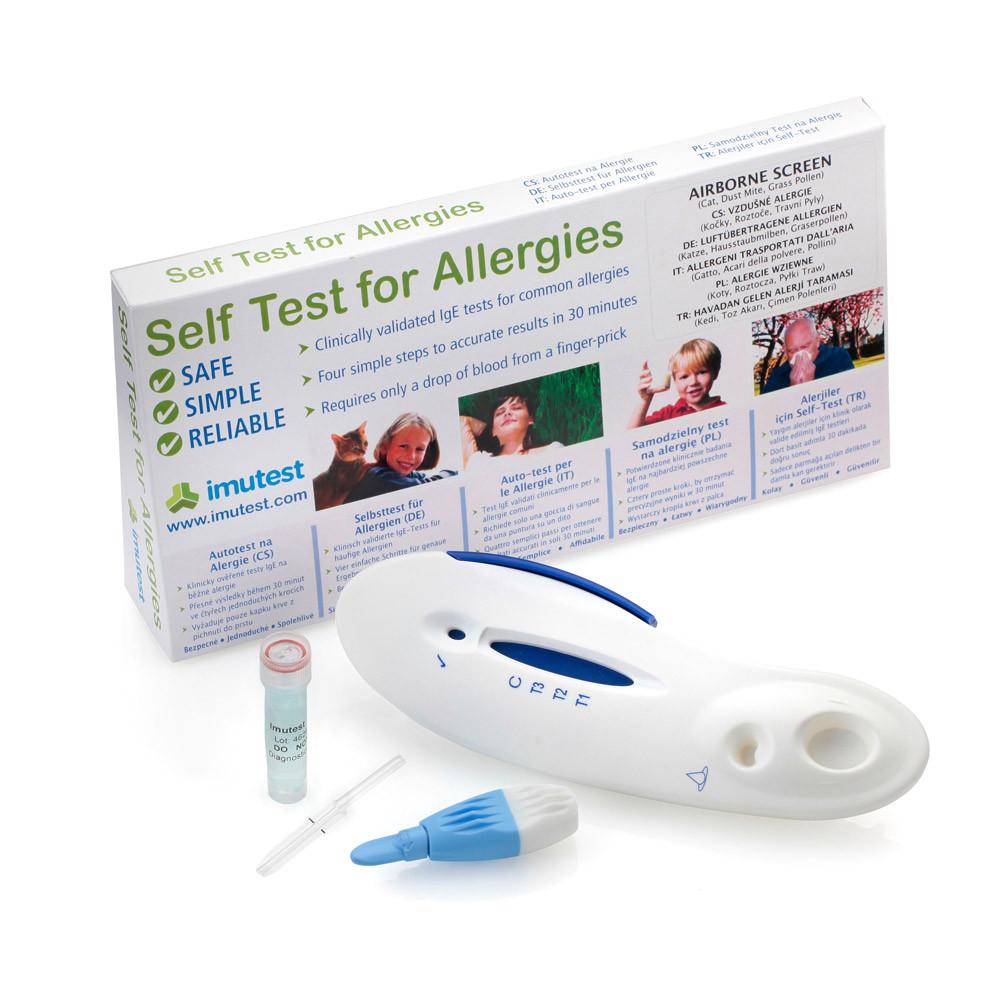
If your symptoms point toward environmental or airborne triggers – sneezing, itchy eyes, a persistently blocked nose, or breathing difficulties that worsen at certain times of year or in certain environments – the Airborne Allergy Screen Kit is designed specifically for you. From a single finger-prick blood sample, it tests simultaneously for the three most prevalent airborne allergens in the UK: cat hair, dust mites and grass pollen.
This matters because knowing which airborne allergen is responsible changes how you respond. Dust mite allergy calls for measures at home – mattress covers, more frequent washing of bedding, reducing soft furnishings. Grass pollen allergy is seasonal and predictable, meaning you can plan antihistamine use in advance and take precautions during high-pollen periods. Cat hair allergy has obvious implications if you are considering getting a pet, or if you visit homes where cats live. The Airborne Screen gives you specific answers to all three questions in a single test.
At £32.99 it is the premium option in our allergy range, and I think it justifies the price for anyone who suspects an airborne trigger. The test takes around 30 minutes and delivers results directly at home – no sending samples away, no waiting for lab reports.
3-in-1: cat hair, dust mite and grass pollen. Results in 30 minutes.
View product
Targeted tests: when you already know what to suspect
Sometimes you do not need a broad screen – you need a specific answer to a specific question. We also stock three targeted single-allergen kits for exactly that purpose.
The Cat Allergy Test Kit is ideal if your symptoms consistently appear around cats and you want confirmation before making a decision – whether that is about getting a cat, visiting a friend who has one, or finally understanding why you always leave certain houses sneezing. Cat allergy is the most common pet allergy in the UK, and it is frequently underdiagnosed because people assume they would know if they were allergic.
The Dust Mite Allergy Test Kit is worth considering if your symptoms are worst first thing in the morning, in bed, or in rooms with carpets and soft furnishings – all classic patterns for dust mite sensitivity. Dust mites are the second most common allergen after pollen and are present in virtually every home, which makes them easy to overlook as a trigger.
The Milk Allergy Test Kit screens specifically for IgE sensitisation to cow’s milk proteins. This is one of the most common food allergies in children and can also develop in adults. It is worth noting that a genuine milk allergy (an immune response) is different from lactose intolerance (a digestive issue), and this test screens for the former. If you or your child experience itching, skin reactions, digestive distress or breathing difficulties after consuming dairy, this kit provides clear results within 30 minutes.
Which allergy test should you choose?
To make it simple, here is how I think about the choice:
- Not sure if allergy is involved at all? Start with the Prima Home Allergy Test Kit at £9.99. It is the lowest-cost entry point and covers a broad range of common triggers.
- Want maximum confidence and hospital-grade accuracy? Go for the Imutest Allergy Check Kit at £28.99.
- Symptoms suggest an airborne trigger (sneezing, itchy eyes, nasal congestion)? The Airborne Allergy Screen Kit at £32.99 tests the three most likely culprits in one go.
- Strong suspicion about a specific trigger? Go straight to the Cat, Dust Mite or Milk Allergy Test Kit for a targeted answer.
What to do after a positive allergy test result
A positive result tells you that your immune system has been sensitised to one or more allergens. Your next step is to book an appointment with your GP, take your test result with you, and ask for a referral to an NHS allergy clinic if you want a full diagnostic workup. NHS allergy clinics can conduct comprehensive skin prick testing and specific IgE blood panels that identify a wider range of allergens with greater precision.
In the meantime, your GP may recommend starting antihistamines, nasal corticosteroid sprays, or other first-line treatments depending on your symptoms. If a food allergy is confirmed, a referral to a dietitian is also standard practice.
While you are thinking about immune health, it is also worth considering whether your diet is giving your immune system the nutritional support it needs. In my experience, many people with frequent allergic symptoms benefit from reviewing their intake of key nutrients. Our guide to immune system supplements covers the role of Vitamin C, Zinc and Vitamin D in supporting normal immune function, and is a useful companion read.
Frequently asked questions about home allergy testing
Can children use these tests? Yes – all of the Imutest and Prima kits are suitable for children aged 6 and over.
Will antihistamines affect the result? No. IgE blood tests are not affected by antihistamines, steroids, or other allergy medications. You do not need to stop your medication before testing.
Can I test in the morning or evening? Unlike some blood tests, allergy IgE tests do not require fasting and can be done at any time of day.
What if my result is negative but I still have symptoms? A negative IgE test does not rule out all possible causes of your symptoms. Some reactions – particularly non-IgE mediated food intolerances – are not detected by standard IgE blood tests. If symptoms persist, please see your GP.
Is a home test as good as a test at my GP? The Imutest kits have been clinically validated as equivalent to hospital testing. A home test is a good first step; NHS allergy clinics offer a broader range of specific allergen testing if a full diagnostic workup is needed.
Ready to find out what is triggering your symptoms?
Allergy symptoms that go uninvestigated tend to become a permanent, accepted feature of life. They do not have to be. A home allergy test takes 10 to 30 minutes, costs from £9.99, and could give you the clarity to finally understand what your immune system has been reacting to – and what you can do about it. We dispatch all orders the same day before 3pm, so your kit will typically arrive the next working day.
Shop Our Allergy Test Range
From a £9.99 broad screen to a hospital-equivalent 3-in-1 airborne panel. Same-day dispatch. Results at home in 10 to 30 minutes.
Prima Allergy Test – £9.99
Imutest Allergy Check – £28.99
Airborne Screen – £32.99
Related guides from Zoom Health:
- Full range of home health test kits
- Home Thyroid Test Kit guide – fatigue and skin problems can also have a thyroid cause
- 7 ways to manage a dust mite allergy
- Immune support supplements from Lindens
Anthony Cunningham – Health Writer & Editor
Anthony Cunningham, BA (Hons), MA, is a UK-based health writer and editor with over 20 years’ experience running Zoom Health, a trusted source for home health tests, preventive care, and wellness guidance. He creates clear, evidence-based articles using NHS, NICE, and WHO guidance. Where possible, content is reviewed by practising clinicians to enhance accuracy and reliability, helping readers make informed healthcare decisions.