About This Article
Zoom Health has supplied home health products and test kits to UK customers for nearly 20 years. This article is for general information only and does not constitute medical advice. Any abnormal test results should be discussed with your GP promptly. Always consult a qualified healthcare professional before making changes to your diet, medication or lifestyle based on a home test result. Home health tests are screening tools and are not a substitute for clinical testing.
Vitamin D is one of the most talked-about nutrients in UK health circles, and with good reason. Public Health England estimates that around one in five adults in this country has low vitamin D levels – and during the winter months, that figure rises significantly. The NHS now recommends that everyone in the UK considers taking a daily vitamin D supplement between October and March. Sales of vitamin D tablets have never been higher.
And yet, in my experience, most people taking vitamin D are guessing. They pick up a bottle from a supermarket or pharmacy shelf, take a tablet each day, and have no real idea whether they were deficient to begin with, whether the dose they are taking is enough, or whether – in rare cases – they might already have adequate levels and are supplementing unnecessarily. Testing first changes all of that. A home vitamin D test takes ten minutes, costs £7.99, and gives you a result across three meaningful categories: sufficient, insufficient, or deficient. That result shapes everything that comes after it.
In this guide I want to explain what vitamin D actually does, who is most at risk of deficiency, what the three-level test result means in practice, and how to use the result to make informed decisions about whether and how much to supplement.
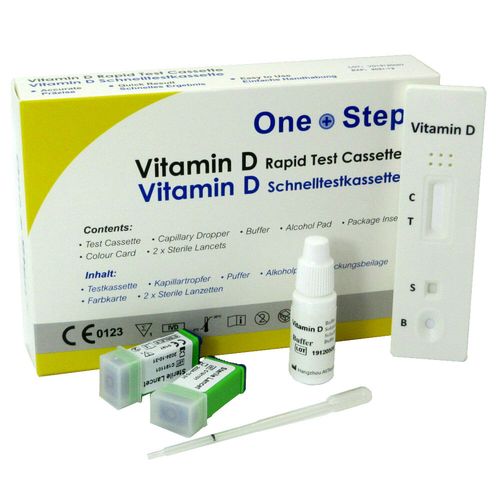
Vitamin D Deficiency Test Kit
Three-level result: sufficient, insufficient or deficient. Also flags possible toxicity. Fully CE Marked. Results in 10 minutes. Rated 5.00/5.
What vitamin D does – and why the UK is particularly vulnerable to deficiency
Vitamin D is unusual among vitamins in that the body produces it internally rather than relying primarily on food. When skin is exposed to UVB sunlight, it synthesises vitamin D3, which is then converted in the liver and kidneys into its active hormonal form. In this active form, vitamin D plays a central role in calcium absorption from the gut – which makes it fundamental to bone density and the prevention of osteoporosis and fractures. It also supports normal muscle function, contributes to immune system regulation, and has a documented role in mood and mental health.
The problem in the UK is simple: we do not get enough sun. Between October and March, the angle of sunlight in Britain is too low for the UVB wavelengths that trigger vitamin D synthesis to reach the skin in meaningful amounts. Even in summer, cloud cover, indoor working, and the use of sunscreen all reduce production. The result is that deficiency is not an edge case in this country – it is the statistical norm across several months of the year, affecting people at all ages and in all walks of life.
The consequences of prolonged deficiency are well documented. In children, severe deficiency can cause rickets – softening and weakening of the bones. In adults, it contributes to osteomalacia (bone softening), increased fracture risk, and muscle weakness. There is also strong research associating low vitamin D with higher rates of respiratory infections, low mood and depression (particularly seasonal affective disorder), and potentially with conditions including heart disease, diabetes, and cognitive decline in older adults. The NHS stops short of making definitive causal claims for some of these associations, but the evidence base is substantial enough to take vitamin D status seriously.
Who is most at risk of vitamin D deficiency?
The Chief Medical Officers of the UK identify several groups as being at particular risk, and I would add a few practical categories from my own experience dealing with customers at Zoom Health:
- People aged 65 and over. The skin becomes less efficient at synthesising vitamin D with age, and older people also tend to spend less time outdoors.
- Pregnant and breastfeeding women. Requirements are higher during pregnancy, and breast milk alone does not provide sufficient vitamin D for infants.
- Infants and children under 5. The NHS recommends daily vitamin D drops for all babies from birth to age one, and for children aged one to four.
- People with darker skin. Higher melanin levels reduce the skin’s ability to synthesise vitamin D from sunlight. People of African, African-Caribbean and South Asian heritage are at significantly elevated risk of deficiency in the UK climate.
- People who cover their skin for cultural or religious reasons. Limited sun exposure means limited synthesis, regardless of outdoor time.
- People who work indoors or are housebound. Office workers, shift workers, and people with limited mobility may go for extended periods without meaningful sun exposure.
- People with obesity. Vitamin D is fat-soluble, and higher body fat can sequester it, reducing the amount available in circulation.
- People with conditions affecting fat absorption. Conditions such as Crohn’s disease, coeliac disease, and cystic fibrosis can impair the absorption of fat-soluble vitamins including D.
If you fall into any of these categories, I would not wait for symptoms before testing. By the time vitamin D deficiency is producing noticeable effects – persistent fatigue, bone pain, muscle weakness, low mood – levels are often considerably depleted. Testing now, before symptoms develop, is the more useful approach.
Understanding the three-level result: sufficient, insufficient, and deficient
This is what sets the Vitamin D Deficiency Test Kit apart from a simple positive/negative home test. Rather than a binary answer, it gives you one of three results, each of which carries different practical implications.
Sufficient means your vitamin D levels are within the range considered adequate for normal physiological function. If you are already taking a standard-dose supplement (typically 400-1000 IU daily) and get a sufficient result, your current approach is working. If you are not supplementing and get a sufficient result, you may be one of the people whose lifestyle – good sun exposure, a diet rich in oily fish and eggs – is keeping levels naturally healthy.
Insufficient means your levels are below optimal but not yet in the severely deficient range. This is the category most commonly associated with the vague, non-specific symptoms that are easy to dismiss: low energy, low mood in winter, a sense of not quite feeling right. At this level, the NHS recommendation of a daily 400 IU supplement is an appropriate starting point, though many people in this bracket benefit from a slightly higher dose of 1000-2000 IU. Discussing the result with your GP will help determine the right approach.
Deficient means levels are significantly low and medical attention is recommended. At this level, a standard over-the-counter supplement dose is unlikely to be sufficient to restore levels in a reasonable timeframe. Your GP can prescribe a high-dose loading regimen – typically high-dose vitamin D3 for a short period, followed by a maintenance dose – and will monitor blood levels through NHS laboratory testing to confirm that levels have normalised.
The test also flags a fourth possibility: levels that appear too high, suggesting possible toxicity. Vitamin D toxicity is rare but can occur with very high-dose supplementation taken over a long period. It is worth knowing that this risk exists, particularly for anyone who has been taking high-dose supplements without monitoring their levels. The test provides a useful safety check in this direction too.
Why I always recommend testing before supplementing
I sell a lot of vitamin D supplements at Zoom Health – our Lindens Vitamin D3 1100 IU tablets are consistently one of our best-selling products, and our Lindens D3 5000 IU high-strength option is popular with people who know their levels are low. I believe in these products. But I believe in testing first even more.
Here is why. A 400 IU supplement taken by someone who is severely deficient will take many months – potentially over a year – to restore levels to the sufficient range. That is months of continued fatigue, bone vulnerability, and immune compromise that could be addressed more quickly with a higher-dose protocol prescribed by a GP. Without testing, they will never know that their modest supplement is inadequate.
Conversely, someone who tests as sufficient and then starts taking a high-dose supplement “just to be safe” is not doing themselves any favours. Vitamin D toxicity – hypervitaminosis D – causes nausea, weakness, kidney problems and, in severe cases, cardiac effects. It requires persistent very high intake to develop, but it is a real risk for anyone taking high-strength supplements without knowing their baseline.
A £7.99 test gives you the information to match your supplementation to your actual status. That is a straightforward return on investment.
How to use the Vitamin D Deficiency Test Kit
The test is made by One Step, a respected CE-marked diagnostics brand, and is straightforward to perform at home. Here is how to get the most reliable result:
- Test in the morning before taking any vitamin D supplement that day, to avoid any short-term effect on the reading.
- Wash your hands thoroughly and warm them up – cold hands reduce blood flow and make the finger prick harder. Soaking in warm water for a minute or massaging the hand from palm to fingertip both help.
- Use the lancet included in the kit to prick the side of a fingertip. Collect the small blood sample in the pipette provided.
- Apply the sample to the test device and add the buffer solution as instructed.
- Read the result at 10 minutes by comparing the test line against the reference chart. The chart shows three bands corresponding to sufficient, insufficient and deficient – as well as the high-level indicator.
If you test regularly or plan to carry out multiple home blood tests, upgrading to a pack of Unistik 3 Comfort lancets makes the finger-prick step noticeably more comfortable. Our guide to choosing a lancet has more detail on the options.
What to do with your result
A sufficient result with no supplementation means your levels are currently healthy. Retest in October at the start of the winter period to check that levels are holding as sun exposure drops.
A sufficient result while already taking a supplement means your current dose and routine are working. Continue as you are and retest annually.
An insufficient result is a prompt to start or increase your vitamin D supplement. The NHS recommends 400 IU daily for most adults, and this is a sensible starting point. Many people in the insufficient range, particularly those over 65 or with darker skin, benefit from 1000 IU daily. Our Lindens D3 1100 IU tablets are a convenient and affordable option at this level. Retest after three months of supplementation to confirm levels have improved.
A deficient result means your GP needs to know. Book an appointment, take your test result, and ask for a confirmatory NHS blood test. Your GP can prescribe a higher-dose loading protocol and monitor your recovery. Do not simply double or triple your over-the-counter supplement dose without medical supervision.
For a deeper understanding of vitamin D’s role in the body and what deficiency means for your long-term health, I have also written a detailed companion article: Vitamin D deficiency in the UK: what you need to know and what to do about it. It covers the science, the NHS guidance, and the supplement options in more depth.
When to retest
Vitamin D levels are not static – they fluctuate with the seasons, your lifestyle, and any supplementation you are taking. I would suggest testing at two key points in the year:
- October – at the start of the period when UK sunlight can no longer maintain vitamin D levels. This tells you whether your summer sun exposure has built up a good reserve, or whether you are heading into winter already insufficient.
- March – at the end of the low-sunlight period, after several months of supplementation. This confirms whether your winter supplementation strategy has been effective and whether levels are recovering as spring arrives.
Annual testing at one or both of these points is, in my view, as sensible a health habit as getting your blood pressure checked. It is quick, inexpensive, and gives you genuinely actionable information.
Test first – then supplement with confidence
At £7.99, the Vitamin D Deficiency Test Kit is one of the most cost-effective health checks available. In ten minutes it tells you where you actually stand – not where you guess you might be. If the result prompts you to adjust your supplementation, it will more than pay for itself in terms of the health benefits of getting your vitamin D levels right. We dispatch all orders the same day before 3pm, so your kit will typically arrive the next working day.
Vitamin D Deficiency Test Kit
Three-level result in 10 minutes. CE Marked. Sufficient, insufficient or deficient – plus toxicity flag. Same-day dispatch.
Also available: Lindens D3 1100 IU tablets – the supplement to reach for once you know your levels need support.
Related guides from Zoom Health:
- Vitamin D deficiency in the UK: what you need to know – the full guide to causes, symptoms and supplementation
- Lindens Vitamin D3 1100 IU tablets – our recommended maintenance supplement
- Guide to choosing a finger pricker lancet
- Full range of home health test kits
Anthony Cunningham – Health Writer & Editor
Anthony Cunningham, BA (Hons), MA, is a UK-based health writer and editor with over 20 years’ experience running Zoom Health, a trusted source for home health tests, preventive care, and wellness guidance. He creates clear, evidence-based articles using NHS, NICE, and WHO guidance. Where possible, content is reviewed by practising clinicians to enhance accuracy and reliability, helping readers make informed healthcare decisions.