About This Article
Zoom Health has supplied home health products and test kits to UK customers for nearly 20 years. This article is for general information only and does not constitute medical advice. Any abnormal test results should be discussed with your GP promptly. Always consult a qualified healthcare professional before making changes to your diet, medication or lifestyle based on a home test result. Home health tests are screening tools and are not a substitute for clinical testing.
Tiredness that no amount of sleep seems to fix. Weight creeping up even though nothing has changed in your diet. A persistent low mood that you can’t quite explain. If any of those sound familiar, I’d encourage you not to write them off as just “getting older” or “being busy.” They’re also classic signs that your thyroid might not be working as it should – and that is something you can check yourself, at home, in about ten minutes.
At Zoom Health, thyroid test kits are among our most consistently popular home health tests. I’ve spoken with many customers over the years who had no idea their thyroid was the root cause of months of unexplained fatigue, and who finally got answers – and the right treatment from their GP – because they took a simple test at home first. This guide explains what the thyroid does, who should consider testing, what the TSH test actually measures, and how to use the kit correctly to get a result you can trust.
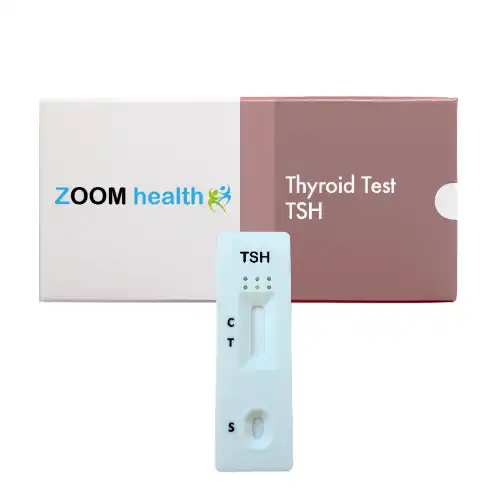
Home Thyroid Test Kit (Prima)
Rated 4.96/5 from 23 customer reviews. Check your TSH levels at home in around 10 minutes. Results you can take straight to your GP.
What does the thyroid actually do?
The thyroid is a small, butterfly-shaped gland that sits at the front of your neck, just below your Adam’s apple. Its job is to produce hormones – chiefly thyroxine (T4) and triiodothyronine (T3) – that regulate how your body uses energy. In effect, it acts as a throttle for your metabolism. Every cell in your body is influenced by thyroid hormones, from your heart rate to your gut motility to how quickly your brain processes information.
When the thyroid is working well, you barely notice it. When it isn’t, the effects can ripple across almost every system in your body. That is what makes thyroid disease so easy to miss: the symptoms are often vague, gradual, and easy to attribute to other causes.
What is hypothyroidism, and how common is it?
An underactive thyroid – the medical term is hypothyroidism – means your thyroid is not producing enough hormone. It is one of the most common hormonal conditions in the UK. According to NHS data, it affects around 1 in 70 women and 1 in 1,000 men, though many cases go undiagnosed for years. The condition becomes more prevalent with age, which is why I often recommend that women over 35 test their thyroid once a year as a matter of routine, even if they feel broadly well.
The symptoms of hypothyroidism tend to develop slowly and can include:
- Persistent fatigue and low energy, even after a full night’s sleep
- Unexplained weight gain or difficulty losing weight
- Feeling cold more often than those around you
- Dry skin, brittle nails and thinning or coarse hair
- Low mood, depression or cognitive “brain fog”
- Constipation
- Irregular or heavier periods in women
- A slowed heart rate
The frustrating thing about this list is that several of these symptoms are also associated with other conditions, stress, or simply the pace of modern life. That is why I always say: don’t guess. Test.
What does the TSH test actually measure?
The home thyroid test does not directly measure thyroid hormone levels. Instead, it measures TSH – Thyroid Stimulating Hormone. This is a hormone produced by your pituitary gland (a small gland at the base of your brain) that essentially tells the thyroid how hard to work.
Think of it as a thermostat. When the body detects that thyroid hormone levels are low, the pituitary responds by producing more TSH to try to stimulate the thyroid into producing more. So a high TSH reading is a signal that the body is having to work harder than normal to maintain adequate thyroid function – which points toward an underactive thyroid.
The Zoom Health Home Thyroid Test Kit is calibrated to detect TSH levels above 5 µIU/mL, which is the standard clinical threshold used by GPs in the UK when deciding whether further investigation is warranted. A positive result on the home test does not give you a diagnosis, but it gives you something concrete and objective to take to your doctor – and in my experience, that matters. Many customers have told me that their GP was dismissive of their symptoms until they arrived with a positive home test result. It moves the conversation on.
Who should consider using this test?
I’d particularly recommend this test if you:
- Are a woman aged 35 to 64 and have not had your thyroid checked recently
- Have a family history of thyroid disease
- Have been experiencing unexplained fatigue, weight gain or low mood for more than a few weeks
- Have an autoimmune condition such as type 1 diabetes, coeliac disease or rheumatoid arthritis – these are associated with higher thyroid disease risk
- Are pregnant or trying to conceive (thyroid function is especially important in early pregnancy)
- Have previously been treated for an overactive thyroid and want to monitor your levels
- Simply want peace of mind
Although hypothyroidism is far more common in women, men are certainly not immune. If you are a man experiencing persistent unexplained tiredness and the other symptoms listed above, this test is worth doing.
How to use the Home Thyroid Test Kit
The kit is manufactured by Prima Lab SA, a Swiss company with a strong track record in home diagnostics. It is straightforward to use, and most people complete the test in around ten minutes. Here is what to expect:
- Wash your hands thoroughly with soap and warm water. Warm hands produce a better blood flow, which makes the finger-prick easier.
- Use the lancet (finger-pricker) included in the kit to prick the side of your fingertip. This is the same type used in GP surgeries. The sensation is a brief, mild sting.
- Collect a small blood sample using the pipette provided. You only need a few drops.
- Apply the sample to the test device as directed in the instructions, then add the buffer solution from the bottle included in the kit.
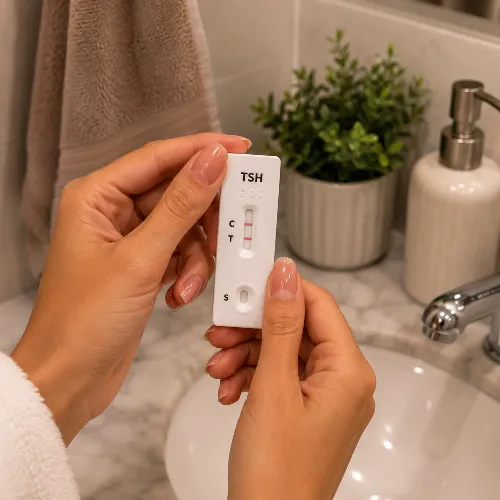
- Wait ten minutes and read the result. One line in the control area means your TSH is within the normal range. Two lines indicates an elevated TSH – time to make an appointment with your GP.
One tip I always pass on: if you are finding it difficult to get enough blood from your fingertip, try soaking your hand in warm water for a couple of minutes beforehand, or gently massage from the palm down toward the fingertip. Several customers have mentioned this in their reviews and it makes a real difference.
If you want a more comfortable testing experience and plan to use home blood tests regularly, it is worth picking up a pack of Unistik 3 Comfort lancets. These are a step up from the standard lancet included with the kit, and many of our customers prefer them for their finer gauge and reduced discomfort. We have a dedicated guide on choosing the right finger pricker if you want more detail.
What to do with your result
A negative result – one line – is reassuring, but it is not a reason to ignore persistent symptoms. Home tests are screening tools. If you still feel unwell despite a normal TSH result, your GP can run a full thyroid panel (including free T3 and free T4 alongside TSH) which gives a more complete picture. It is also worth noting that the home test screens specifically for hypothyroidism; an overactive thyroid (hyperthyroidism) involves a suppressed TSH and requires laboratory analysis to confirm.
A positive result – two lines – means your TSH is elevated above the 5 µIU/mL threshold. This is not a diagnosis, but it is a clear prompt to see your GP as soon as you can. Take the test with you. Most GPs will arrange a confirmatory blood test via your local NHS laboratory, and if hypothyroidism is confirmed, treatment with levothyroxine is well-established, effective, and usually transforms how you feel within a few weeks.
Do not sit on an elevated result. Untreated hypothyroidism can affect heart health, fertility and mental wellbeing over time. The sooner you get a confirmed diagnosis and start treatment, the better.
How does a home TSH test compare to a GP blood test?
It is a fair question, and I want to be transparent about it. An NHS blood test will give you a quantitative TSH reading (a precise number in µIU/mL), along with free T4 and sometimes free T3. The home test gives you a binary result: above or below the 5 µIU/mL threshold. It cannot tell you exactly how elevated your TSH is, and it does not test the actual thyroid hormones directly.
What the home test does exceptionally well is act as a first-line screen – quickly, privately, and without waiting several weeks for a GP appointment. Many of our customers have found that getting a GP referral for thyroid symptoms has become harder in recent years. Having a positive home test result in hand when you make that call can make the difference between being offered a blood test and being told to “wait and see.”
Think of it as opening a door rather than walking through it. The home test gets you into the conversation with your doctor. The confirmatory laboratory test is what leads to a formal diagnosis and treatment.
What customers say
With 23 reviews and a rating of 4.96 out of 5, the feedback on our Home Thyroid Test Kit speaks for itself. Customers consistently mention the speed of delivery (we ship same day on orders placed before 3pm), the clarity of the instructions, and – most importantly – the accuracy of the results. Several reviewers have noted that their home test result was later confirmed by their GP’s own blood test, which gives me real confidence in recommending this kit.
The most common constructive comment is that getting enough blood from a finger prick can take a little practice. That is true of virtually all home blood tests, and it is why I recommend the warm water technique above, or upgrading to a Unistik 3 Comfort lancet if you plan to test regularly.
Ready to check your thyroid?
If you have been putting off looking into those nagging symptoms, a home thyroid test is a low-cost, low-effort way to get some clarity. At £9.99 – and currently on sale from £13.99 – it is one of the best value steps you can take for your health. We hold stock at all times and ship the same day, so in most cases you will receive your kit the very next day.
If your result is positive, you will have something concrete to take to your GP. If it is negative, you can cross one significant cause off the list and look elsewhere – and that peace of mind has its own value.
Home Thyroid Test Kit (Prima)
TSH screening at home in 10 minutes. Rated 4.96/5. Same-day dispatch.
Also browsing? See our full range of home health test kits.
Related guides from Zoom Health:
Anthony Cunningham – Health Writer & Editor
Anthony Cunningham, BA (Hons), MA, is a UK-based health writer and editor with over 20 years’ experience running Zoom Health, a trusted source for home health tests, preventive care, and wellness guidance. He creates clear, evidence-based articles using NHS, NICE, and WHO guidance. Where possible, content is reviewed by practising clinicians to enhance accuracy and reliability, helping readers make informed healthcare decisions.