About This Article
Zoom Health has supplied home health products and test kits to UK customers for nearly 20 years. This article is for general information only and does not constitute medical advice. Any abnormal test results should be discussed with your GP promptly. Always consult a qualified healthcare professional before making changes to your diet, medication or lifestyle based on a home test result. Home health tests are screening tools and are not a substitute for clinical testing.
In my years running Zoom Health, I’ve noticed a consistent and slightly unfair pattern in how couples approach fertility difficulties. The woman is usually the one who ends up at the GP first, undergoing blood tests, scans and sometimes months of investigation, while the man’s fertility is often the very last thing considered, if it’s considered at all. Yet male factor issues are involved in around half of all couples who struggle to conceive, either as the sole cause or as a contributing factor alongside female fertility issues. I want to use this guide to make the case for testing earlier rather than later, and to explain what home male fertility tests can and genuinely cannot tell you.
Why Male Fertility Gets Overlooked
Part of the reason is structural. Female fertility investigations involve standard tests that are well established within GP practice, like hormone blood tests and ultrasound scans, whereas a male semen analysis usually requires a referral to a specialist clinic, which can mean a wait of several months on the NHS in many parts of the UK. Part of it is also cultural. Many men feel embarrassment around producing a sample for testing, and that embarrassment, multiplied across an entire population of couples trying to conceive, has a real cumulative effect on how fertility investigations unfold.
A home fertility test removes both of those obstacles. It can be done privately, at home, before any clinical referral is needed, and it gives you and your GP a useful starting point if a referral does become necessary.
What These Tests Actually Measure
Home male fertility tests are screening tools, not diagnostic ones, and the distinction matters. A full clinical semen analysis examines several parameters together: sperm concentration, motility (how well the sperm move), morphology (their shape), volume, and pH, among others. Home tests typically focus on just one or two of these, usually concentration, because it’s the parameter that can be measured most reliably without laboratory equipment.
The World Health Organization sets the lower reference threshold for normal sperm concentration at 15 million sperm per millilitre of semen. Most home tests are calibrated around this figure, giving you a positive result if your count is at or above it, and a negative result if it falls below.
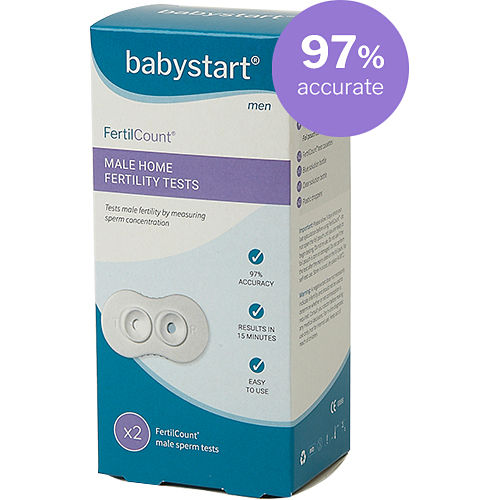
FertilCount Male Fertility Test, 2 Pack
FertilCount is the test I’d point most men toward as a starting point. It’s a rapid diagnostic test of sperm concentration that uses a colour comparison method: you collect a fresh semen sample, add it to a test well alongside two reagent solutions, and after a short waiting period compare the resulting colour intensity against a reference well. If the test well colour is the same as or darker than the reference, that indicates a sperm concentration at or above the WHO threshold. The pack contains two tests, which is worth having, since semen quality can fluctuate noticeably from one sample to the next due to factors like recent illness, heat exposure, or simply natural variation, so a single test on its own can be misleading in either direction.
Results are available in under 15 minutes, and the whole process is designed to be done discreetly, in your own home, with results read by you rather than communicated by a clinician over the phone.
A Quicker Alternative for a Simple Yes or No
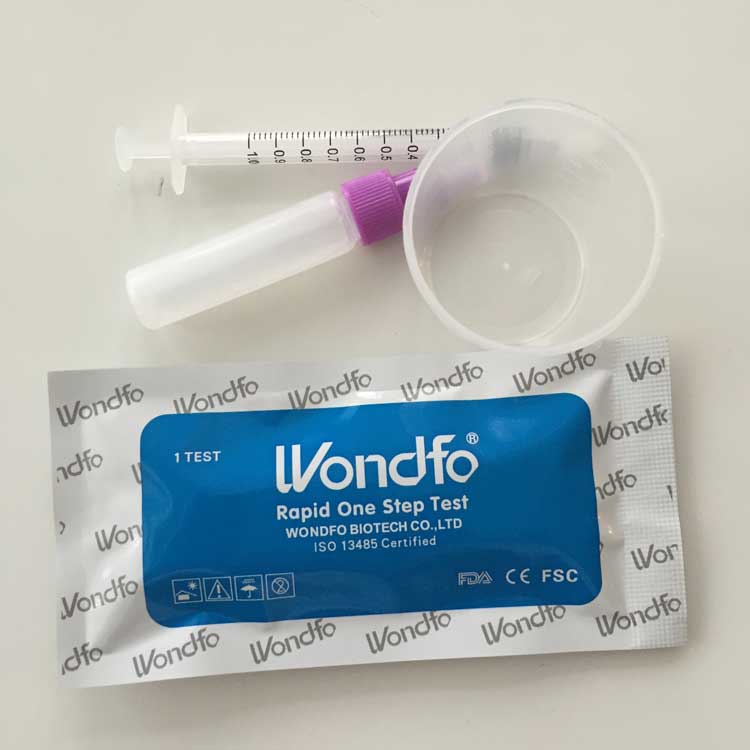
Sperm Count Test Kit for Sperm Concentration
If you’d prefer an even simpler process, our Sperm Count Test Kit takes a different technical approach. Rather than a colour comparison, it detects a protein called SP10, which is expressed exclusively in testicular tissue and has been validated as a reliable marker for sperm concentration. You apply the sample directly to the test, and a result is available in around five minutes. As with FertilCount, a positive result indicates a sperm count above 15 million per millilitre, the same WHO-recommended threshold, while a negative result suggests it falls below that figure.
The trade-off between the two is straightforward. FertilCount gives you two tests in a pack, which I’d generally recommend if you want to retest and build a slightly more confident picture, whereas the SP10 test is faster to read and slightly cheaper per test if you mainly want a quick first answer.
What These Tests Cannot Tell You
This is the part I’d encourage every man to read carefully before testing. Sperm concentration is only one of several factors that determine fertility. A man can have a perfectly normal sperm count and still have significantly reduced motility, meaning the sperm don’t swim effectively enough to reach and fertilise an egg, or abnormal morphology, meaning the sperm are shaped in a way that interferes with their function. Neither of these is measured by a home concentration test. This means a positive result is reassuring as far as it goes, but it is not a clean bill of fertility health, and a negative result, while worth taking seriously, is not in itself a diagnosis of infertility.
There’s also natural variation to account for. Semen quality is genuinely sensitive to short-term factors: a recent fever or illness, excessive alcohol consumption, certain medications, prolonged heat exposure such as frequent hot baths or saunas, and even tight clothing over an extended period can all temporarily depress sperm concentration. This is precisely why testing more than once, ideally with a few weeks between samples, gives a far more reliable picture than relying on a single result.
How to Get the Most Reliable Result
A few practical steps make a genuine difference to result reliability. Most manufacturers recommend abstaining from ejaculation for two to three days before collecting a sample, since this allows sperm concentration to stabilise at a representative level rather than being temporarily depleted from recent activity. The sample should be collected directly into the container provided, kept at room temperature, and tested within the window specified in the instructions, usually within an hour or so of collection, since sperm quality and motility decline the longer a sample is left standing.
If you get a negative or borderline result, I’d recommend retesting after a few weeks rather than treating one test as definitive, and if a second test also comes back low, that’s a sensible point to bring the results to your GP. A persistently low concentration across more than one home test is exactly the kind of finding that justifies a referral for a full clinical semen analysis, and having that home test history can sometimes help move the conversation along more quickly.
Fitting Male Testing Into the Wider Picture
I think male fertility testing works best as a parallel step rather than a last resort. If you and your partner are starting to actively try for a baby, there’s no real downside to testing early on both sides rather than waiting twelve months for female-only investigation to run its course first. If you’re also tracking ovulation, I’ve written a separate guide on how ovulation testing works, and the two pieces of information, her fertile window and a baseline read on his sperm concentration, give you a genuinely more complete picture of where you stand as a couple.
It’s also worth being mindful of what’s used during intercourse itself. Many lubricants on the market are not sperm-friendly and can interfere with motility regardless of how healthy the sperm count is to begin with, which I cover in detail in my guide to fertility-friendly lubricants.
My Recommendation
For most men testing for the first time, I’d suggest FertilCount, simply because the two tests in a pack let you account for natural variation without buying a second kit straight away. If you’ve already had a baseline test and just want a quick recheck, the SP10 Sperm Count Test Kit is a sensible, slightly faster option. Either way, treat a single result as a starting point for a conversation, not a final answer.
Get a private, at-home starting point on male fertility today.
Anthony Cunningham – Health Writer & Editor
Anthony Cunningham, BA (Hons), MA, is a UK-based health writer and editor with over 20 years’ experience running Zoom Health, a trusted source for home health tests, preventive care, and wellness guidance. He creates clear, evidence-based articles using NHS, NICE, and WHO guidance. Where possible, content is reviewed by practising clinicians to enhance accuracy and reliability, helping readers make informed healthcare decisions.