Zoom Health has supplied home health products and medical supplies to UK customers for nearly 20 years. This article is for general information only and does not constitute medical advice. It is intended to help you understand injection equipment and safe practice, not to advise on dosage, medication choice or treatment decisions. Always follow the guidance of your GP, pharmacist or prescribing clinician regarding any medication you self-administer, and seek medical attention if you experience an adverse reaction.
Home self-injection has become a routine part of life for a great many of our customers, whether that is a weekly B12 injection, a TRT or steroid cycle, or another prescribed treatment given at home rather than in a clinic. Yet very little is ever written about the practical side of it. Most guidance online jumps straight to dosage and protocol, and skips over the equipment questions that actually trip people up week to week, things like which needle to use, which kit size makes sense, and how to dispose of everything safely once you are done.
I wrote this five part series to fill that gap. Each article tackles one specific, practical question that comes up again and again from our customers, and together they cover everything you need to know to manage a home injection routine confidently and safely. This page brings all five together in one place, along with a quick guide to where to start depending on your situation.
The Five Guides in This Series
1. Choosing the Right Needle Gauge for Home Injections
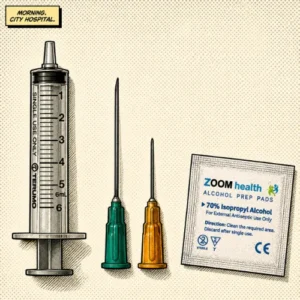
Every injection kit includes more than one needle colour, and this confuses far more people than it should. I explain what gauge actually means, why green, blue and orange needles each exist for a different purpose, and why most home injectors end up using two different needles rather than one, drawing with one and injecting with another.
Read the full guide to needle gauge selection
2. Full Injection Kits Explained: Choosing the Right Size and Combination
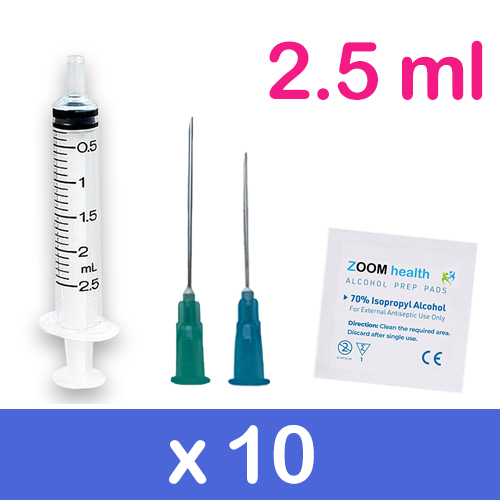
Once you know your needle gauge, the next question is which complete kit to buy. I break down syringe volume, needle colour and pack size, and walk through how to calculate roughly how many syringes you will need for a given routine, so you are not left short midway through a cycle or sitting on far more stock than you need.
Read the full guide to choosing an injection kit
3. Luer Slip Syringes for Home Injection: What They Are and Why We Use Them
Our home injection kits use Luer slip syringes, and I explain exactly what that means, why it is the right fit for self-injection at home rather than a compromise, and when the alternative, Luer lock, genuinely is the better choice, which is mostly in clinical and hospital settings rather than a standard home routine.
Read the full guide to Luer slip syringes
4. Safe Sharps Disposal at Home: What You Need and How to Do It Properly
A used needle is not ordinary rubbish, and it should never go in a household bin. I cover why a dedicated sharps bin matters, how our compact 0.25L sharps bin works, and how to build disposal into your routine so it becomes an automatic last step rather than something dealt with later.
Read the full guide to sharps disposal
5. Self-Injection Technique and Safety: Putting It All Together
The final article in the series brings everything together, covering how to prepare before you inject, how to draw up correctly, site rotation, the injection itself, aftercare, and the warning signs that genuinely warrant a call to your GP rather than waiting things out.
Read the full guide to self-injection technique and safety
Not Sure Where to Start? Here’s a Quick Way to Decide
If you are completely new to self-injection and have not yet bought anything, start with the needle gauge guide first, then move on to the kit selection article. Between the two you will have everything you need to choose your first kit with confidence.
If you already have a kit and are simply trying to understand why it is put together the way it is, particularly the syringe type, the Luer slip article will answer that directly.
If you are already injecting and want to tighten up your routine, the sharps disposal and technique articles are the two most worth reading, since they cover the habits that matter most over a long term routine rather than a single injection.
A Word on Why I Wrote This Series
I have spent twenty years writing about home health products, and injection supplies are some of the most practical, least glamorous items we sell, but also some of the most important to get right. Nobody wants to think too hard about needle gauge or sharps disposal. They just want their routine to work smoothly, safely and without drama, week after week. That is exactly what this series is aimed at.
None of this replaces the specific guidance your GP, pharmacist or prescribing clinician has given you about your own medication, dose or technique. What I hope it does is take the guesswork out of the equipment side of things, so the only thing you need to think about each week is the injection itself, not which needle to reach for or where the sharps bin has got to.
Browse Our Full Range of Injection Supplies
If you would rather skip straight to shopping, our complete range of needles, full injection kits and sharps disposal bins is available to browse directly. Everything ships in plain, unmarked packaging, which I know matters to a great many of our customers ordering medical supplies to a home address.
Browse our full injection kits or browse needles and sharps disposal separately.
Anthony Cunningham, BA (Hons), MA, is a UK-based health writer and editor with over 20 years’ experience running Zoom Health, a trusted source for home health tests, preventive care, and wellness guidance. He creates clear, evidence-based articles using NHS, NICE, and WHO guidance. Where possible, content is reviewed by practising clinicians to enhance accuracy and reliability, helping readers make informed healthcare decisions.