About This Article
Zoom Health has supplied home health products and medical supplies to UK customers for nearly 20 years. This article is for general information only and does not constitute medical advice. It is intended to help you understand injection equipment and safe practice, not to advise on dosage, medication choice or treatment decisions. Always follow the guidance of your GP, pharmacist or prescribing clinician regarding any medication you self-administer, and seek medical attention if you experience an adverse reaction.
In my last article I covered how to choose between green, blue and orange needles. Once that decision is out of the way, most people land on the same conclusion: rather than buying syringes, needles and swabs as separate items, a complete injection kit is the simpler route. The question then becomes which kit, because what looks like a single product is actually sixteen different combinations once you account for syringe volume, needle gauge and pack size.
I want to break that down properly, because choosing the wrong size either leaves you short halfway through a cycle or sitting on far more stock than you will use before it is needed. Neither is ideal, and the right answer is usually simpler to work out than it first appears.
What’s Actually in a Full Injection Kit
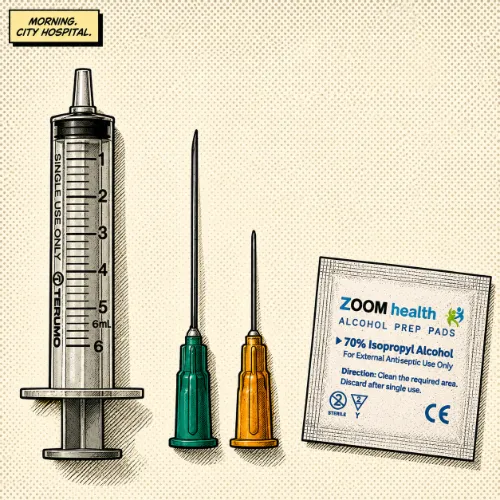
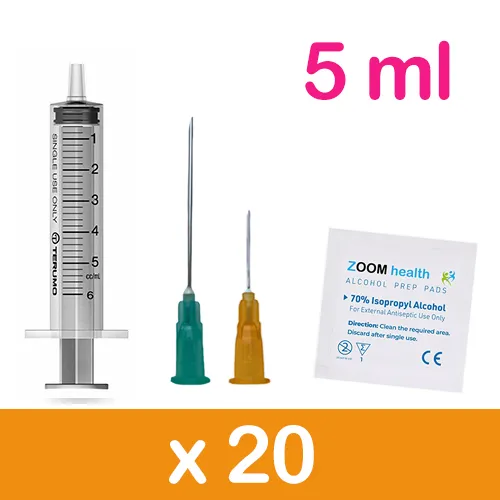
Every kit we sell follows the same formula. You get a matched set of syringes, a drawing needle, an injecting needle, and alcohol swabs, all in the same quantity and all individually blister packed for sterility. A typical kit, for example, pairs Terumo syringes with 21G green drawing needles and either 23G blue or 25G orange injecting needles, plus a swab for every single use.
The logic is the same one I covered in the needle gauge article. You draw your medication up using the wider green needle, then switch to a fresh blue or orange needle to administer it, cleaning the injection site with a swab beforehand. Buying it as a kit means you are never caught short of one component while having plenty of another, which is a surprisingly common problem when people buy supplies separately.
Syringe Volume: 2.5ml or 5ml
The first real decision is syringe size. We stock our full injection kits in 2.5ml and 5ml barrels, and the right choice comes down entirely to the volume of your individual injection rather than anything to do with the needle.
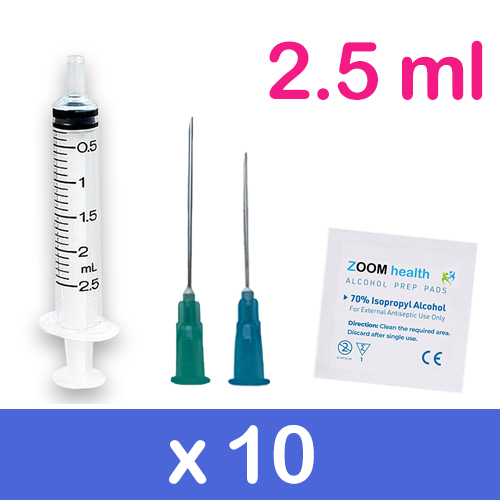
A 2.5ml syringe is the better fit for smaller, more precise doses. The graduations are spaced further apart relative to the barrel, which makes it easier to draw an accurate small volume without second guessing yourself against the markings. This is the size most people reach for when injecting B12 or smaller volume preparations where precision matters more than capacity.
A 5ml syringe makes more sense once your dose volume increases, since you are not trying to stretch a small barrel to its limit or risk drawing past the usable range. If you regularly find yourself needing close to the full capacity of a 2.5ml syringe, stepping up to 5ml usually makes the whole process more comfortable and accurate, even though the barrel itself is physically larger.
Needle Colour: Blue or Orange Kits
Every kit pairs its syringes with a 21G green drawing needle as standard, but the injecting needle differs between the Blue and Orange ranges. This is the same blue versus orange decision from the needle gauge article, just bundled into the kit you choose rather than bought separately.
Blue kits use the 23G needle that most people settle on as their everyday standard, particularly for intramuscular injections and thicker preparations. Orange kits use the finer 25G needle, better suited to shallower subcutaneous injections and to anyone who prioritises comfort over speed of flow. If you already know which gauge suits your routine from the needle gauge guide, choosing between a Blue or Orange kit is simply a case of matching that preference.
Pack Size: 10, 20, 40 or 100
This is where most of the confusion happens, because the right pack size has very little to do with preference and everything to do with how often you inject and how far ahead you want to plan.
A 10 pack covers a short course or lets you trial a kit before committing to a larger quantity. It is also a sensible starting point if you are new to self-injection and want to get comfortable with the process before buying in bulk. A 20 pack suits a routine that runs for several weeks at a steady, predictable frequency, and tends to be the sweet spot for people on a weekly or twice weekly schedule who do not want to reorder too often.
40 and 100 packs exist for longer term, established routines. The per unit cost drops noticeably as pack size increases, which makes sense once you are confident in your routine and simply want to avoid running low partway through a cycle. The trade off is that you are committing to more stock up front, so I would not recommend jumping straight to a 100 pack until you know your injection frequency and have settled on your preferred needle gauge.
Working Out How Many You Need
The simplest way to plan is to count backwards from your injection frequency. If you inject once a week and you know your cycle or treatment plan runs for twelve weeks, that is twelve syringes, which puts you squarely in 10 to 20 pack territory depending on whether you want a small buffer. If you inject twice weekly across a similar period, you are looking at closer to 24, which tips you towards a 40 pack.
It is always worth adding a small buffer to whatever number you calculate. Vials occasionally need a second draw if your needle catches the rubber stopper awkwardly, and having one or two spare syringes on hand means a minor hiccup does not turn into an unplanned reorder.
Why Buying a Kit Beats Buying Components Separately
You can, of course, buy syringes, needles and swabs as separate line items, and there are situations where that makes sense, particularly if you already have a stock of one component and just need to top up another. But for most people starting out, a complete kit removes the guesswork. Everything arrives matched and in the right ratio, so you are never left with forty syringes and only ten swabs.
All of our kits also ship in plain, unmarked packaging with no indication of contents on the outside, which matters to a lot of people ordering medical supplies to a home address.
A Word on Safety and Storage
However large a pack you choose, the same basic principles apply. Store your kit somewhere clean, dry and out of reach of children, use each syringe and needle once only, and dispose of used sharps in an approved sharps container rather than general waste. I cover safe sharps disposal properly in the next article in this series, including the compact sharps bin we stock specifically for home use.
If you are new to self-injection or unsure which volume or gauge is right for your specific treatment, your GP, pharmacist or prescribing clinician remains the right person to confirm what is appropriate for you. This guide is here to help you choose your equipment with confidence, not to advise on the medication itself.
Final Thoughts
Once you know your dose volume and your injection frequency, choosing a kit becomes a straightforward calculation rather than a guess. Match the syringe size to your dose, match the needle colour to your comfort and injection site preference from the gauge guide, and size the pack to however many injections you realistically expect to need before your next order. Getting this right the first time saves you both money and the inconvenience of running short midway through a routine.
Anthony Cunningham – Health Writer & Editor
Anthony Cunningham, BA (Hons), MA, is a UK-based health writer and editor with over 20 years’ experience running Zoom Health, a trusted source for home health tests, preventive care, and wellness guidance. He creates clear, evidence-based articles using NHS, NICE, and WHO guidance. Where possible, content is reviewed by practising clinicians to enhance accuracy and reliability, helping readers make informed healthcare decisions.