About This Article
Zoom Health has supplied home health products and medical supplies to UK customers for nearly 20 years. This article is for general information only and does not constitute medical advice. It is intended to help you understand injection equipment and safe practice, not to advise on dosage, medication choice or treatment decisions. Always follow the guidance of your GP, pharmacist or prescribing clinician regarding any medication you self-administer, and seek medical attention if you experience an adverse reaction.
If you have ever opened a box of injection supplies and found three different coloured needles staring back at you, you are not alone. I get asked about this more than almost anything else in our medical supplies range. People assume any needle will do the job, then they either struggle to draw their medication out of the vial, or they wince through an injection that did not need to be that uncomfortable.
The colour coding on needle hubs is not decoration. It is an internationally recognised system that tells you the gauge, which is really just a measurement of how wide or narrow the needle is. Get the gauge right for the job and the whole process becomes faster, cleaner and noticeably less painful. Get it wrong and you are working against the equipment rather than with it.
I want to walk you through what each gauge is actually for, why most home injectors end up using two different needles rather than one, and how to choose with confidence rather than guesswork.
What “Gauge” Actually Means
Needle gauge follows the Birmingham Wire Gauge system, which can feel backwards the first time you encounter it. The higher the number, the narrower the needle. So a 25G needle is thinner than a 23G needle, which is thinner again than a 21G needle. It is the opposite of what most people expect, but once it clicks, it is easy to remember.
Each gauge also has a standard colour, regardless of which manufacturer makes it. This matters because it means you can identify a needle at a glance, without reading microscopic text on the packaging. In the UK home injection market, the three you will encounter most often are green (21G), blue (23G) and orange (25G).

21G Green: The Drawing Needle
This is the one people are most often surprised by, because it is rarely the needle you actually inject with. The 21G green needle is wider and longer, at 1.5 inches or 40mm, and its job is to draw your medication out of the vial efficiently, particularly if what you are working with is thicker or more viscous than water.
A wider bore means less resistance when you pull back the plunger, so drawing up takes seconds rather than a frustrating minute of careful pulling. It also reaches comfortably to the bottom of most vials, which matters when you want to get every last drop out rather than leaving product behind. The trade-off is that a 21G needle is too thick and too long to use comfortably for the injection itself, so most people draw with green and then switch to a finer needle before they inject.
I sell our 21G green needles in packs of 100, individually wrapped and CE marked, which keeps the cost sensible if you are drawing up regularly. You can see the full listing here.
23G Blue: The Standard Injection Needle
If you only ever bought one type of injection needle, blue 23G is the one most people in the UK reach for. It sits in the middle of the gauge range, at 1.25 inches or 30mm, and is generally regarded as the standard size for intramuscular injections including TRT and steroid cycles.
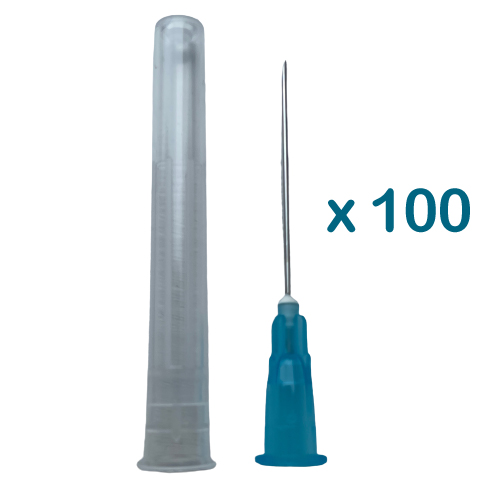
The reasoning behind this is fairly straightforward. A 23G needle is narrow enough to keep discomfort manageable, but wide enough that you are not fighting the plunger if your medication has any thickness to it. It reaches deep enough for a proper intramuscular injection in sites like the glute or thigh, which is why it has become something of a default in this category. If you are not sure where to start, this is usually it.
25G Orange: The Comfort Needle
The 25G orange needle is the narrowest of the three and noticeably shorter, at 5/8 of an inch or 16mm. Where blue is the all rounder, orange is the one people switch to when comfort is the priority, particularly for subcutaneous injections rather than deep intramuscular ones.
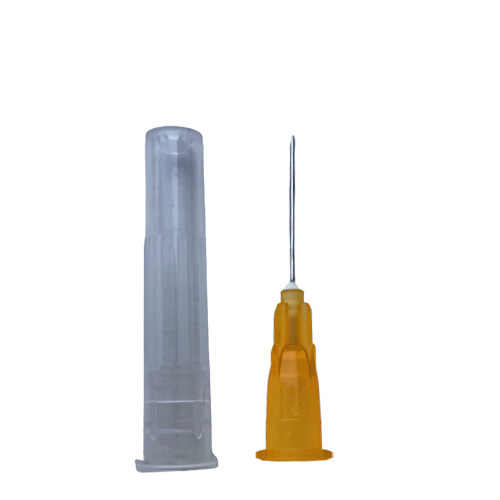
The shorter length suits injection sites where you do not need to go as deep, and the narrower bore reduces the sensation on entry. The trade-off, much like with blue, is that thicker liquids take longer to push through, so this is much more of an injecting needle than a drawing needle. Many people who inject more frequently, such as weekly B12 or smaller volume subcutaneous doses, prefer orange specifically because the day to day discomfort adds up less over time.
Why Most People Use Two Needles, Not One
This is the part that catches first time buyers out. The sensible approach, and the one reflected in nearly every injection kit we sell, is to draw with one needle and inject with another. You draw up with the wider green 21G needle because it is faster and protects the tip of your injecting needle from being blunted on the rubber vial stopper, then you swap to a fresh blue or orange needle for the injection itself.
Using the same needle for both steps is not unsafe in the way that reusing a needle between sessions would be, but it is harder work and more uncomfortable than it needs to be. A needle that has just punched through a rubber stopper is duller than a brand new one, and you will feel that difference on the way in. It is a small habit that makes a real difference to comfort, and once you have done it a couple of times it becomes automatic.
Choosing Between Blue and Orange
If you are still unsure which of the two injecting gauges suits you, the decision usually comes down to two questions: what are you injecting, and where are you injecting it?
Thicker oil based preparations generally need the slightly wider bore of a 23G blue needle to pass through smoothly, and deep intramuscular sites tend to call for blue as well, simply because it has the length and rigidity for a confident, controlled injection. Thinner, water based preparations and shallower subcutaneous sites are where 25G orange tends to shine, particularly if comfort is your main concern and you are injecting often enough that small differences add up.
There is no harm in keeping both on hand. A lot of our customers do exactly that, using blue for some injections and orange for others depending on what they are administering that week.
A Note on Buying Loose Needles
One thing worth knowing is that you do not need to buy a full injection kit every time you need more needles. If you already have syringes and swabs but are running low on a specific gauge, all three of our needle types are available individually, sold per needle, which means you can top up exactly what you are short of rather than buying a complete kit you do not need. They arrive CE marked, individually wrapped and in plain, unmarked packaging.
Safety Reminders Worth Repeating
Whichever gauge you choose, the basics stay the same. Use a fresh, sterile needle for every single injection, never recap a used needle, and dispose of it immediately in an approved sharps container rather than in household waste. If you are new to self-injection or unsure which gauge is right for your specific medication, your GP, pharmacist or prescribing clinician is the right person to confirm what is appropriate for you. This article is here to help you understand the equipment, not to replace that guidance.
Final Thoughts
Once you understand what green, blue and orange are each built for, the choice stops being guesswork. Draw with green, inject with blue for most standard intramuscular work, and keep orange on hand for when comfort and a shallower injection site are the priority. It is a small piece of knowledge that makes a noticeable difference to how smoothly your injection routine runs.
If you would rather not buy needles separately, our full injection kits bundle the right needles, syringes and swabs together in one box. I cover how to choose between those kits, including pack sizes and syringe volumes, in the next article in this series.
Anthony Cunningham – Health Writer & Editor
Anthony Cunningham, BA (Hons), MA, is a UK-based health writer and editor with over 20 years’ experience running Zoom Health, a trusted source for home health tests, preventive care, and wellness guidance. He creates clear, evidence-based articles using NHS, NICE, and WHO guidance. Where possible, content is reviewed by practising clinicians to enhance accuracy and reliability, helping readers make informed healthcare decisions.