
About This Article
Zoom Health has supplied home health products and medical supplies to UK customers for nearly 20 years. This article is for general information only and does not constitute medical advice. It is intended to help you understand injection equipment and safe practice, not to advise on dosage, medication choice or treatment decisions. Always follow the guidance of your GP, pharmacist or prescribing clinician regarding any medication you self-administer, and seek medical attention if you experience an adverse reaction.
A question I get fairly often, usually from someone who has just read up on syringe types out of curiosity, is whether they should be using a Luer lock syringe rather than the Luer slip syringes that come in our home injection kits. It is a reasonable thing to wonder, particularly if you have come across hospital or clinical guidance that talks up the locking mechanism as the safer option. So I want to explain exactly what Luer slip means, why it is the right fit for self-injection at home, and when the answer genuinely is different.
If you are looking after a relative in a care setting, working in a clinical role, or simply want the fuller technical picture including arterial access and high pressure procedures, I would point you instead to our separate guide on Luer lock and Luer slip syringes for healthcare professionals, which covers that ground properly. This article is written specifically for people self-injecting at home, most commonly B12, vitamin or TRT and steroid cycles, where the considerations are a little different.
What Luer Slip Actually Means
Every syringe needs a way to attach the needle to the barrel, and there are two common methods. A Luer lock syringe has a small threaded collar around the tip. The needle hub twists on and locks into place, so it cannot come off without being twisted back the other way. A Luer slip syringe skips the thread entirely. The needle hub simply pushes onto the tapered tip and is held in place by friction.
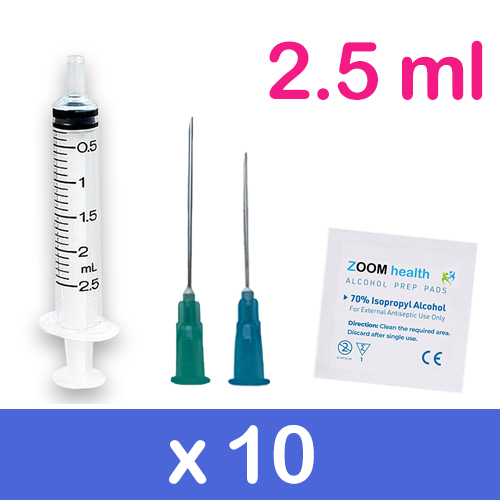
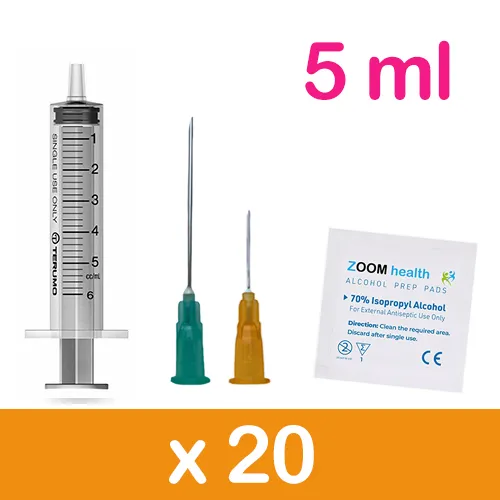
Our injection kits, including every Blue and Orange kit across all pack sizes, use Luer slip syringes paired with detachable needles. This is not a downgrade or a budget shortcut. It is simply the connection type that suits the way most people use these kits at home.
Why Luer Slip Suits Home Self-Injection
The biggest practical advantage of a Luer slip syringe is speed and simplicity when switching needles, and this matters more for home injectors than it might first appear. As I covered in the first article in this series, the standard approach is to draw your medication up using a green 21G needle, then swap to a blue or orange needle before you inject. With a Luer slip syringe, that swap takes a second. You pull the drawing needle off and push the injecting needle on. There is no twisting, no risk of cross-threading the connection, and no fumbling with a small locking collar while you are holding a syringe steady with the other hand.
For a routine that you might be doing weekly or twice weekly, often without anyone else in the room to help, that simplicity adds up. It is one less thing to think about during a process that already involves drawing accurately, finding your injection site and managing the needle change cleanly.
Luer slip syringes are also the established standard for low pressure subcutaneous and intramuscular injections, which covers the overwhelming majority of home injection use, including B12, vitamin and TRT or steroid administration. The locking mechanism on a Luer lock syringe exists to stop a needle being forced off under genuine pressure, which is a real concern in procedures like arterial access or rapid intravenous push, but is simply not a factor in a standard intramuscular or subcutaneous injection performed at a normal, controlled pace.
Is There Any Safety Difference for Home Use
I want to be direct about this, because I know it is the question underneath the question. Used correctly, a Luer slip syringe is not less safe for the injections people are doing with our kits. The friction fit is more than sufficient to hold a needle in place through a normal draw and a normal injection. Where Luer lock genuinely earns its place is in clinical settings involving higher pressure delivery, prolonged procedures, or situations where a needle coming loose mid-procedure would be a serious complication, none of which describes a standard at-home injection.
The one habit worth being deliberate about, regardless of which connection type you are using, is not rushing the needle change. Push the needle on firmly and check it is seated properly before you draw or inject. This takes a second and removes any realistic chance of the needle separating during use.
When You Might Genuinely Need Luer Lock
There are situations where Luer lock is the right and necessary choice, and it is worth knowing what they look like so you can recognise if you are in one. Anything involving arterial or venous catheter access, prolonged infusions, rapid or forceful injection, or any procedure where a clinician is working under time pressure or with the patient moving, calls for the locking mechanism. This is squarely the territory of hospitals, care homes and clinical procedures, which is exactly why our healthcare focused guide on this topic exists separately.
If you are self-administering a prescribed injectable medication at home at a normal pace, following the instructions given by your prescriber, you are not in that category, and a Luer slip syringe is doing exactly the job it is designed for.
Getting Comfortable With the Push-Fit Connection
If you have not used a Luer slip syringe before, the technique is genuinely simple, but a couple of small habits make it smoother. Hold the syringe barrel steady rather than the plunger when attaching a needle, push straight on rather than at an angle, and give it a very slight twist as you push to help it seat evenly. You will feel it settle into place. There is no need to force it beyond that point.
When removing a used needle for disposal, the same logic applies in reverse. A gentle, steady pull is all that is needed. I cover how to dispose of that needle safely once it is off the syringe in the next article in this series.
A Quick Note on Compatibility
One thing worth knowing if you ever buy needles separately rather than as part of a kit is that detachable hypodermic needles, including our 21G green, 23G blue and 25G orange ranges, are made to a universal fitting and will attach to either a Luer lock or a Luer slip syringe. The connection type is a property of the syringe barrel, not the needle, so you do not need to match needle brand to syringe type. This is covered in more detail in the first article in this series on choosing the right needle gauge.
Final Thoughts
Luer slip is not a compromise built into our home injection kits, it is the right connection type for the job they are designed to do. It is faster to work with when you are changing needles between drawing and injecting, it is the established standard for low pressure subcutaneous and intramuscular injections, and it carries no realistic safety disadvantage when used as intended for a routine self-administered injection. Luer lock has its place, but that place is largely in clinical and hospital settings handling higher pressure procedures, not a B12 or TRT injection given at home at a steady, controlled pace.
If anything in your own situation makes you unsure which type of equipment is appropriate, your GP, pharmacist or prescribing clinician is always the right person to ask. Next in this series, I will cover how to dispose of used needles and syringes safely once you are done with them, including the sharps bin we stock specifically for home use.
Anthony Cunningham – Health Writer & Editor
Anthony Cunningham, BA (Hons), MA, is a UK-based health writer and editor with over 20 years’ experience running Zoom Health, a trusted source for home health tests, preventive care, and wellness guidance. He creates clear, evidence-based articles using NHS, NICE, and WHO guidance. Where possible, content is reviewed by practising clinicians to enhance accuracy and reliability, helping readers make informed healthcare decisions.