About This Article
Zoom Health has supplied home health products and medical supplies to UK customers for nearly 20 years. This article is for general information only and does not constitute medical advice. It is intended to help you understand injection equipment and safe practice, not to advise on dosage, medication choice or treatment decisions. Always follow the guidance of your GP, pharmacist or prescribing clinician regarding any medication you self-administer, and seek medical attention if you experience an adverse reaction.
Of everything I have covered in this series so far, sharps disposal is the part most people give the least thought to before they start self-injecting, and the part I think deserves more attention than it gets. Choosing the right needle gauge or the right kit size is about making your injections work well. Sharps disposal is about making sure nobody, including you, gets hurt once the injection is over.
A used needle is not just rubbish. It carries a small but real risk of injury and infection to anyone who comes into contact with it, whether that is you reaching into a bin bag later, a partner, a child, or a council waste worker handling your rubbish weeks down the line. The good news is that managing this properly takes very little effort once you have the right container and a habit to go with it.
Why Household Bins Are Not an Option
I want to be straightforward about this because it matters. Used needles, lancets and syringes should never go into a normal household bin, a recycling bin, or down the toilet. A used needle dropped loose into a bin bag can easily puncture the bag, the outer bin liner, or the skin of whoever handles that bag next. It does not matter how careful you think you are being. Bin bags get squeezed, lifted and thrown, and a needle does not need much force behind it to do damage.
This is not a UK legal requirement in the way that, say, drink driving limits are, but it is universal clinical and public health guidance, and for good reason. Once you start self-injecting regularly, whether for B12, vitamins, TRT or steroid cycles, you are producing a small but steady stream of sharps waste that needs a proper home from day one, not just on the days you remember to think about it.
What an Approved Sharps Bin Actually Does
An approved sharps container is built specifically to remove the two main risks of handling used needles. It needs to be puncture resistant, so a needle cannot work its way back out through the wall of the container, and it needs a mechanism that stops sharps falling back out once they are inside, even if the container is knocked over or shaken.
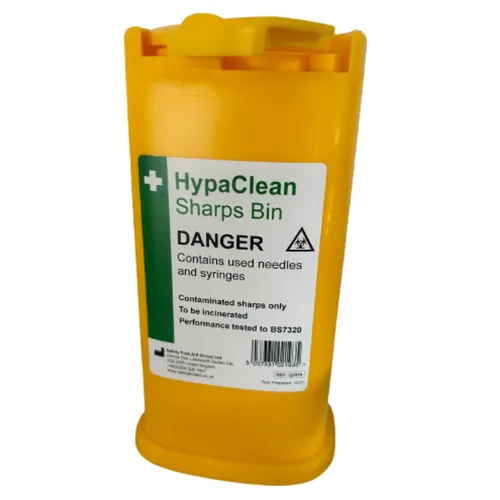
Our own 0.25L sharps bin is built around exactly this idea, but scaled down for home use rather than a clinical setting. It is made from durable yellow polypropylene, weighs just 40 grams, and is marked clearly with the standard biohazard symbol so there is never any ambiguity about what it contains if anyone else in the house comes across it. The wide opening lets you drop a used needle in at almost any angle without having to line anything up carefully, which matters more than it sounds when you are managing an injection routine one handed. Once a needle goes in, an internal locking flap holds it there, so the bin can be knocked, dropped or tipped without anything coming back out.
Building Disposal Into Your Routine
The easiest way to get this right every time is to treat disposal as the final step of the injection itself, not as a separate task for later. Keep your sharps bin in the same place you do your injections, whether that is a bathroom cabinet, a bedside drawer or wherever your routine happens, so the needle goes straight in the moment you are done rather than getting set down on a surface “for a second” and forgotten.
I would also say, do not recap a used needle before disposing of it. It feels like a tidier habit, but trying to get a cap back onto a needle you cannot see the tip of is one of the more common ways people end up with an accidental needlestick. Drop it straight into the bin uncapped.
What Goes in the Bin
Used needles, including your drawing and injecting needles together, are the obvious contents, but lancets and any other single use sharp from your home health routine belong in there too. Syringe barrels without a needle attached are generally lower risk and some people dispose of these separately, but if you are at all unsure, the simplest and safest approach is to put the whole assembly, needle and syringe together, into the sharps bin and not worry about separating components.
What to Do Once the Bin Is Full
A 0.25L bin is designed for a steady but moderate flow of sharps waste rather than industrial volumes, which makes it well suited to a typical home injection routine. Do not try to compress the contents down to squeeze more in. Once it is reasonably full, it is time to deal with it properly, which usually means one of two routes.
Many GP surgeries, pharmacies and local councils in the UK offer a take back or collection service for full sharps bins, particularly if you are self-injecting a prescribed medication. It is worth asking your prescriber or local pharmacy directly what arrangement is available in your area, since this varies by council. If a formal collection route is not available to you, your local council’s website will usually list how to arrange specialist clinical waste collection rather than putting a sealed sharps bin out with general rubbish.
Keeping It Out of Reach
However careful your own routine is, a sharps bin should always be stored somewhere children cannot get to it. The wide opening and one handed design that make the bin convenient for you are exactly the features that make it appealing for a curious child to investigate. A high shelf, a locked cabinet, or simply a drawer that is genuinely out of a child’s reach is worth the small extra thought.
A Quick Word on Travel
If your injection routine needs to continue while you are away from home, the compact size of a 0.25L bin makes it genuinely practical to pack. Keep it in checked luggage or hand luggage according to current airline and security guidance for medical sharps, and carry a letter from your prescriber confirming your medication if you are travelling internationally, since this can smooth over questions at security or customs.
Final Thoughts
Sharps disposal is one of the simplest parts of a home injection routine to get right, and one of the few areas where there genuinely is no good shortcut. A dedicated, puncture resistant sharps bin kept exactly where you inject, used every single time without exception, removes almost all of the risk that comes with handling used needles at home. It is a small habit, but it is the one that protects you, your household and anyone else who might come into contact with your waste long after you have forgotten about that particular injection.
If you are new to self-injection and have not yet settled on a needle gauge or kit size, I would recommend starting with the earlier articles in this series, beginning with how to choose the right needle gauge for your routine. In the next and final article, I will bring everything together with a proper look at self-injection technique and safety, from preparing the site to knowing when something needs medical attention.
Anthony Cunningham – Health Writer & Editor
Anthony Cunningham, BA (Hons), MA, is a UK-based health writer and editor with over 20 years’ experience running Zoom Health, a trusted source for home health tests, preventive care, and wellness guidance. He creates clear, evidence-based articles using NHS, NICE, and WHO guidance. Where possible, content is reviewed by practising clinicians to enhance accuracy and reliability, helping readers make informed healthcare decisions.