About This Article
Zoom Health has supplied home health products and test kits to UK customers for nearly 20 years. This article is for general information only and does not constitute medical advice. Any abnormal test results should be discussed with your GP promptly. Always consult a qualified healthcare professional before making changes to your diet, medication or lifestyle based on a home test result. Home health tests are screening tools and are not a substitute for clinical testing.
When my wife and I were trying to conceive our first child, I remember being genuinely surprised by how little I understood about ovulation. I had assumed, in the vague way many people do, that a woman is roughly equally fertile across her cycle, give or take. I was wrong, and I suspect a lot of people reading this are working from the same misunderstanding. Fertility has a narrow window each month, and knowing exactly when that window opens is one of the most useful pieces of information a couple trying to conceive can have. After two decades of running Zoom Health and talking to thousands of customers about exactly this subject, I want to walk you through how ovulation testing actually works, what the numbers mean, and which test is right for your situation.
This isn’t a basic biology lesson. I want to focus on the practical side: what these tests detect, why some are more useful than others depending on your cycle, and how to avoid the most common mistakes people make when they start testing.
What Ovulation Tests Actually Measure
Most ovulation tests work by detecting luteinising hormone, usually shortened to LH, in your urine. LH is present in your body throughout your cycle at a low background level, but in the 24 to 36 hours before you ovulate, your pituitary gland releases a sharp spike of it. This is called the LH surge, and it’s the trigger that causes the egg to be released from the ovary. A standard ovulation test is designed to pick up that surge and flag it to you, giving you a window of roughly one to two days in which you’re most likely to conceive if you have intercourse.
The trouble with detecting only LH is that it gives you a fairly narrow warning. By the time the surge appears, ovulation is imminent but the days leading up to it, when fertility is already rising, can be missed if you’re only testing once a day or starting your testing window too late.
Why Dual Hormone Testing Changes the Picture
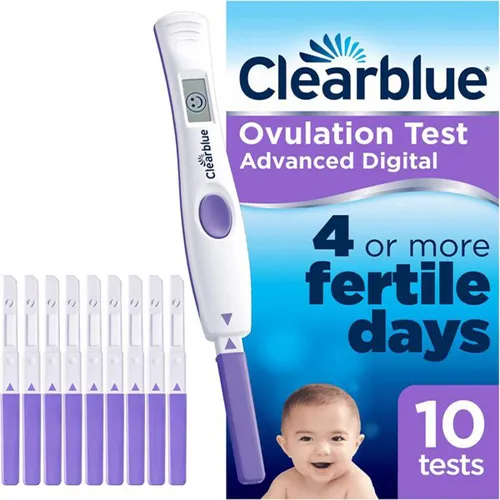
Clearblue Advanced Digital Ovulation Test Kits, 10 Pack
The test I recommend most often to people trying to conceive is the Clearblue Advanced Digital Ovulation Test. What sets it apart is that it tracks two hormones rather than one: LH, and also estrone-3-glucuronide, known as E3G, which is a metabolite of oestrogen. Oestrogen rises in the days before the LH surge as the dominant follicle matures, so by tracking both hormones the test can identify a broader fertile window, typically four or more fertile days each cycle, rather than the one or two days you get from an LH-only test.
In practical terms, this matters because sperm can survive in the female reproductive tract for up to five days under the right conditions, while the egg itself is only viable for around 12 to 24 hours after release. If you’re only catching the LH surge itself, you may already be near the end of your most fertile window. Catching the rising oestrogen a few days earlier gives you more opportunities to conceive within a single cycle, which is precisely why this test typically identifies more fertile days than single-hormone alternatives.
The test displays one of three results on its digital screen: a flashing smiley face for high fertility, a steady smiley face for peak fertility, or a circle when your fertility is currently low. There’s no line interpretation involved, which removes one of the most common sources of user error with traditional ovulation strips. Each pack contains ten test sticks and a reusable digital holder, generally enough for one to two cycles depending on how frequently you test.
When to Start Testing in Your Cycle
One of the most common questions I get asked is when to actually start testing. This depends on the length of your typical cycle. If you have a 28-day cycle, ovulation usually occurs around day 14, so I generally suggest beginning testing around day 10 or 11 to make sure you don’t miss the early rise in oestrogen. If your cycles are longer or shorter, or irregular, the starting point shifts accordingly, and this is where tracking your cycle length over a few months before you begin testing becomes genuinely useful. It saves you testing too early and wasting sticks, or worse, starting too late and missing the window entirely.
I’d also say this clearly: test first thing in the morning is not always correct advice for ovulation tests, unlike pregnancy tests. LH is typically produced in a burst that the body clears through urine later in the day, so many fertility specialists recommend testing in the late morning or early afternoon, having reduced your fluid intake for around two hours beforehand so the urine isn’t overly diluted.
Common Mistakes That Lead to Missed Surges
Through years of fielding questions from customers, a handful of mistakes come up again and again. The first is testing too infrequently. If you only test every other day, there’s a real chance you’ll test on either side of the surge and miss it entirely, particularly because the surge itself can be relatively brief in some women. Testing daily, or even twice daily once you’re in your fertile window, gives you a much more reliable picture.
The second mistake is drinking large amounts of water before testing, which dilutes the hormone concentration in urine and can mask a genuine surge. The third, and this applies particularly to women with polycystic ovary syndrome, is testing throughout the entire cycle when baseline LH is already elevated, which can produce confusing or persistently positive-looking results on cheaper strip tests that aren’t designed to account for an already-raised baseline. If this applies to you, it’s worth discussing your testing approach with your GP, since a dual-hormone test that also tracks oestrogen can sometimes give a clearer picture than LH alone in this situation, though it isn’t a guarantee.
What a Positive Ovulation Test Doesn’t Tell You
It’s worth being honest about the limitations here. An ovulation test confirms that your LH has surged, which strongly suggests ovulation is about to happen, but it doesn’t confirm that an egg was actually released, nor does it tell you anything about egg quality, fallopian tube health, or any of the other factors involved in conception. If you’ve been testing positive each cycle, having intercourse during your fertile window, and have not conceived after 12 months of trying, or six months if you’re over 35, the NHS recommends seeing your GP for further investigation. The same applies sooner if you have any known reproductive health conditions or irregular cycles that make timing especially difficult to pin down.
Bringing It Together With the Rest of Your Fertility Toolkit
Ovulation testing is most useful as one part of a wider approach rather than a standalone tool. Once you’ve identified your fertile window, the next sensible step for many couples is making sure that anything used during intercourse isn’t working against you. I cover this in detail in my guide to fertility-friendly lubricants, since a surprising number of ordinary lubricants can interfere with sperm survival. And if a male partner’s fertility is a concern, whether through known history or simply wanting a starting point before involving a GP, I’ve also written a separate guide to home male fertility testing that explains what these tests can and can’t tell you.
Once your cycle and testing window are established, many couples also find it more economical to move to a combined ovulation and pregnancy test pack rather than buying each separately, which I cover in my guide to building a sensible trying-to-conceive testing routine.
My Recommendation
If you’re serious about identifying your fertile window with precision, I’d steer you toward a dual-hormone digital test over a basic single-line strip. The wider fertile window detection and the removal of line-reading guesswork genuinely make a difference, particularly in the early months when you’re still learning your own cycle’s rhythm. It costs more per test than a basic strip, but for most couples actively trying to conceive, the additional clarity is worth it.
Ready to start tracking your fertile window with confidence?
Anthony Cunningham – Health Writer & Editor
Anthony Cunningham, BA (Hons), MA, is a UK-based health writer and editor with over 20 years’ experience running Zoom Health, a trusted source for home health tests, preventive care, and wellness guidance. He creates clear, evidence-based articles using NHS, NICE, and WHO guidance. Where possible, content is reviewed by practising clinicians to enhance accuracy and reliability, helping readers make informed healthcare decisions.