About This Article
Zoom Health has supplied home health products and test kits to UK customers for nearly 20 years. This article is for general information only and does not constitute medical advice. Any abnormal test results should be discussed with your GP promptly. Always consult a qualified healthcare professional before making changes to your diet, medication or lifestyle based on a home test result. Home health tests are screening tools and are not a substitute for clinical testing.
One of my favourite customer reviews on our Home Blood Group Test simply says: “Very good – after 62 years not knowing, I finally know.” I find that genuinely moving. Sixty-two years of not knowing something so fundamental about your own biology – and then, with a small kit, a finger prick, and a few minutes at the kitchen table, finally having the answer.
Blood group is one of those pieces of information that most people assume they know, or assume they can easily find out, or assume they do not really need. In practice, many people do not know theirs. It is rarely recorded anywhere they can easily access. It is not on most medical records in a form that is immediately retrievable in an emergency. And it is one of the few pieces of health information that could, in certain circumstances, be the difference between receiving a safe blood transfusion and a dangerous one.
Unlike every other test in our home health testing series, the blood group test is not about detecting a problem. It is about knowing something essential about yourself – and being prepared. This guide explains the ABO and Rhesus blood group systems, why knowing your type matters, and who should particularly consider testing. It also walks through exactly how to use the EldonCard kit and what the results mean.
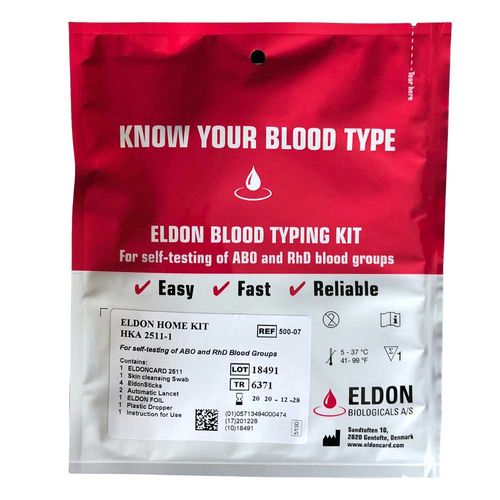
Home Blood Group Test (Eldon)
Determines ABO and Rhesus (D) blood type at home in minutes. Includes lancets, applicators, test card and full instructions. Rated 4.92/5 from 87 customer reviews.
The ABO blood group system – what it means and why it matters
Blood group is determined by antigens – specific proteins and sugars – on the surface of red blood cells. The ABO system, discovered by Karl Landsteiner in 1901 and one of the most important scientific discoveries of the twentieth century, classifies blood into four groups based on which antigens are present:
- Group A – has A antigens on red blood cells and anti-B antibodies in the plasma. Around 38% of the UK population.
- Group B – has B antigens on red blood cells and anti-A antibodies in the plasma. Around 10% of the UK population.
- Group AB – has both A and B antigens, and no ABO antibodies. The universal recipient for red cells – can receive blood from any ABO group. Around 3% of the UK population.
- Group O – has neither A nor B antigens, and both anti-A and anti-B antibodies in the plasma. The universal donor for red cells – can donate to any ABO group. The most common UK blood type at around 48%.
Why does this matter medically? Because if you receive blood containing antigens your immune system does not recognise as self, it mounts a rapid and potentially life-threatening immune response – a transfusion reaction. A severe ABO incompatibility reaction can cause kidney failure, shock, and death. This is why blood type verification is one of the most critical safety checks in any clinical setting where a transfusion might be needed. Having your blood type to hand does not replace that clinical verification, but it can be invaluable information in an emergency – particularly one that occurs far from an NHS hospital.
The Rhesus factor – positive, negative, and why it matters in pregnancy
Alongside the ABO group, every person is also either Rhesus positive (Rh+) or Rhesus negative (Rh-), determined by the presence or absence of the D antigen on red blood cells. Around 85% of UK people are Rh positive. The remaining 15% are Rh negative.
For most purposes, Rh factor is less immediately critical than ABO in transfusion settings – incompatible Rh blood can be given in certain emergencies without the same risk of an immediate acute reaction. But for women of childbearing age, the Rh factor is particularly important. If a Rh negative woman conceives a baby with a Rh positive partner, the baby may inherit the Rh positive gene. If any foetal blood enters the mother’s bloodstream – which can happen during delivery, miscarriage, or certain antenatal procedures – the mother’s immune system may develop antibodies against Rh positive blood.
This sensitisation typically does not affect a first pregnancy, but in subsequent Rh positive pregnancies, the mother’s antibodies can cross the placenta and attack the baby’s red blood cells, causing a serious condition called haemolytic disease of the foetus and newborn. This is entirely preventable with an injection called anti-D immunoglobulin, which is offered routinely to Rh negative women during pregnancy and after any event that could cause foetal-maternal bleeding. Knowing your Rh status before or early in pregnancy allows your midwife or GP to manage this appropriately from the start.
Seven good reasons to find out your blood type
1. Emergency preparedness. In any serious accident or medical emergency, being able to tell paramedics or hospital staff your blood type is potentially valuable information, particularly if cross-matching is not immediately available. Many people who have discovered their blood type through our kit carry a small card in their wallet alongside their driving licence. Some wear medical ID bracelets. This is especially relevant for people with rarer blood types.
2. International travel. Medical facilities in many countries operate differently from the NHS. In some regions, specific blood types may be less readily available in blood banks. Carrying a card identifying your blood group gives medical staff in any country immediate information to work with in an emergency. Several customers tell me they obtained the test specifically before travelling to more remote destinations.
3. Pregnancy planning. As I have described above, Rh negative women planning a pregnancy benefit significantly from knowing their status before conception, allowing their midwife to plan anti-D prophylaxis appropriately from the earliest stages. This is one of the most clinically concrete reasons for any woman of childbearing age to test.
4. Blood donation. If you are considering becoming a blood donor – and given that NHS Blood and Transplant regularly appeals for donors of all types, I would encourage everyone to consider it – knowing your blood type can help you understand where your donation will be most valuable. O negative is the universal donor group and is the blood most often used in emergencies. If you are O negative, your donation is among the most versatile on the database.
5. Knowing for your children. Several customers buy a kit for every member of the family to ensure the whole household’s blood types are recorded. This is particularly relevant for parents with young children who may not yet be on any medical records system with blood type documented.
6. Family history and genetics. Blood type is inherited, and knowing your type can sometimes provide useful context for family medical history discussions. It can also, more practically, help confirm biological relationships in certain circumstances, though it is not a substitute for DNA testing.
7. Personal curiosity. Sometimes there is no clinical reason. People simply want to know. After sixty-two years not knowing, one of our customers finally found out. That is entirely sufficient reason.
What blood types are most common in the UK?
The distribution of blood types in the UK breaks down approximately as follows, combining ABO and Rh factor:
- O positive – the most common, around 35% of the population
- A positive – around 30%
- B positive – around 8%
- O negative – around 13% – the universal donor, highly sought after by blood banks
- A negative – around 8%
- AB positive – around 2%
- B negative – around 2%
- AB negative – the rarest, around 1%
If you turn out to be O negative or AB negative, registering as a blood donor is particularly worthwhile – both groups are in consistent high demand and their donation profiles make them especially valuable to NHS Blood and Transplant.
How to use the Home Blood Group Test – step by step
The kit uses EldonCard technology – a well-established blood typing method that has been in clinical and consumer use for decades. The card contains four reagent spots that react with blood to show which antigens are present. The test is slightly more involved than a simple dip-strip, but it is manageable at home and the instructions are detailed and clear. Many customers note that having a second person to assist makes it easier, particularly for the blood collection step.
Here is how it works:
- Read the full instructions first before you begin. This test has more steps than a standard finger-prick test, and reading through the process before starting makes everything smoother.
- Lay out all the kit components on a clean flat surface at room temperature: the test card, the four applicators (eldonsticks), the pipette, lancets, and alcohol swabs.
- Using the pipette, place one drop of tap water onto each of the four coloured reagent spots on the EldonCard. This rehydrates the reagents.
- Wipe a fingertip with the alcohol swab and allow it to dry completely. Warm your hands first for better blood flow – the warm water technique works well here too.
- Use one of the lancets to prick the side of your fingertip and allow a small drop of blood to form. Squeeze gently from the base of the finger if needed.
- Using the four applicators individually – one per reagent spot, never mixed – transfer a small amount of blood to each of the four spots on the card. Each applicator is used only once to avoid cross-contamination between spots.
- Stir and spread the blood on each spot using its dedicated applicator, mixing it with the rehydrated reagent.
- Tilt the card gently for about 30 seconds to observe agglutination – the clumping reaction that indicates which antigens are present.
- Read the result immediately after tilting, using the result chart included in the kit. Agglutination (clumping) in a spot indicates a positive reaction with that reagent. The pattern of reactions across the four spots determines your ABO and Rh blood type.
The kit includes two lancets in case a second attempt at blood collection is needed, and two alcohol swabs. A video guide is available to support the written instructions – several customers mention this in their reviews as particularly helpful for first-time users.
Reading and recording your result
The result card included in the kit walks you through interpretation step by step. The four reagent spots on the EldonCard correspond to anti-A, anti-B, anti-D (Rh), and a control. The presence or absence of agglutination in each spot gives your full ABO and Rh blood type.
Once you have your result, I recommend recording it in several places: write it on the result card from the kit and keep it somewhere accessible, add it to any personal medical information you carry, and consider carrying a copy in your wallet, particularly when travelling abroad. Several of our customers have told me they created a small laminated card to carry in their passport. It is a simple step that could matter enormously in the right circumstances.
One important point to be absolutely clear about: this test is not for transfusion determination. The kit tells you your ABO and Rh blood type with high accuracy for the common groups, but hospitals always independently verify blood type before transfusion regardless of any information the patient provides. Rare blood sub-types and unusual groups are not detectable with this method and require specialist laboratory analysis. The home test is for personal knowledge and preparedness – not a clinical substitute for hospital blood typing.
What this test cannot tell you – and what it can
I always prefer to be direct about the limitations of home testing, and this kit is no exception. The EldonCard identifies the eight common ABO/Rh combinations listed above. It does not detect rare sub-types of the Rh system (such as weak D variants), minor blood group systems (Kell, Duffy, Kidd and others) that are relevant in specialist transfusion medicine, or the full complexity of blood typing that a hospital laboratory performs prior to a transfusion.
What it does with high accuracy, and what is relevant for the vast majority of people, is identify your ABO group and your Rh (D) status. For the purposes of general awareness, travel preparedness, pregnancy planning, and blood donation registration, this is the information you need. Most people who have never known their blood type will find everything they were looking for in the result.
What our customers say
With 87 reviews and a rating of 4.92 out of 5, the Home Blood Group Test is one of the most thoroughly reviewed products in our entire home health range. The feedback is consistently warm. Customers mention fast delivery, clear instructions, the helpfulness of the video guide, and – repeatedly – the satisfying feeling of finally knowing something they had always wondered about. One reviewer bought the kit three times to test different family members. Another described it as “the most useful kit for the money” they had purchased. A customer on blood thinners with a rare blood group noted they now carry the result card in case of emergency and described the experience as both easy and reassuring.
The most common constructive comment – and it is a fair one – is that the test involves more steps than a standard finger-prick kit and benefits from having someone to help. If you plan to test alone, reading the instructions carefully beforehand and laying everything out in order before you start makes the process significantly smoother.
Complete your home health profile – start with knowing your blood type
This is the final post in our Home Health Testing Guides series, and it feels right to close with a test that is not about catching a problem but about knowing yourself. Your blood type is a piece of fundamental biological information that belongs in your personal health records alongside your GP’s details and your medication list. It costs £9.99, takes a few minutes, and lasts a lifetime. We dispatch all orders the same day before 3pm.
If you have worked through our home health testing series and want to build on what you have learned, our full range of home health tests covers cholesterol, thyroid, diabetes, iron deficiency, vitamin D, PSA, allergy, H. pylori, and kidney function – everything you need for a comprehensive annual health MOT, from the comfort of your own home.
Home Blood Group Test (Eldon)
Determines ABO and Rh blood type at home in minutes. Complete kit. Rated 4.92/5 from 87 reviews. Same-day dispatch.
Explore our full home health testing range – ten tests covering the most important markers for long-term health.
Complete the series – all ten home health testing guides:
- Cholesterol Test guide
- Thyroid (TSH) Test guide
- Diabetes Test guide
- Allergy Testing guide
- Vitamin D Test guide
- Iron Deficiency (Ferritin) Test guide
- PSA Prostate Test guide
- H. Pylori Stomach Test guide
- Kidney Function Test guide
- Full home health testing range
Anthony Cunningham – Health Writer & Editor
Anthony Cunningham, BA (Hons), MA, is a UK-based health writer and editor with over 20 years’ experience running Zoom Health, a trusted source for home health tests, preventive care, and wellness guidance. He creates clear, evidence-based articles using NHS, NICE, and WHO guidance. Where possible, content is reviewed by practising clinicians to enhance accuracy and reliability, helping readers make informed healthcare decisions.