About This Article
Zoom Health has supplied home health products and test kits to UK customers for nearly 20 years. This article is for general information only and does not constitute medical advice. Any abnormal test results should be discussed with your GP promptly. Always consult a qualified healthcare professional before making changes to your diet, medication or lifestyle based on a home test result. Home health tests are screening tools and are not a substitute for clinical testing.
Prostate cancer is the most common cancer in men in the UK. Around 52,000 men are diagnosed with it every year – that is roughly one every ten minutes. It is also one of the most treatable cancers when caught early: the five-year survival rate for prostate cancer diagnosed at its earliest stage is close to 100%. Caught late, when it has spread beyond the prostate, that picture changes significantly.
Despite this, the UK has no national prostate cancer screening programme. There is no routine invitation letter for men over 50, no equivalent of the bowel cancer screening kit that arrives in the post. The NHS offers a PSA blood test to any man who requests one – but only if he asks. Many men never do. Some do not know the test exists. Others have heard conflicting things about whether PSA testing is worthwhile and have put it in the “too complicated to think about” pile.
I want to address that directly in this guide. The PSA test is not perfect, and I will be clear about what it can and cannot tell you. But for men aged 45 and over, understanding your PSA baseline and monitoring it annually is, in my view, one of the most valuable health checks available – and it can now be done at home, in ten minutes, without a GP appointment. This post explains how the test works, what the result means, and how to use it wisely.
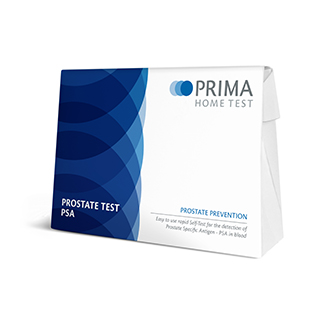
Home Prostate Test (PSA)
Checks PSA levels in blood via a simple finger-prick sample. Results in 10 minutes. Cut-off calibrated at 4ng/ml. Recommended for men aged 45-75. Rated 5.00/5.
What is the prostate, and what does PSA actually measure?
The prostate is a small, walnut-sized gland that sits beneath the bladder and surrounds the urethra – the tube through which urine and semen pass out of the body. Its primary function is to produce seminal fluid, which nourishes and transports sperm. In younger men, it typically causes no problems at all. From middle age onwards, it becomes one of the most important organs to monitor.
PSA stands for Prostate Specific Antigen. It is a protein produced exclusively by the prostate gland, and small amounts of it are always present in the bloodstream. The key word is “specific” – PSA is only produced by prostate tissue, which makes it a useful marker of prostate activity and, potentially, prostate health.
When the prostate is enlarged, inflamed, or affected by cancer, PSA production increases and blood levels rise. The home test measures whether your PSA level is above or below 4ng/ml (nanograms per millilitre), which is the internationally recognised threshold for further investigation. A result above this level does not mean you have prostate cancer – but it does mean your GP needs to know, and that further tests are warranted.
What causes a raised PSA? It is not always cancer
This is the most important thing to understand about PSA testing, and it is the reason the test has attracted some controversy over the years. An elevated PSA can be caused by several conditions, not all of them serious:
- Benign prostatic hyperplasia (BPH) – non-cancerous enlargement of the prostate, which is extremely common in men over 50 and causes urinary symptoms such as a weak stream, difficulty starting urination, and needing to go more frequently at night.
- Prostatitis – inflammation or infection of the prostate, which can cause pelvic pain, urinary symptoms, and significantly elevated PSA.
- Prostate cancer – malignant growth within the prostate gland.
- Recent physical activity – vigorous cycling, for instance, can temporarily raise PSA. It is advisable to avoid cycling and sexual activity for 48 hours before testing.
- Urinary tract infection – can also temporarily elevate PSA and should be resolved before testing.
Around three in four men with a raised PSA do not have prostate cancer. This is the false positive issue that has led some to question the value of PSA screening. I understand the concern – unnecessary anxiety and unnecessary biopsies carry real costs. But I would frame it differently: a raised PSA is a prompt for further investigation, not a diagnosis. The investigations that follow – a more detailed PSA test, an MRI scan, and if needed a biopsy – are what establish whether cancer is present. The home PSA test simply gets you into that process earlier, when the options available are broader and outcomes are better.
Why I recommend testing from age 45 – not 50
The NHS currently recommends that men can request a PSA test from age 50. But the evidence increasingly suggests that starting earlier – at 45, or even younger for high-risk groups – produces significantly better outcomes.
A large-scale clinical study conducted in Sweden followed men who had their PSA tested between the ages of 45 and 49 and found that this early screening could cut prostate cancer-related deaths by nearly half. The reasoning is straightforward: PSA at 45 establishes a baseline. If PSA is low at 45 and rises over subsequent annual tests, that upward trend is detectable and actionable long before a single elevated reading would trigger concern. A man who first tests at 55 and gets a result of 3.8ng/ml has no baseline to compare it against. A man who has been testing annually since 45 and watched his PSA slowly climb from 1.2 to 3.8 has a much more informative picture.
Certain groups should consider starting even earlier. Men with a family history of prostate cancer – particularly a father or brother diagnosed under 60 – have approximately two to three times the average risk and should discuss early screening with their GP from age 40. Black men in the UK also have a significantly higher risk of prostate cancer and are encouraged to consider testing from 45 or earlier.
Symptoms that should always prompt a GP visit
Early prostate cancer typically causes no symptoms at all – which is precisely what makes PSA testing valuable. By the time symptoms develop, the cancer may have progressed. That said, there are symptoms associated with prostate problems that should always be taken seriously and discussed with a GP promptly, whether or not you have tested at home:
- Needing to urinate more frequently, particularly at night
- Difficulty starting urination, or a weak or interrupted flow
- A feeling that the bladder has not fully emptied
- Pain or burning during urination
- Blood in the urine or semen
- Pain in the lower back, hips or pelvis that does not go away
- Unexplained weight loss or persistent fatigue alongside urinary symptoms
These symptoms are more commonly caused by benign prostatic hyperplasia or prostatitis than by cancer – but none of them should be dismissed or left uninvestigated. If you have any of these symptoms, see your GP regardless of the outcome of a home PSA test.
How to use the Home Prostate Test correctly
The kit is manufactured by Prima Lab SA, the Swiss diagnostics company behind several of our most trusted home health tests, including our thyroid test kit. It uses an immunochromatographic reaction calibrated at the internationally recognised 4ng/ml threshold and delivers results in ten minutes. Here is how to get the most reliable result:
- Avoid cycling and sexual activity for 48 hours before testing. Both can temporarily elevate PSA and give a misleading result.
- If you have had a urinary tract infection recently, wait until it has fully cleared before testing. Infection can raise PSA significantly.
- Wash your hands thoroughly and warm them under warm water before starting. Good blood flow makes the finger-prick step easier and the sample collection more reliable.
- Use the lancet included in the kit to prick the side of a fingertip and collect the blood sample in the pipette provided.
- Apply the sample to the test device and add the buffer solution as instructed.
- Read the result at ten minutes. One line in the control window means your PSA is within the normal range – below 4ng/ml. Two lines means your PSA is elevated above the threshold.
As with all home blood tests, the warm water technique is worth knowing: soaking your hand in warm water for a minute before the finger prick, or gently massaging from palm to fingertip, significantly improves blood flow. If you test regularly and want a more comfortable experience, our Unistik 3 Comfort lancets are a worthwhile upgrade, and our guide to choosing a finger pricker has more detail on the options available.
Understanding your result
A negative result – PSA below 4ng/ml – is reassuring. Record the date and repeat the test annually. Over time, your annual results build a baseline that is far more informative than any single test. A gradual upward trend over several years, even if individual readings stay below 4ng/ml, is worth discussing with your GP.
A positive result – PSA at or above 4ng/ml – means you should contact your GP promptly and ask for a confirmatory laboratory PSA test. Take your home test result with you. Your GP will discuss next steps, which typically begin with a repeat PSA blood test. If the elevated reading is confirmed, the next stage is usually an MRI scan of the prostate – an approach that has significantly reduced unnecessary biopsies in recent years by identifying which men genuinely need further investigation.
A positive home PSA result is not a cancer diagnosis. Most men with a raised PSA do not have cancer. But it is a result that deserves prompt medical attention, not a wait-and-see approach. Early action is what makes the difference in outcomes.
PSA testing and the NHS: what you are entitled to ask for
In England, any man over 50 who requests a PSA test from their GP is entitled to one under the NHS Prostate Cancer Risk Management Programme. Your GP is required to discuss the benefits and limitations of the test, answer your questions, and then carry it out if you wish to proceed. You do not need symptoms to request it.
If you are between 45 and 50 and want a PSA test, you can ask your GP, though there is currently no formal programme for this age group. Some GPs will test on request; others may be more cautious. A positive home test result gives you concrete grounds to request a follow-up laboratory test regardless of age.
Prostate Cancer UK operates a dedicated helpline and has a straightforward online risk checker that is worth completing before or alongside home testing. Their guidance and the work of charities in this space has been instrumental in keeping prostate health in public conversation, and I would encourage any man with concerns to use their resources alongside their GP.
Making annual PSA monitoring a habit
The men who benefit most from PSA testing are those who test consistently, year after year, and build up a picture of their PSA over time. A single result tells you where you are today. A series of annual results tells you whether your prostate is stable, slowly changing, or showing a trend that needs attention – and it tells you this years earlier than waiting for symptoms ever would.
I would suggest pairing your annual PSA test with one or two other home health checks – our cholesterol test is a natural companion for men over 45, since cardiovascular risk and prostate health are both worth monitoring annually. A half-hour investment once a year, across two or three simple home tests, gives you a meaningful picture of several important health markers. It is the closest thing available to a private health MOT at a fraction of the cost.
What our customers say
The Home Prostate Test has a perfect rating of 5.00 out of 5 from five customer reviews. Reviewers consistently mention ease of use, clear instructions, peace of mind, and fast delivery. One customer noted they plan to do it every year – which is exactly the approach I recommend. Another described it as easy to use and reassuring, which captures what a well-designed screening tool should feel like: not frightening, but empowering.
Take control of your prostate health today
The absence of a national prostate screening programme means that for most men, the initiative has to come from themselves. At £11.99 – currently on sale from £13.99 – the Home Prostate Test is an affordable, private, ten-minute way to establish your PSA baseline or to check in on a number you have been monitoring for years. We ship all orders the same day before 3pm, so your kit will typically arrive the next working day.
Test once, and you have a data point. Test every year, and you have the kind of longitudinal picture that catches problems early – when outcomes are best and options are widest.
Home Prostate Test (PSA)
PSA screening at home in 10 minutes. Cut-off at 4ng/ml. Recommended for men aged 45-75. Rated 5.00/5. Same-day dispatch.
Also worth testing annually: Total Cholesterol Test – a natural companion check for men over 45.
Related guides from Zoom Health:
- Cholesterol testing at home – a companion annual check for men over 45
- Home Diabetes Test guide – another important screen for men in this age group
- Guide to choosing a finger pricker lancet
- Full range of home health test kits
Anthony Cunningham – Health Writer & Editor
Anthony Cunningham, BA (Hons), MA, is a UK-based health writer and editor with over 20 years’ experience running Zoom Health, a trusted source for home health tests, preventive care, and wellness guidance. He creates clear, evidence-based articles using NHS, NICE, and WHO guidance. Where possible, content is reviewed by practising clinicians to enhance accuracy and reliability, helping readers make informed healthcare decisions.