About This Article
Zoom Health has supplied home health products and test kits to UK customers for nearly 20 years. This article is for general information only and does not constitute medical advice. Any abnormal test results should be discussed with your GP promptly. Always consult a qualified healthcare professional before making changes to your diet, medication or lifestyle based on a home test result. Home health tests are screening tools and are not a substitute for clinical testing.
Around half of the world’s population is currently infected with Helicobacter pylori. That is a remarkable statistic – a bacterium carried by roughly four billion people, most of whom have no idea. In the UK, estimates suggest that between 20% and 40% of adults are infected, with rates rising significantly among older age groups and in communities where H. pylori was more prevalent a generation ago.
For most people who carry it, H. pylori causes no obvious symptoms, at least initially. But left undetected and untreated, it quietly damages the protective lining of the stomach and duodenum, creating the conditions in which ulcers develop. It is responsible for around 90% of duodenal ulcers and 80% of gastric ulcers. It also significantly raises the risk of stomach cancer – a link recognised by the World Health Organisation, which classifies H. pylori as a Group 1 carcinogen. And yet it can be completely eliminated with a straightforward course of antibiotics and antacids that typically lasts one to two weeks.
The challenge is that most people never connect their symptoms – if they have them at all – to a bacterial infection. Indigestion, bloating, a burning feeling after eating, and persistent stomach discomfort are common enough to be written off as stress, diet, or simply “the way I am.” A home test changes that. It takes minutes, it is discreet, and a positive result gives you a clear path to treatment that can eliminate the infection permanently. This guide explains what H. pylori is, what it does, which of our two home tests is right for your situation, and what to do with your result.
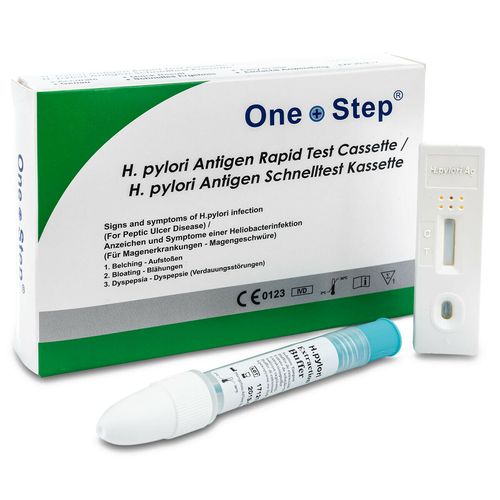
H. Pylori Faecal Test Kit
Stool antigen test – detects current active infection. No blood required. The clinically preferred method for H. pylori screening and post-treatment confirmation.
Also available: Blood Antibody Test – £9.99
What is H. pylori, and how does infection happen?
Helicobacter pylori is a spiral-shaped bacterium that has evolved to survive in one of the most hostile environments in the human body – the acidic interior of the stomach. It does this by burrowing into the protective mucous layer that lines the stomach wall, where it is shielded from stomach acid and can establish itself for years, or even decades, without being detected.
Infection most commonly occurs in childhood, typically through contaminated food or water, or through close person-to-person contact in households where H. pylori is present. In higher-income countries with good sanitation, infection rates have fallen over recent generations – but older adults in the UK are significantly more likely to be infected than younger people, reflecting the lower sanitation standards of their childhood environments. In some communities, particularly where overcrowding was common, infection rates among people now in their fifties and sixties can be substantially higher than the national average.
Once established, H. pylori is not cleared by the immune system on its own. Without treatment, it remains in the stomach indefinitely. The body mounts an immune response – which is why antibodies to H. pylori appear in the blood of infected individuals – but this response is not sufficient to eliminate the bacterium. Only antibiotic treatment achieves eradication.
What does H. pylori do to the stomach – and why does it matter?
H. pylori survives by producing an enzyme called urease, which neutralises stomach acid in its immediate vicinity. As a byproduct, this process generates compounds that irritate and inflame the stomach lining – a condition called gastritis. In most people, this inflammation is low-grade and produces either no symptoms at all, or mild discomfort that comes and goes.
Over time, however, persistent inflammation weakens the protective mucous layer. When this protection breaks down, stomach acid comes into direct contact with the underlying tissue. This is the mechanism by which ulcers form. H. pylori is responsible for the overwhelming majority of peptic ulcers – around 90% of duodenal ulcers and 80% of gastric ulcers. Many people who have been told they have an “acid problem” or who have been taking antacids for years may in fact have an undiagnosed H. pylori infection driving the symptoms.
The longer-term concern is stomach cancer. Chronic H. pylori infection causes ongoing inflammation and cellular changes in the stomach lining that, over decades, can progress toward malignancy. The World Health Organisation classifies H. pylori as a definite cause of gastric cancer – the third most common cause of cancer death worldwide. In the UK, stomach cancer accounts for around 2% of all cancers and has a relatively poor prognosis when caught late, partly because early-stage gastric cancer causes few specific symptoms. Detecting and eradicating H. pylori removes one of its most significant preventable risk factors.
Symptoms of H. pylori infection: what to look out for
The majority of H. pylori infections are silent – no symptoms at all. When symptoms do occur, they are caused by the gastritis or ulceration the infection produces, rather than by the bacterium itself. The most common include:
- A gnawing or burning pain in the upper abdomen, often worse when the stomach is empty and sometimes relieved temporarily by eating or antacids
- Persistent bloating, particularly after meals
- Frequent burping or belching
- Nausea, with or without vomiting
- Loss of appetite
- Unintentional weight loss
- Dark or tarry stools, or vomiting blood – both of which indicate bleeding from an ulcer and require urgent medical attention
If you have been managing persistent upper abdominal discomfort with over-the-counter antacids for more than a few weeks without resolution, H. pylori infection is a very plausible explanation and testing is a logical next step. Many people who test positive and then complete eradication treatment describe a significant and lasting improvement in their digestive health that they had not experienced in years.
Two home tests – understanding which one is right for you
We stock two H. pylori home tests at Zoom Health, and they work differently. Understanding the distinction helps you choose the right one for your situation.
The Faecal Stool Antigen Test (recommended)
The H. Pylori Faecal Test Kit detects H. pylori antigens directly in a stool sample. Antigens are proteins produced by the bacterium itself – so a positive result means the bacterium is currently present and active in your gastrointestinal tract. This is the key clinical advantage of the stool antigen test: it only detects current, active infection.
This makes it the preferred method for both initial diagnosis and for confirming eradication after treatment. Studies show that more than 90% of patients with duodenal ulcers and 80% of those with gastric ulcers test positive for H. pylori using stool antigen testing. The test is used routinely in clinical practice and is the approach recommended by NICE guidelines for confirming eradication.
At £7.99 (sale from £10.99), it is also the more affordable of our two options. No blood is required – the sample is stool, collected at home using the simple collection device in the kit. Results are available quickly and are straightforward to interpret.
Stool antigen test. Detects current active infection. Preferred for initial testing and post-treatment confirmation.
View product
The Blood Antibody Test
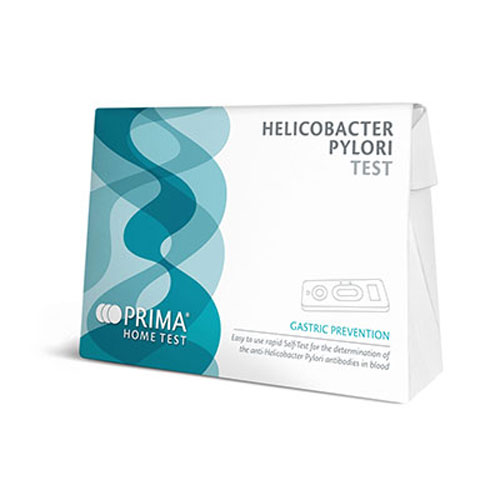
The H. Pylori Blood Antibody Test uses a finger-prick blood sample to detect IgG antibodies to H. pylori in the bloodstream. The immune system produces these antibodies in response to infection, and they remain detectable in the blood for a significant period – even after the infection has been successfully treated. Results are available within 30 minutes.
The blood test is a useful initial screening tool if you have never been tested and want a quick indication of whether you have ever been exposed to H. pylori. A negative result provides reasonable reassurance that no current or recent infection is present. A positive result, however, does not distinguish between a current active infection and a past infection that has already been treated – which is its key limitation compared to the stool antigen test.
I would recommend the blood test primarily as a first-line screen for someone who has never investigated H. pylori before, particularly if they are uncomfortable with stool sample collection. If the blood test is positive and you have symptoms, the logical next step is a stool antigen test or a GP-arranged breath test to confirm whether infection is currently active.
Finger-prick blood test. Results in 30 minutes. Good first-line screen; cannot distinguish current from past infection.
View product
Which test should you choose?
- Never been tested and have digestive symptoms? Start with the faecal stool antigen test at £7.99. It gives the most clinically meaningful result for current infection.
- Prefer a blood test and want an initial screen? The blood antibody test at £9.99 is a good starting point, understanding that a positive result will need follow-up to confirm active infection.
- Had H. pylori treatment in the past and want to confirm eradication? Use the faecal stool antigen test – the blood test will still show antibodies for months after successful treatment and is not suitable for post-treatment confirmation.
- No symptoms but want general reassurance? Either test is appropriate. The blood test involves a finger prick; the stool test requires a small faecal sample. Choose whichever you are comfortable with.
How to use the tests correctly
For the faecal stool antigen test: collect a small stool sample using the collection device provided in the kit. The sample does not need to be refrigerated if it is being tested immediately. Apply the sample to the test device using the pipette or swab included, add the diluent solution, and read the result at the time specified in the instructions. One line in the control window is a negative result; two lines is positive for active H. pylori infection. Avoid taking antibiotics, bismuth compounds, or proton pump inhibitors (such as omeprazole) for at least two weeks before testing – these can suppress H. pylori and produce a false negative.
For the blood antibody test: wash and warm your hands before the finger-prick step, collect the blood sample in the pipette provided, apply it to the test device with the diluent solution, and read the result at 30 minutes. The same two-line / one-line interpretation applies. If you test regularly or are sensitive to finger-prick lancets, our Unistik 3 Comfort lancets offer a finer gauge and more comfortable experience. Our guide to choosing a finger pricker has more detail.
What to do with a positive result
A positive result from either test is a prompt to contact your GP. Take your test result with you. Your GP will typically confirm the diagnosis with a laboratory test – usually a urea breath test, which is highly accurate and widely available in primary care – before prescribing treatment.
H. pylori eradication treatment typically consists of a combination of two antibiotics and a proton pump inhibitor (PPI) taken for seven to fourteen days, a regimen known as triple therapy. Success rates are high – around 85-90% with first-line treatment in the UK. If first-line treatment fails, alternative antibiotic combinations are available. After completing treatment, your GP will usually arrange a follow-up test to confirm eradication, most commonly a urea breath test or stool antigen test performed at least four weeks after antibiotics are completed.
Once H. pylori has been eradicated, gastric ulcers can heal, and the significantly elevated risk of ulcer recurrence associated with active infection is removed. Many patients notice a meaningful and lasting improvement in their digestive symptoms after successful treatment.
Who should consider testing for H. pylori?
I would suggest testing if any of the following apply to you:
- You have persistent upper abdominal pain, bloating or indigestion that has not resolved despite using over-the-counter antacids for more than a few weeks
- You have been diagnosed with a gastric or duodenal ulcer – H. pylori testing is standard practice in this context and treatment can prevent recurrence
- You have a close family member with a history of stomach cancer or peptic ulcer disease
- You grew up in a country or household with higher H. pylori prevalence
- You are over 55 and have never been tested – infection rates rise significantly with age in the UK
- You are taking long-term NSAIDs (such as ibuprofen or aspirin) – the combination of H. pylori and NSAIDs substantially raises ulcer risk
What our customers say
The Blood Antibody Test is rated 4.71 out of 5 from seven customer reviews. Customers consistently note the ease of use and speed of delivery, and several have confirmed that their home test result was followed up by their GP. The faecal stool antigen kit is a newer addition to our range; we expect its customer ratings to build quickly given its strong clinical credentials as the preferred method for H. pylori detection.
Don’t let an undetected infection go on damaging your stomach
H. pylori is one of the most common bacterial infections in the world – and one of the most treatable. A home test takes minutes, costs from £7.99, and can set in motion a course of treatment that eliminates the infection permanently and protects your long-term digestive health. We ship all orders the same day before 3pm.
Choose Your H. Pylori Test
Faecal Stool Antigen Test – £7.99
Blood Antibody Test – £9.99
Both kits ship same day. Full range: home health tests
Related guides from Zoom Health:
- Full range of home health test kits
- Cholesterol test guide – another important marker for long-term health
- Home Diabetes Test guide
- Guide to choosing a finger pricker lancet
Anthony Cunningham – Health Writer & Editor
Anthony Cunningham, BA (Hons), MA, is a UK-based health writer and editor with over 20 years’ experience running Zoom Health, a trusted source for home health tests, preventive care, and wellness guidance. He creates clear, evidence-based articles using NHS, NICE, and WHO guidance. Where possible, content is reviewed by practising clinicians to enhance accuracy and reliability, helping readers make informed healthcare decisions.