About This Article
About This Article: Zoom Health has supplied home health products and test kits to UK customers for nearly 20 years. This article is for general information only and does not constitute medical advice. High cholesterol is a significant health risk and any abnormal test results should be discussed with your GP promptly. Always consult a qualified healthcare professional before making changes to your diet, medication or lifestyle based on a home test result. Home health tests are screening tools and are not a substitute for clinical testing.
Published: 9 May 2026 | By: Anthony Cunningham
High cholesterol is one of the most significant and most underdiagnosed cardiovascular risk factors in the UK. An estimated 60% of UK adults have raised cholesterol levels, according to NHS data – yet because high cholesterol produces no symptoms whatsoever, the majority of those people have no idea. This is why the NHS describes high cholesterol as a silent condition: it accumulates risk over years without announcing itself, until the consequences – heart attack, stroke, peripheral arterial disease – make themselves known in ways that cannot be ignored. Understanding what cholesterol is, what the numbers mean, and how to monitor your levels at home is one of the most practical things you can do for your long-term cardiovascular health.
What Cholesterol Actually Is
Cholesterol is a waxy, fat-like substance found in every cell of the body. Despite its reputation, cholesterol is not inherently harmful – it is essential for the production of hormones including oestrogen, testosterone and cortisol, for the synthesis of vitamin D, for the formation of bile acids that aid fat digestion, and for the structural integrity of cell membranes. The body produces most of the cholesterol it needs in the liver, with dietary intake accounting for a smaller proportion than is commonly assumed.
The problem arises not from cholesterol itself but from the balance between different types of cholesterol-carrying proteins – lipoproteins – in the bloodstream. Low-density lipoprotein (LDL) cholesterol – commonly called “bad” cholesterol – carries cholesterol from the liver to cells around the body. When LDL levels are elevated, excess cholesterol can deposit on the walls of arteries, gradually forming plaques that narrow the vessel and restrict blood flow. This process, called atherosclerosis, is the underlying mechanism of most heart attacks and strokes. High-density lipoprotein (HDL) cholesterol – “good” cholesterol – carries cholesterol back from the arteries to the liver for processing and excretion, and has a protective effect against atherosclerosis.
Triglycerides are a third blood fat that is measured alongside cholesterol in a full lipid profile. They are the main form in which the body stores fat, and elevated triglyceride levels – particularly when combined with high LDL and low HDL – significantly increase cardiovascular risk.
Why High Cholesterol Has No Symptoms
This is the most important thing to understand about cholesterol, and the reason why home testing is so valuable. Unlike high blood pressure, which can cause headaches or dizziness in some people, or diabetes, which produces thirst, frequent urination and fatigue, high cholesterol produces no physical symptoms at all during the years in which it is silently damaging arterial walls. The first indication that cholesterol has been causing problems for years is often a cardiovascular event – a heart attack or stroke – that arrives without warning and may cause irreversible damage or death before any opportunity for intervention.
This is not a reason for fatalism – it is a reason for proactive monitoring. High cholesterol is very effectively managed when identified, through a combination of dietary changes, increased physical activity, and if necessary medication. The challenge is that management requires identification, and identification requires testing. In the UK, NHS cholesterol testing is typically offered at GP health checks for adults aged 40 to 74, but many people fall outside this window or prefer not to wait for a scheduled appointment. Home testing provides an accessible, immediate alternative.
Understanding Your Cholesterol Numbers
A cholesterol test measures total cholesterol in millimoles per litre of blood (mmol/L). In the UK, the general guidance is that total cholesterol should ideally be 5 mmol/L or below. Above 5 mmol/L is considered raised; above 7.5 mmol/L is considered high. However, total cholesterol alone is a limited measure – the ratio of total cholesterol to HDL cholesterol is a more informative indicator of cardiovascular risk, because high HDL can partly offset the risk associated with high total cholesterol.
In a full lipid profile from a GP, you would receive LDL cholesterol, HDL cholesterol, triglycerides and total cholesterol separately. A home total cholesterol test – the type available at Zoom Health – measures total cholesterol, which is the appropriate starting point for screening and monitoring. If your result is above the normal range, a full lipid profile from your GP is the recommended next step to understand the complete picture.
As a general reference: total cholesterol below 5 mmol/L is desirable for most adults. Between 5 and 6.4 mmol/L is mildly elevated and warrants dietary review and lifestyle attention. Between 6.5 and 7.8 mmol/L is moderately elevated and a GP consultation is strongly advisable. Above 7.8 mmol/L is severely elevated and prompt medical attention is important. These thresholds should be interpreted in the context of other cardiovascular risk factors – including blood pressure, smoking status, diabetes, age, sex and family history – which is why sharing your result with your GP is always the right next step when levels are raised.
Who Should Test Their Cholesterol at Home?
Home cholesterol testing is most valuable for several groups of people. Adults over 40 who have not had a cholesterol check within the past five years should consider routine monitoring – cardiovascular risk increases with age and the NHS recommends regular cholesterol checks from this age. People with a family history of high cholesterol or early cardiovascular disease in close relatives are at elevated genetic risk and should test more regularly. Anyone who has recently made significant dietary or lifestyle changes and wants to monitor the effect on their cholesterol will find home testing a practical way to track progress between GP appointments. People taking steps to address known high cholesterol through diet can use home testing to gauge whether their efforts are producing measurable results. And anyone who simply wants the peace of mind of knowing their cholesterol status – without waiting weeks for a GP appointment – will find home testing an efficient and affordable option.
What Affects Cholesterol Levels?
Diet is the most commonly cited factor in cholesterol levels, but its influence is more nuanced than simple “avoid fat” advice suggests. Saturated fat – found in red meat, full-fat dairy, butter, coconut oil and processed foods – raises LDL cholesterol. Trans fats, found in partially hydrogenated vegetable oils used in some processed and fried foods, raise LDL and lower HDL simultaneously and are particularly harmful. Conversely, unsaturated fats – particularly omega 3 fatty acids from oily fish and monounsaturated fats from olive oil and avocados – have a beneficial effect on the lipid profile. Soluble fibre, found in oats, legumes, apples and other fruits, reduces LDL cholesterol by binding to it in the digestive tract and removing it before absorption.
Physical activity raises HDL cholesterol and reduces LDL and triglycerides. Excess body weight, particularly abdominal fat, is associated with higher LDL, lower HDL and elevated triglycerides. Smoking lowers HDL cholesterol directly. Genetics play a significant role – familial hypercholesterolaemia, an inherited condition affecting around one in 250 people in the UK, causes very high LDL levels regardless of diet and lifestyle and requires medication to manage effectively. Age and hormonal changes also influence cholesterol – levels tend to rise with age in both sexes, and women often see a significant increase after the menopause.
The Connection Between Omega 3 and Cholesterol
Omega 3 fatty acids – EPA and DHA from oily fish and fish oil supplements – have a well-established beneficial effect on the lipid profile, particularly on triglycerides. At clinically relevant doses, EPA and DHA significantly reduce triglyceride levels, and DHA contributes to the maintenance of normal blood triglyceride concentrations – an EFSA-approved health claim. They also contribute to the normal function of the heart, another permitted claim based on strong research. If your home cholesterol test indicates raised levels and you are looking at nutritional approaches to support a healthier lipid profile alongside dietary changes, omega 3 supplementation is one of the most evidence-supported options available. Read our full omega 3 guide for details on choosing the right supplement.
Our Cholesterol Test at Zoom Health
Qucare Total Cholesterol Test Kit
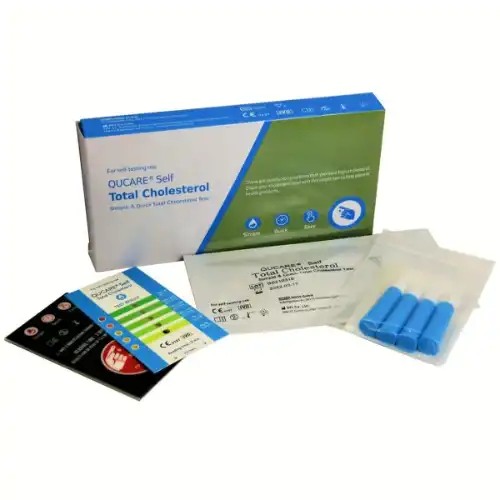
The Qucare Total Cholesterol Test Kit measures the concentration of total cholesterol in a small finger-prick blood sample, providing a clear numerical result that can be compared against the reference ranges above. The test is designed to be straightforward to use at home without clinical training – a sterile lancet for the finger prick, a test strip, and a colour-comparison chart for reading the result are all included. Results are available within minutes. Customers consistently report that the test is easy to use and that results align closely with subsequent laboratory testing – one verified buyer noted accuracy within 5 to 10% of a follow-up doctor’s blood test, which is the level of precision appropriate for a screening tool of this kind.
The kit contains two tests, which allows for retesting to confirm an initial result or for monitoring at a later date. This is a useful feature: cholesterol levels can be affected by recent meals, illness and temporary lifestyle factors, and a confirmatory second test provides more reliable information than a single measurement. Ship same day from our Southwell base when ordered before our daily dispatch cutoff.
Total cholesterol screening | Finger prick test | Results in minutes | 2 tests per kit | Buy from Zoom Health
How to Get the Most Accurate Result
For the most reliable home cholesterol reading, follow these practical steps. Test in the morning if possible, as cholesterol levels are more stable in a fasted state – avoid eating for at least four hours before testing. Keep your hands warm before performing the finger prick, as cold hands restrict blood flow and make obtaining an adequate sample more difficult. Warm them under running warm water for a minute beforehand. Use the side of a fingertip rather than the pad, where nerve endings are less concentrated and the skin is easier to penetrate. Do not squeeze the finger hard to force blood out – this dilutes the sample with tissue fluid and can affect accuracy. If you are unwell, have recently changed your diet significantly, or have been under unusual physical stress, wait until your health and routine have normalised before testing for the most representative result.
Once you have your result, record it with the date so you can track changes over time. If your result is above 5 mmol/L, share it with your GP and discuss whether a full lipid profile is appropriate. If your result is above 7.5 mmol/L, contact your GP promptly rather than waiting for a routine appointment.
Monitor your cholesterol at home
Browse our full range of home health test kits at Zoom Health, or read our omega 3 guide for nutritional support for a healthy lipid profile.
About the Author
Anthony Cunningham – Health Writer & Editor
Anthony Cunningham, BA (Hons), MA, is a UK-based health writer and editor with over 20 years’ experience running Zoom Health, a trusted source for home health tests, preventive care, and wellness guidance. He creates clear, evidence-based articles using NHS, NICE, and WHO guidance. Where possible, content is reviewed by practising clinicians to enhance accuracy and reliability, helping readers make informed healthcare decisions.