About This Article
Zoom Health has supplied home health products and drug testing kits to UK customers for nearly 20 years. This article is for general information only and does not constitute legal or medical advice. Drug and alcohol testing in the workplace is subject to UK employment law; always seek qualified legal guidance before implementing a testing programme. Test results should be interpreted in context and confirmed by appropriate means before any formal action is taken.
Alcohol is the most widely misused substance in the UK, and it is also the one that employers are most likely to encounter as a genuine workplace problem. The Health and Safety Executive estimates that alcohol misuse costs UK employers around £7.3 billion each year in lost productivity, sickness absence, and accidents. And unlike most other substances, alcohol presents a specific challenge that is easy to overlook: the morning-after problem.
Most people understand that driving or operating machinery while drunk is dangerous and illegal. Fewer people fully appreciate how long alcohol can remain at impairing levels in the body after a heavy night, or what that means for someone who needs to be fit for work the next morning. A person who stopped drinking at midnight, slept for six hours, and drove to a construction site at 7am may still have a blood alcohol concentration that exceeds workplace safety thresholds, or even the legal drink-drive limit, despite feeling broadly normal.
In this guide I want to cover the UK legal landscape around workplace alcohol, explain the morning-after risk in practical terms, compare the testing methods available, and recommend the products we stock at Zoom Health that are most appropriate for different situations – from formal employer testing programmes through to personal checks before driving or starting a shift.
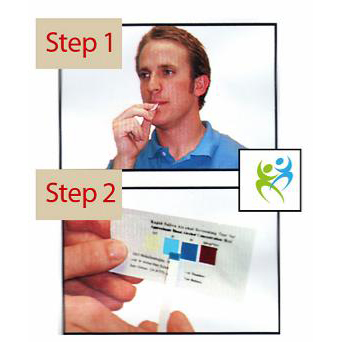
Rapid Saliva Alcohol Test – £1.49 | Results in 2 minutes | Tests 4 BAC levels including the UK legal limit | Simple colour-match reading
The UK Legal Limits: What Employers and Employees Need to Know
The drink-drive limit in England, Wales, and Northern Ireland is 80mg of alcohol per 100ml of blood (0.08% BAC), or 35 micrograms per 100ml of breath. In Scotland, the limit is stricter at 50mg per 100ml of blood (0.05% BAC), reduced in 2014 to bring it in line with most of the rest of Europe.
These are legal limits for driving on public roads – they are not workplace alcohol standards. Many employers, particularly in safety-critical industries, operate at considerably lower thresholds than the legal drink-drive limit. A zero-tolerance policy (0.00% BAC) is common in sectors such as aviation, rail, nuclear, and offshore energy. A threshold of 20mg/100ml – a quarter of the legal driving limit – is frequently used in construction, manufacturing, and heavy industry. Some general workplace policies use the drink-drive limit as their threshold, but that is generally regarded as too permissive for most physically or cognitively demanding roles.
There is no single statutory workplace alcohol limit in UK law, outside of a handful of regulated industries. Employers set their own thresholds within their drug and alcohol policies. What the law does require is that employers take reasonable steps to ensure that employees are fit for work, and that they do not allow employees who are impaired by alcohol to operate machinery, drive vehicles, or work in situations where impairment creates a risk to health and safety. Under the Health and Safety at Work Act 1974, this is a duty of care that cannot be delegated.
The Morning-After Risk: How Long Does Alcohol Stay in the System?
This is the question I am asked most often in the context of alcohol testing, and the answer is both simpler and more complicated than most people expect. The simple version: the body eliminates alcohol at a broadly consistent rate of around 1 unit per hour, once peak blood alcohol concentration is reached. The complicated version: everything else about alcohol metabolism varies considerably between individuals.
As a rough illustration, consider someone who drinks 8 pints of 4% lager over the course of an evening – a total of around 18 units. Even if they stop drinking at midnight and sleep for eight hours, they will likely wake at 8am with a blood alcohol concentration still in the range of 50 to 80mg/100ml, depending on their body weight, gender, whether they ate, and their individual metabolism. They may feel tired but not obviously drunk. They may feel capable of driving or operating machinery. But they may still be above the legal drink-drive limit, and almost certainly above a 20mg/100ml workplace threshold.
The practical implication for anyone in a safety-critical role – lorry driver, machine operator, scaffolder, crane driver, paramedic – is that a heavy night on a Sunday does not necessarily mean they are fit to start work at 6am on Monday. The only reliable way to know is to test. Subjective assessment of how sober you feel is a notoriously poor indicator of actual blood alcohol concentration, particularly at moderate levels of impairment.
For employers, this underlines why for-cause and start-of-shift testing policies are a meaningful safety measure rather than a box-ticking exercise. A worker who is visibly intoxicated is obviously unfit. A worker who had 10 pints last night, slept it off, showered, and turned up looking presentable is a less obvious risk – but potentially a more dangerous one, precisely because the impairment is not apparent.
Saliva Testing vs Breath Testing: Which Method Is Right?
For workplace alcohol testing, the two main rapid-screening methods are saliva testing and breath testing. Both detect current alcohol presence rather than historical use – alcohol is eliminated from the body relatively quickly, and unlike cannabis, it leaves no long-term metabolites that persist for days or weeks.
Saliva testing works by detecting alcohol directly in oral fluid. The relationship between saliva alcohol concentration and blood alcohol concentration is approximately 1:1, which makes saliva a scientifically sound proxy for blood levels. Saliva tests are inexpensive, portable, do not require any specialist equipment, and results appear within 2 minutes via a colour-match chart. Their limitation is that they are semi-quantitative rather than precisely quantitative – they identify which range a person’s BAC falls into rather than giving an exact figure.
Breath testing measures alcohol vapour in exhaled breath and converts it to an equivalent blood alcohol reading. Disposable breath tests such as the Test and Drive kit use a chemical reaction to indicate alcohol presence via a colour change. Digital breathalysers provide a more precise numerical BAC reading and are used by police forces and occupational health teams when a more exact figure is needed. For formal disciplinary or legal purposes, only an evidential-grade breathalyser – or a blood test – provides the level of precision that would stand up to challenge.
For most employers running a practical workplace screening programme, saliva testing and disposable breath testing are both appropriate first-line tools. Neither is suitable as standalone evidence for a disciplinary process – a positive screening result should be followed up with a formal evidential test if action is being considered. But as a rapid check at the start of a shift, for a for-cause test following a near-miss, or for a personal check before driving in the morning, both methods are practical, affordable, and reliable enough to be genuinely useful.
The Rapid Saliva Alcohol Test: What It Measures
The Rapid Saliva Alcohol Test (£1.49) is a single-use stick test that provides a BAC estimate in 2 minutes via a colour-matched reactive pad. It identifies four levels: no alcohol detected; 20mg/100ml; 80mg/100ml (the England/Wales/Northern Ireland drink-drive limit); and 300mg/100ml (a level consistent with heavy intoxication). The test is sensitive down to 0.02% BAC, and the relationship between saliva and blood alcohol it relies on has been well established in the scientific literature for decades.
The test is well suited to personal use – checking whether you are likely to be over the limit before driving the morning after – and to low-volume workplace screening where a quick, non-invasive check is needed. At £1.49 per unit it is also the most affordable alcohol testing option we stock, making it practical to keep a supply at home or in a vehicle.
One point worth noting: nothing should be placed in the mouth for at least 10 minutes before the test. Food, drink, tobacco, or mouthwash can all affect the saliva alcohol reading. In a workplace context, this is straightforward to enforce – test on arrival before the employee has eaten or drunk anything. For personal morning-after use, test before having a coffee or brushing your teeth.
Rapid Saliva Alcohol Test Strips: The Bulk-Testing Option
For employers who need to carry out regular or random alcohol screening across a larger workforce, the Rapid Saliva Alcohol Test Strips (from £1.49 per strip, available in packs of 1, 5, or 10) offer the same core functionality as the single saliva test in a strip format. Each strip is individually foil-wrapped for hygiene and shelf-life, with a colour guide printed on the packaging. BAC is indicated across a range from 0.02% to 0.30%, covering every relevant threshold from zero-tolerance to high impairment.
The strip format is slightly faster to deploy in a testing situation than the stick test, and the individual foil wrapping makes them practical to carry in a vehicle, site kit, or testing kit bag. For a team leader or safety officer who may need to carry out an unannounced check or respond quickly to a post-incident situation, keeping a small supply in a jacket pocket or glove compartment is a sensible precaution.
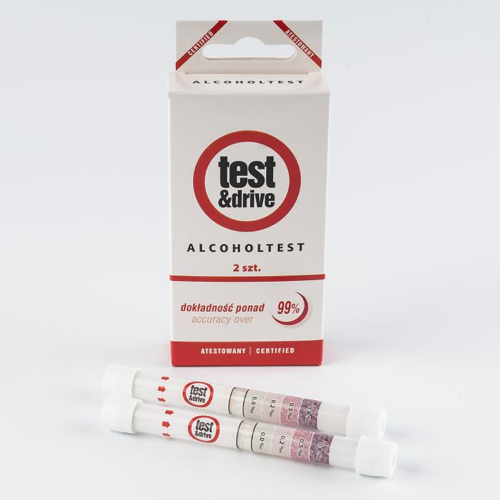
Test and Drive Alcohol Breath Test – 2 Pack – £3.99 | Disposable breath test | Detects BAC from 0.02% | Semi-quantitative readings at 0.0, 0.2, 0.5 and 0.8% | Suitable for personal and workplace use
The Test and Drive Breath Test: A Reliable Disposable Option
The Test and Drive Alcohol Breath Test (£3.99 for a pack of 2) is a disposable breath-based test that uses a glass tube containing active granules. When the user blows through the tube, the granules change colour in the presence of alcohol. The colour is then matched against a chart to read BAC at four semi-quantitative levels: 0.0, 0.2%, 0.5%, and 0.8% by volume.
The Test and Drive is calibrated to detect BAC from 0.2g/L (0.02% by volume) upwards, which makes it sensitive enough to identify anyone above a 20mg/100ml workplace threshold. It is particularly useful as a personal morning-after driving check, since the four-level colour scale maps directly onto the key thresholds – it will clearly distinguish between no alcohol, below the Scottish limit, below the England/Wales limit, and well over it. The kit includes full instructions and can be performed anywhere without any additional equipment.
At £2 per test in the 2-pack format, it is slightly more expensive per unit than the saliva tests, but the breath-based format suits some workplaces better – particularly where the mechanics of saliva testing (collection time, pad saturation) may be harder to manage in a fast-moving operational environment.
Combining Alcohol and Drug Testing in the Workplace
Many workplaces that implement alcohol testing also run a parallel drug testing programme, and there is a practical argument for combining the two into a single screening process. Running both tests simultaneously – an alcohol saliva or breath check alongside a multi-panel urine or saliva drug screen – adds minimal time or cost to a testing process but significantly broadens the coverage.
This is particularly relevant in industries where polydrug use (combining alcohol with other substances) is a known risk. Alcohol combined with cannabis, benzodiazepines, or opiates produces considerably greater impairment than either substance alone, but a test that only covers alcohol will miss the compounding effect of a second substance. For safety-critical environments, a combined approach is increasingly regarded as best practice.
For employers building a combined testing programme, the most practical pairing is a saliva alcohol test alongside a 5 or 6 Panel Saliva Drug Test, which allows both to be administered simultaneously using oral fluid. Alternatively, a saliva alcohol test at arrival, followed by a urine multi-panel if required, is a common two-stage approach for more thorough screening.
A Note on Evidential Testing and Legal Process
The tests described in this post are screening tools. They are reliable and appropriate for first-line assessment, but they are not evidential-grade instruments. An alcohol screening result – whether from a saliva test or a disposable breath tube – cannot be used as the sole basis for disciplinary action, dismissal, or legal proceedings.
If a formal process is required following a positive alcohol screen – whether disciplinary, regulatory, or legal – an evidential-standard breathalyser reading or a blood test carried out by a qualified medical professional is necessary. Any employer who moves to formal action solely on the basis of a screening test, without following a fair procedure and obtaining confirmatory evidence, faces significant legal exposure. The screening step is valuable because it identifies who needs to be removed from safety-critical work immediately while further process takes place – it is not the end of the process.
ACAS guidance on workplace alcohol and drug policies covers the procedural requirements in detail. For regulated industries, sector-specific guidance from bodies such as the DVLA, Civil Aviation Authority, or Office for Nuclear Regulation will also apply.
Browse the full range of alcohol testing products at Zoom Health – saliva tests, breath tests, and test strips for personal and workplace use.
Featured in this article:
- Rapid Saliva Alcohol Test – £1.49
- Rapid Saliva Alcohol Test Strips – From £1.49
- Test and Drive Alcohol Breath Test – 2 Pack – £3.99
- 5 Panel Oral Fluid Saliva Drug Test Kit – From £6.99 (for combined drug and alcohol screening)
Related Articles
Anthony Cunningham – Health Writer & Editor
Anthony Cunningham, BA (Hons), MA, is a UK-based health writer and editor with over 20 years’ experience running Zoom Health, a trusted source for home health tests, preventive care, and wellness guidance. He creates clear, evidence-based articles using NHS, NICE, and WHO guidance. Where possible, content is reviewed by practising clinicians to enhance accuracy and reliability, helping readers make informed healthcare decisions.