About This Article
Zoom Health has supplied home health products and test kits to UK customers for nearly 20 years. This article is for general information only and does not constitute medical advice. Any abnormal test results should be discussed with your GP promptly. Always consult a qualified healthcare professional before making changes to your diet, medication or lifestyle based on a home test result. Home health tests are screening tools and are not a substitute for clinical testing.
Most people assume that a blood pressure reading taken at the GP surgery is the most accurate and reliable measurement available. In many cases that is true. But for a significant proportion of the population, the surgery reading is actually one of the least representative numbers you could take. Two conditions – white coat hypertension and masked hypertension – mean that for millions of people in the UK, a clinic reading is either falsely high or falsely normal. Both have real consequences, and both can only be identified through home monitoring.
I have been talking to customers about blood pressure monitoring for nearly 20 years, and these two conditions come up constantly. People are started on medication they may not need. Others are reassured by normal clinic readings while living with consistently elevated pressure at home. In this guide I want to explain both conditions clearly, and make the case for why a validated upper arm monitor used consistently at home gives you – and your GP – a far more complete picture than any clinic appointment can provide on its own.

OMRON M2 – Digital Automatic Blood Pressure Monitor
Clinically validated upper arm monitor with Intellisense technology and hypertension sensor. Compact, fully automatic, and easy to use. £29.99 was £34.99
What is white coat hypertension?
White coat hypertension is the name given to a pattern where blood pressure is elevated when measured in a clinical setting but returns to normal outside it. The name comes from the traditional white coat worn by doctors, though the phenomenon can occur in any formal medical environment – a nurse-led clinic, a hospital ward, or even a pharmacy measurement booth.
The mechanism is straightforward. For many people, entering a medical environment triggers a mild stress response. Anxiety, anticipation, and the clinical atmosphere all contribute to a temporary rise in blood pressure that may persist throughout the appointment. The person leaves, the anxiety resolves, and their blood pressure settles back to its usual level – but the reading in their notes says something quite different.
Research suggests that white coat hypertension affects somewhere between 15% and 30% of people diagnosed with hypertension in clinical settings. That is a substantial proportion. A 2019 analysis published in the Annals of Internal Medicine found that around a third of people with elevated office readings had normal blood pressure when monitored outside the clinic. For those individuals, medication prescribed on the basis of a clinic reading alone may be unnecessary – and antihypertensive drugs carry real side effects and lifestyle implications.
This is not a trivial concern. It is one of the primary reasons that NICE guidance recommends offering ambulatory blood pressure monitoring or home blood pressure monitoring to confirm a diagnosis of hypertension before treatment begins. A validated home monitor is the practical tool that makes this confirmation possible.
What is masked hypertension – and why it is more dangerous
Masked hypertension is the opposite pattern, and in many ways it is the more worrying of the two. It describes a situation where blood pressure readings in the clinic are normal or borderline, but home readings are consistently elevated. The hypertension is, in effect, masked by the clinical setting.
Why might blood pressure be lower in the surgery than at home? There are several explanations. Some people experience a genuine calming effect in a clinical environment. Others have elevated pressure during their normal working day – driven by occupational stress, commuting, irregular hours, or habitual lifestyle factors – that is not present during a daytime GP appointment. The clinic measurement captures a moment of relative calm that does not represent the person’s typical cardiovascular load.
Masked hypertension is estimated to affect around 10% to 15% of the population with seemingly normal clinic readings. The cardiovascular risk associated with it is significant. Because the condition is invisible to clinic-based monitoring alone, people with masked hypertension may go years without diagnosis, accumulating the same organ damage – to the heart, kidneys, and blood vessels – as someone with recognised and untreated hypertension. Studies have shown that masked hypertension carries a cardiovascular event risk comparable to sustained hypertension.
The only way to detect masked hypertension is through monitoring outside the clinical setting. Home monitoring is the most practical route for most people.
Why home monitoring gives your GP better data than a clinic appointment
A GP appointment typically produces one or two blood pressure readings. Those readings are taken after you have walked from the waiting room, possibly navigated a car park, and sat briefly in a clinical environment. They may or may not reflect the blood pressure you experience during the rest of your day, your working week, or your typical morning routine. They are a snapshot taken under conditions that are, for many people, mildly atypical.
Home monitoring, done correctly over seven consecutive days, produces up to 14 readings taken across different times of day, in familiar surroundings, after appropriate rest periods. The average of those readings is what clinical guidelines describe as a home blood pressure measurement. This average is what NICE recommends GPs use to confirm a hypertension diagnosis, adjust medication, or reassess treatment. It is a fundamentally more robust number than anything a clinic can provide in a standard appointment.
The British Hypertension Society recommends taking two readings morning and evening, with a one-minute gap between each pair, for seven days. Discard the first day’s readings, which tend to be slightly higher as people adjust to the process, and average the remaining six days. Bring this log to your GP appointment. This is the data that allows meaningful clinical decisions to be made, rather than reactive ones based on a single elevated number.
The OMRON M2 – why it is the right tool for this job
If you are going to use home monitoring to generate data that your GP will rely on for clinical decisions, the device you use matters. An unvalidated monitor that reads consistently three or four points high or low produces a misleading average. A validated, clinically tested monitor produces a reliable one.
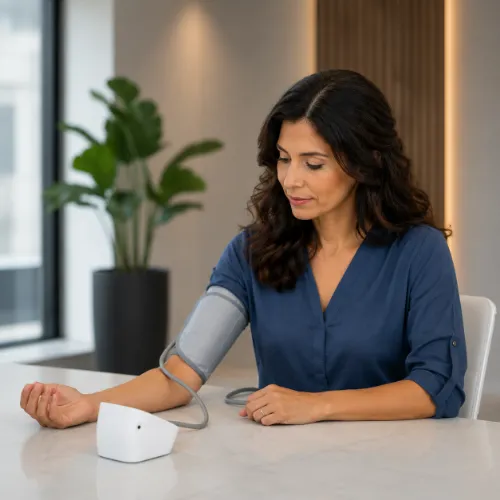
The OMRON M2 is one of the most widely used validated home blood pressure monitors in the UK, and for good reason. OMRON is a brand with a long clinical track record, and the M2 uses OMRON’s Intellisense technology, which inflates the cuff to the optimal pressure for each individual measurement rather than to a fixed maximum. This means the measurement is both more comfortable and more accurate, because unnecessary over-inflation can affect the reading and cause the arm to tense in response.
The M2 also includes a hypertension indicator – a simple visual marker that flags readings above the standard hypertension threshold, making it easy to identify readings that warrant attention without needing to remember classification numbers. For people new to blood pressure monitoring, this kind of at-a-glance interpretation is genuinely helpful.
The device is compact enough to use anywhere in the house and straightforward enough for daily use without any technical knowledge. One button starts the measurement. The cuff is a standard upper arm design fitting circumferences of 22 to 32cm. Currently on sale at £29.99 – reduced from £34.99 – it represents excellent value for a clinically validated device from one of the most trusted names in home blood pressure monitoring.
How to create a home monitoring log your GP will actually find useful
The value of home monitoring is directly proportional to the quality of the data you collect. A few random readings taken at different times, in different positions, without any record of context, tell your GP very little. A structured seven-day log tells them a great deal.
Take readings twice a day – once in the morning before breakfast and before any medication, and once in the evening before bed. Sit quietly for five minutes first. Sit with your back supported, feet flat on the floor, and your arm resting on a flat surface with the cuff at heart level. Take two readings one minute apart and record both. Note the time, and add any relevant context – a poor night’s sleep, an unusually stressful day, or a morning where you were running late and rushed the preparation.
Do this for seven days. Keep the records in a simple notebook or use a blood pressure log sheet. At the end of the week, calculate your average by adding all the readings and dividing by the number of readings taken. Present this average, along with the full log, to your GP. If your GP has asked you to monitor specifically to confirm or rule out a hypertension diagnosis, they will likely want to see the raw data as well as the average.
If you are monitoring over the longer term – checking whether lifestyle changes are having an effect, or whether medication is working – the same discipline applies. Consistency in timing, positioning, and preparation is what makes home readings comparable to each other over time.
What your home readings might reveal
For most people who start home monitoring, one of three things happens. They find that their readings are consistently normal, which is reassuring and gives them a genuine baseline for the future. They find that their readings are elevated in a way that mirrors their clinic readings, which confirms that hypertension is real rather than white coat in origin and supports a treatment decision. Or they find a discrepancy – either readings that are lower than the clinic suggested (pointing toward white coat hypertension) or higher than their clinic readings implied (pointing toward masked hypertension).
In any of these three scenarios, the home data adds value. Normal readings provide reassurance and a personal reference point. Consistently elevated readings that match clinic readings give your GP confidence that treatment is warranted. A discrepancy is perhaps the most clinically significant finding of all, because it changes the conversation entirely and may lead to a very different management approach.
It is worth noting that home monitoring can also reveal patterns that are not visible from averages alone. Morning hypertension – where blood pressure is significantly higher in the first hour after waking than at other times of day – is a specific risk factor for cardiovascular events and is not always apparent from clinic readings. Some people find that their evening readings are consistently higher than their morning ones, or vice versa. These patterns are worth discussing with your GP as part of a full picture of your cardiovascular health.
Get the full picture with validated home monitoring
The OMRON M2 Basic gives you clinically validated upper arm readings you can trust – and data your GP can act on. Currently on sale at £29.99 (was £34.99).
When to act on your readings
Home blood pressure monitoring is a tool for generating data, not for making clinical decisions unilaterally. The readings you collect should inform a conversation with your GP, not replace one.
If your seven-day average is consistently at or above 135/85, contact your GP. This is the home monitoring equivalent of the 140/90 clinic threshold and is the level at which further investigation or treatment is typically considered. If any individual reading reaches 180/120 or above, and you are experiencing symptoms such as a severe headache, chest pain, vision disturbance, or difficulty breathing, treat this as a medical emergency and call 999.
If you have been prescribed medication for hypertension and want to monitor its effectiveness, home monitoring is an excellent tool – but discuss the approach with your prescriber first. They may want readings taken at specific times relative to your medication schedule, or may prefer to use ambulatory monitoring for the initial assessment.
For most people, home monitoring is a positive and empowering experience. Understanding your own blood pressure – its patterns, its responses to lifestyle factors, and its trends over time – puts you in a far stronger position in any clinical conversation. You arrive at your GP appointment with data rather than uncertainty, and that changes the quality of the care you receive.
You can browse the full range of blood pressure monitors at Zoom Health, including both upper arm and wrist options, to find the device that suits your needs.
Anthony Cunningham – Health Writer & Editor
Anthony Cunningham, BA (Hons), MA, is a UK-based health writer and editor with over 20 years’ experience running Zoom Health, a trusted source for home health tests, preventive care, and wellness guidance. He creates clear, evidence-based articles using NHS, NICE, and WHO guidance. Where possible, content is reviewed by practising clinicians to enhance accuracy and reliability, helping readers make informed healthcare decisions.