About This Article
Zoom Health has supplied home health products and test kits to UK customers for nearly 20 years. This article is for general information only and does not constitute medical advice. Any abnormal test results should be discussed with your GP promptly. Always consult a qualified healthcare professional before making changes to your diet, medication or lifestyle based on a home test result. Home health tests are screening tools and are not a substitute for clinical testing.
During the pandemic, pulse oximeters went from being a niche clinical device to something millions of households wanted on their shelves. That surge in interest has largely persisted, and for good reason. A pulse oximeter is one of the simplest and most informative health monitoring tools available for home use. Clip it onto your fingertip, wait a few seconds, and you have two pieces of information that can tell you a great deal about how well your heart and lungs are working together.
I have stocked pulse oximeters at Zoom Health for many years, and the questions I receive about them have evolved considerably. Early on, people mostly wanted to know how to use one. Now I am more often asked what the numbers actually mean, when a reading should prompt concern, and which device is worth buying. In this guide I will answer all three, with a particular focus on the Kinetik Wellbeing JPD500E – a clinical-grade oximeter that is FDA approved and used by NHS Scotland.
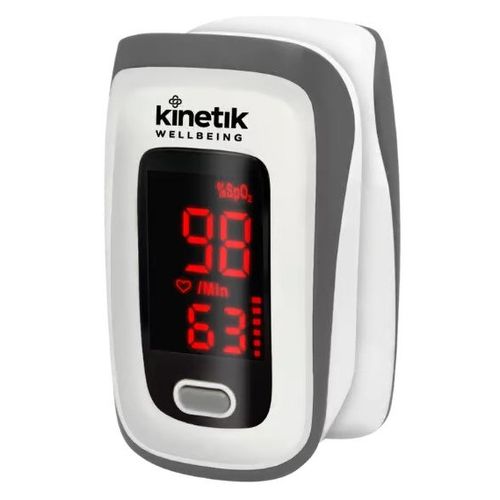
Kinetik Wellbeing Finger Pulse Oximeter (SpO2) – JPD500E
FDA approved. Class IIa medical device. Used by NHS Scotland. Measures blood oxygen saturation and pulse rate in seconds. Includes lanyard and batteries. £27.99
What a pulse oximeter actually measures
A pulse oximeter measures two things simultaneously: your blood oxygen saturation level, expressed as SpO2, and your pulse rate in beats per minute. These are displayed as two separate numbers on the device screen, and both carry useful health information.
SpO2 stands for peripheral oxygen saturation. It tells you what percentage of your red blood cells are currently carrying oxygen. The device works by shining two wavelengths of light through your fingertip – one red, one infrared. Oxygenated haemoglobin and deoxygenated haemoglobin absorb these wavelengths differently, and the oximeter calculates the ratio to produce a percentage figure. The whole process takes a few seconds and is entirely painless and non-invasive.
The pulse rate reading comes from the same light-based detection. As your heart beats, blood pulses through the capillaries in your fingertip in a rhythm the oximeter can detect. This gives you a real-time heart rate without any need for chest electrodes or manual counting. For most people, the combination of SpO2 and pulse rate in one compact device makes a pulse oximeter one of the most informative home monitoring tools available alongside a blood pressure monitor.
What is a normal SpO2 reading?
For a healthy adult breathing normally at sea level, a normal SpO2 reading is between 95% and 100%. Most people without underlying lung or heart conditions will sit comfortably between 96% and 99% at rest. A reading of 95% is generally considered the lower boundary of normal, though context matters – someone who typically reads at 99% will notice a drop to 95% differently from someone whose baseline has historically been 96%.
A reading below 95% warrants attention. Below 94%, the NHS advises seeking medical assessment, particularly if you are also experiencing breathlessness, chest pain, confusion, or unusual fatigue. A reading below 90% is classified as hypoxaemia – dangerously low blood oxygen – and requires urgent medical attention. If you record a reading in this range and you are not at high altitude or using a known interfering factor, call 999 or go to your nearest emergency department.
It is worth noting that individual baselines vary. People with certain chronic lung conditions such as COPD may have a normal resting SpO2 of 88% to 92%, and for them this range is expected and managed in collaboration with their medical team. If you have an existing respiratory or cardiac condition, ask your GP or specialist what your target range should be, and monitor against that rather than a population average.
What can affect the accuracy of your reading
Pulse oximeters are highly accurate devices when used correctly, but there are a handful of factors that can produce misleading results. Knowing these helps you interpret your reading with appropriate confidence.
Cold hands are the most common issue in a UK household setting. If your fingertip is cold, blood flow to the periphery is reduced, and the oximeter may struggle to detect a reliable signal. Warm your hands for a few minutes before taking a reading if you have been outdoors or in a cold room. Similarly, nail polish – particularly dark colours – can interfere with the light transmission through the fingertip. Remove nail polish from whichever finger you plan to use, or try a different finger.
Movement is another source of error. Keep your hand still and your finger relaxed inside the device during the measurement. Shivering, fidgeting, or holding the oximeter at an angle can all introduce signal noise. The JPD500E’s LED display and fast processing help minimise the time you need to hold still, but a few steady seconds is still needed for an accurate figure.
Bright ambient light, particularly direct sunlight, can occasionally affect readings in some devices. If you get an unexpectedly low reading, try cupping your other hand over the device to shade it and repeat the measurement. Finally, anaemia can cause the oximeter to overestimate oxygen saturation in some cases, because it detects the proportion of haemoglobin carrying oxygen rather than the absolute quantity. If you have known anaemia and are monitoring oxygen saturation, discuss the implications with your GP.
Understanding your pulse rate reading
The pulse rate displayed by your oximeter is your heart rate in beats per minute. For most healthy adults at rest, a normal range is 60 to 100 beats per minute. Athletes and people who exercise regularly often have resting heart rates below 60 – this is a sign of cardiovascular efficiency rather than a problem, and is sometimes called athlete’s heart.
A resting heart rate consistently above 100 is called tachycardia and may have a range of causes, from dehydration and stress to thyroid disorders or cardiac arrhythmia. A resting heart rate persistently below 60 in someone who is not physically active, or that is accompanied by dizziness, fatigue, or fainting, is called bradycardia and also merits a GP conversation.
Knowing your resting heart rate baseline is useful context for everything else. I find that many people do not have a clear sense of what their normal is until they start monitoring. Taking a reading on several consecutive mornings before getting out of bed gives you a reliable personal baseline that makes future readings much easier to interpret.
Who benefits most from a pulse oximeter at home
While a pulse oximeter is a useful tool for most households, there are groups for whom it is particularly valuable.
People with asthma, COPD, or other respiratory conditions can use it to track their oxygen saturation during and after periods of worsening symptoms. A drop in SpO2 can be an early indicator that a condition is deteriorating before breathlessness becomes severe, giving more time to seek appropriate treatment. Those with heart conditions or a history of heart failure may also benefit, since reduced cardiac output can manifest as falling SpO2.
Anyone recovering from a respiratory illness, including pneumonia or severe respiratory infections, can use a pulse oximeter to monitor their recovery at home and to identify if their condition is worsening rather than improving. Sleep is another context where some people find monitoring informative. Suspected sleep apnoea, where breathing repeatedly stops and restarts during the night, can cause oxygen levels to dip. Overnight monitoring with a compatible device can support a conversation with your GP about whether a formal sleep study is warranted.
Travellers going to high altitude destinations may also find a pulse oximeter useful. At altitude, the reduced partial pressure of oxygen means SpO2 naturally falls. Understanding your readings at altitude – and recognising when they fall below safe levels – can be genuinely important for safety.
The Kinetik Wellbeing JPD500E – clinical grade for home use
The device I stock and recommend is the Kinetik Wellbeing Finger Pulse Oximeter JPD500E, and I want to explain specifically why it stands out from the many cheaper alternatives on the market.
It is certified as a Class IIa medical device under European medical device regulation. This classification – shared with devices such as surgical instruments and short-term implantable equipment – means the JPD500E has been assessed against a meaningful safety and performance standard. FDA approval from the United States adds a further layer of independent validation. And the fact that NHS Scotland uses this device in clinical practice is, to my mind, the most concrete endorsement possible. When a national health service selects a device for patient monitoring, it is not making that decision on the basis of price alone.
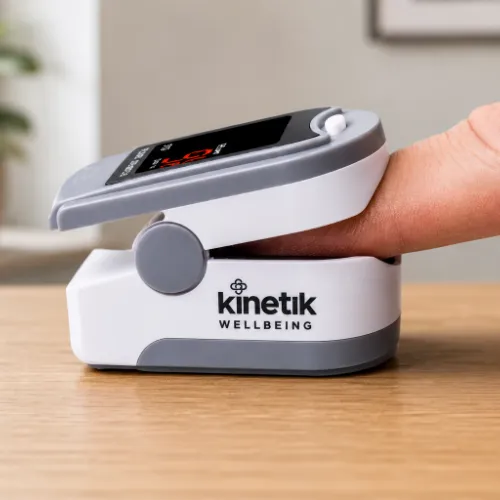
In practical terms, the JPD500E clips onto any fingertip, takes a reading within seconds, and displays both SpO2 and pulse rate clearly on its LED screen. Over 30 hours of continuous monitoring from a single set of batteries means you do not need to worry about constant replacements. The included lanyard allows you to keep the device around your neck for regular monitoring throughout the day. One-button operation means there is no learning curve. The device arrives with batteries included, so you can use it the moment it arrives.
At £27.99 it sits above the cheapest unregulated devices you can find online, and well below clinical-grade devices designed for hospital procurement. For a household wanting a reliable, validated oximeter, it represents the right point on that spectrum.
Monitor your blood oxygen and pulse rate at home
The Kinetik Wellbeing JPD500E is FDA approved, Class IIa certified, and trusted by NHS Scotland. Batteries and lanyard included. Ready to use straight from the box. £27.99 at Zoom Health.
When to seek medical advice based on your readings
Home monitoring is most valuable when you know the thresholds that should prompt action. For SpO2, the key numbers are these. A single reading below 95% is worth noting but may reflect a cold finger or brief movement. Repeat the reading after warming your hand and sitting still. If you consistently record readings below 95% across multiple measurements, speak to your GP. If you record a reading below 90%, particularly alongside any symptoms, treat it as an emergency and seek immediate care.
For pulse rate, a one-off elevated reading during or after exertion is entirely expected. A resting heart rate that is consistently above 100 or below 50, particularly if accompanied by symptoms such as dizziness, chest discomfort, or unusual fatigue, should be discussed with your GP. Do not attempt to diagnose the cause yourself – there are many possible explanations and a clinical assessment is needed.
One practical habit I recommend to anyone starting home monitoring is to establish your personal baseline over a week of consistent readings before drawing any conclusions. What matters is not just the absolute number but whether it is changing – and whether the direction of change is something to act on.
You can find the full range of pulse oximeters and blood pressure monitors on the Zoom Health website. If you are building a home health monitoring kit, pairing a pulse oximeter with a validated blood pressure monitor gives you a strong foundation for keeping track of your cardiovascular health between GP visits.
Anthony Cunningham – Health Writer & Editor
Anthony Cunningham, BA (Hons), MA, is a UK-based health writer and editor with over 20 years’ experience running Zoom Health, a trusted source for home health tests, preventive care, and wellness guidance. He creates clear, evidence-based articles using NHS, NICE, and WHO guidance. Where possible, content is reviewed by practising clinicians to enhance accuracy and reliability, helping readers make informed healthcare decisions.