About This Article
Zoom Health has supplied home health products and test kits to UK customers for nearly 20 years. This article is for general information only and does not constitute medical advice. Any abnormal test results should be discussed with your GP promptly. Always consult a qualified healthcare professional before making changes to your diet, medication or lifestyle based on a home test result. Home health tests are screening tools and are not a substitute for clinical testing.
If you have been told your blood pressure is on the high side, or you simply want to keep a closer eye on your cardiovascular health at home, the first question most people ask me is this: should I buy an upper arm monitor or a wrist monitor? It sounds like a small detail, but the answer matters more than you might expect. The type of monitor you choose affects accuracy, ease of use, and ultimately whether the data you collect is genuinely useful to you and your GP.
I have been supplying blood pressure monitors to UK customers through Zoom Health for nearly 20 years, and in that time I have seen wrist monitors improve dramatically. Early wrist devices had a deserved reputation for inconsistency. The best modern wrist monitors have addressed the main reasons for that, and the Kinetik Wellbeing WBP3 is a good example of how far the technology has come. In this guide I will walk you through the differences between monitor types, explain what to look for in a wrist device, and help you decide which approach suits your situation.
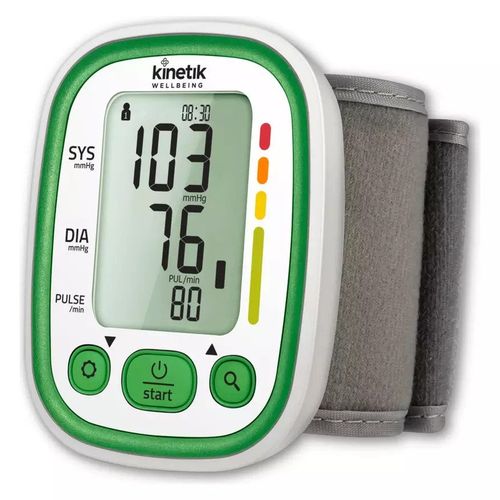
Kinetik Wellbeing Advanced Wrist Blood Pressure Monitor WBP3
Clinically validated. Positioning sensor for accuracy. Averages your last 3 readings as recommended by the British Hypertension Society. Irregular heartbeat detection. In association with St John Ambulance. £24.99
Why monitoring your blood pressure at home is worth doing
Around one in three adults in the UK has high blood pressure, and the NHS estimates that roughly half of those people are undiagnosed. High blood pressure rarely causes noticeable symptoms until serious damage has already occurred, which is why it has earned the label “the silent killer.” Monitoring at home gives you a window into your cardiovascular health that a single GP reading simply cannot provide.
There are two specific phenomena that make home monitoring particularly valuable. The first is white coat hypertension, where blood pressure spikes at the doctor’s surgery due to anxiety but returns to normal at home. This can lead to medication being prescribed unnecessarily. The second is masked hypertension, where readings appear normal in the clinic but are elevated at home. This one is more dangerous because it can go undetected for years. Neither condition shows up reliably from a clinic measurement alone. A validated home monitor used correctly helps detect both.
The phrase “used correctly” is important here, and it is central to the upper arm versus wrist debate – because the biggest historical weakness of wrist monitors was not the technology itself, but the difficulty of consistent positioning.
The positioning problem with wrist monitors – and how it has been solved
For years, the standard guidance was that upper arm monitors were more reliable than wrist devices for home use. The reasoning was straightforward. Blood pressure measurement is sensitive to the height of the cuff relative to the heart. An upper arm cuff, when used seated with the arm resting on a flat surface, naturally sits at roughly the correct height. A wrist monitor requires the user to consciously hold their wrist at heart level during the measurement. Even a few centimetres of difference introduces meaningful error.
The problem was never that wrist monitors could not measure blood pressure accurately. It was that accuracy depended on positioning, and positioning was left entirely to the user. Studies showed that many people, even when instructed carefully, held their wrist too low or too high without realising it.
The Kinetik Wellbeing WBP3 addresses this with a built-in positioning sensor. The monitor detects whether your wrist is at the correct height before taking a reading, and alerts you if it is not. This removes the main source of user error that made earlier wrist devices unreliable. Combined with clinical validation – independent testing against a reference standard – it is a meaningfully different proposition to the wrist monitors of ten years ago.
What makes the Kinetik WBP3 stand out
Clinical validation and the positioning sensor are the two features I would highlight first, but the WBP3 has several other practical strengths worth knowing about.
The monitor automatically takes and averages your last three readings, which is the approach recommended by the British Hypertension Society for home monitoring. A single reading can be affected by a momentary stress response, mild movement, or simply the natural variability that exists in everyone’s blood pressure. Averaging three readings taken over a short period gives a more stable and representative number. Many monitors at this price point take one reading and display it. The WBP3 takes three and gives you the average – which is what the clinical guidance actually recommends.
It also includes an irregular heartbeat detector. This alerts you if the device detects a possible arrhythmia during measurement. It is not a diagnostic tool and any alert should be followed up with your GP, but as an early warning feature it has real value, particularly for people over 50 who are at higher risk of atrial fibrillation.
The 120-reading memory is divided between two users, making it well suited to couples who want to monitor together. The adjustable cuff fits wrists between 13.5 and 21.5cm, which covers the large majority of adults. The display is large and clear, with a simple classification indicator that shows whether your reading falls into the optimal, normal, medium, high, or very high category. At £24.99, it is a well-specified device at a competitive price point, and it carries the backing of St John Ambulance, whose association with Kinetik reflects a shared focus on accessible, practical health monitoring.
Upper arm monitors – when they remain the better choice
I want to be balanced here rather than simply advocate for one type over the other. Upper arm monitors remain the clinical default for good reasons, and there are situations where I would still recommend one.
If you have been prescribed medication for hypertension and your GP is using your home readings to adjust your dosage, an upper arm monitor at the brachial artery remains the most comparable measurement to what is taken in the surgery. The clinical literature on antihypertensive treatment thresholds is based predominantly on upper arm readings, and where precision really matters, that context is relevant.
Similarly, if you have a wrist circumference outside the 13.5 to 21.5cm range of the Kinetik cuff, you will need to check the specifications of whichever device you are considering. Cuff fit is critical regardless of monitor type.
For general health monitoring, early detection of trends, travel use, or shared monitoring between two people, a clinically validated wrist monitor with a positioning sensor is a perfectly sound choice. The key word throughout is “validated.” A cheap, unvalidated wrist monitor from an unrecognised brand is a different product entirely and one I would not recommend. Clinical validation is non-negotiable.
How to use a wrist monitor correctly
Even with the WBP3’s positioning sensor doing much of the work, good technique still matters. These are the principles I share with all customers who are new to home monitoring.
Sit quietly for five minutes before taking a reading. Do not measure immediately after exercise, caffeine, a cigarette, or a stressful moment. Sit with your back supported and feet flat on the floor. Fit the cuff snugly around your wrist, with the monitor unit on the inside of your wrist. Raise your forearm so your wrist is level with your heart – the positioning sensor will confirm when you have this right. Keep still and breathe normally during the measurement.
Take readings at consistent times each day. The British Hypertension Society recommends morning and evening, before meals and before any medication where possible. Record every reading. If you are preparing for a GP appointment, seven consecutive days of twice-daily readings gives your doctor a far more useful picture than any number of individual readings taken in the surgery. This seven-day average is the standard that clinical guidelines are built around.
Understanding what your readings mean
Blood pressure is expressed as two numbers, for example 120/80 mmHg. The top number is systolic pressure – the force exerted when your heart beats and pushes blood into your arteries. The bottom number is diastolic pressure – the force when your heart relaxes between beats.
For home readings, the NHS and British Hypertension Society use the following classifications. Below 120/80 is optimal. Between 120/80 and 129/84 is normal. Between 130/85 and 139/89 is described as high normal. At or above 140/90 home readings should be discussed with your GP – this is the hypertension threshold for clinic measurement, and a home equivalent of around 135/85 is considered similarly significant, since home readings tend to run slightly lower than clinic readings in most people. If you record a reading at or above 180/120, this represents a hypertensive crisis and requires immediate medical attention. Call 999.
The WBP3’s built-in classification indicator shows you where your reading sits in real time, which is a useful feature if you are not yet familiar with the numbers.
Start monitoring your blood pressure at home
The Kinetik Wellbeing WBP3 is clinically validated, compact, and built for accurate wrist monitoring with a positioning sensor that removes the guesswork. £24.99 at Zoom Health.
When to involve your GP
Home monitoring is a supplement to professional care, not a replacement for it. If your seven-day average is consistently at or above 135/85, bring your log to your GP. Note the times of each reading, the readings themselves, and any relevant context such as a disturbed night’s sleep or an unusually stressful day.
If at any point the irregular heartbeat indicator activates repeatedly across multiple readings, mention this to your GP. Occasional alerts can occur due to movement or an awkward reading, but repeated alerts across calm, correctly positioned measurements may warrant an ECG.
For most people, home monitoring is reassuring and informative rather than alarming. The goal is to understand your baseline, spot trends early, and give your GP better data to work with. A clinically validated wrist monitor with a positioning sensor, used consistently with good technique, is one of the most practical health investments you can make.
You can browse our full range of blood pressure monitors on the Zoom Health website, and if you have any questions about which device suits your needs, our team is happy to help.
Anthony Cunningham – Health Writer & Editor
Anthony Cunningham, BA (Hons), MA, is a UK-based health writer and editor with over 20 years’ experience running Zoom Health, a trusted source for home health tests, preventive care, and wellness guidance. He creates clear, evidence-based articles using NHS, NICE, and WHO guidance. Where possible, content is reviewed by practising clinicians to enhance accuracy and reliability, helping readers make informed healthcare decisions.