About This Article
Zoom Health has supplied home health products and drug testing kits to UK customers for nearly 20 years. This article is for general information only and does not constitute legal or medical advice. Home drug tests are screening tools only – any positive result should be confirmed by laboratory analysis before conclusions are drawn. If you are concerned about a young person’s drug use, we encourage you to seek support from a qualified professional alongside any testing you carry out.
Of all the conversations I have had over the years about drug testing, the ones that stay with me most are from parents. They are not HR managers following a policy or safety officers managing compliance – they are people who are frightened, uncertain, and trying to work out whether the child they love is using drugs. That is a very different starting point from a workplace testing context, and it calls for a very different kind of guidance.
Home drug testing for teenagers and young adults is a genuinely contested subject. There are parents who swear by it as a deterrent that gave their child a socially acceptable reason to say no. There are young people who say it destroyed trust in their family. There are professionals on both sides of the debate. I am not going to pretend there is a clean, settled answer. What I am going to do is give you the most honest and practical guide I can to what home testing can and cannot achieve, how to approach it in a way that is least likely to cause lasting damage, and which products are most appropriate if you decide testing is the right step for your family.
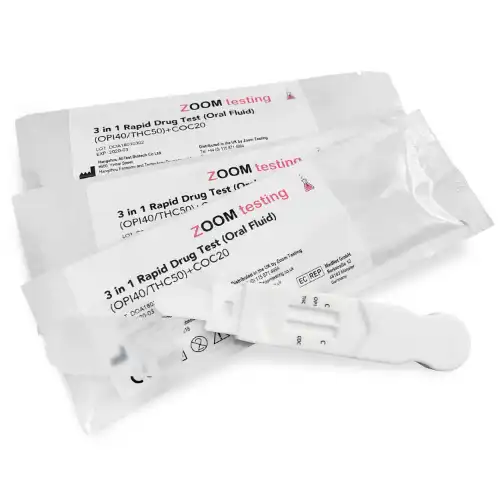
3 in 1 Saliva Drug Test Kit – £6.99 (on sale from £7.99) | Tests for cannabis, cocaine and heroin | Results in minutes | Non-invasive oral test | Impossible to tamper with | UK-designed panel | 99% accurate
Why Parents Consider Drug Testing in the First Place
Drug use among teenagers in the UK is neither rare nor evenly distributed. Around one in five 15-year-olds in England has tried an illegal drug at least once, according to NHS data, and cannabis is by far the most common first drug. By the mid to late teens, experimentation with other substances – cocaine, MDMA, ketamine – becomes more common, particularly in certain social environments. Most young people who try drugs do not go on to develop problematic patterns of use, but some do, and the difference between those two outcomes is not always visible to parents until it has already caused significant harm.
The warning signs that typically prompt parents to consider testing are a cluster of changes rather than any single indicator: unexplained money disappearing, altered sleep patterns, withdrawal from family activities, a change in social circle, declining school or work performance, mood shifts that seem disproportionate or sudden. None of these individually proves drug use – all of them have other explanations – but together they can create a picture that a parent cannot ignore.
Testing sometimes enters the picture not because a parent wants to catch a young person out, but because they want to rule drug use in or out as one possible explanation for what they are observing. In that context, a home test is a tool for clarity rather than a surveillance measure. It is worth holding onto that framing, because it shapes how a testing conversation goes and whether the outcome is productive.
What Testing Can and Cannot Tell You
Before choosing a test or having a conversation about testing, it is worth being honest with yourself about what the result will and will not tell you. This matters because the limitations of home testing are significant, and acting as though a result is more definitive than it actually is can cause serious harm to a young person and to your relationship with them.
A positive result tells you that a particular drug or its metabolites were present in the sample above a detection threshold. For a urine test, this means use occurred at some point within the detection window – which could be the previous evening or, in the case of cannabis, as long as a month ago for a regular user. For a saliva test, the window is much narrower – 8 to 24 hours for most substances. A positive result does not tell you how much was used, how often, in what context, whether it was a one-off experience at a party or a daily habit, or whether the young person is in any difficulty as a result.
A negative result tells you that drug levels were below the detection threshold at the time of testing. It does not confirm that drugs have never been used, or that they will not be used in future. Someone who used cannabis two months ago and has not used since will test negative, as will someone who used cocaine four days ago and has since cleared the substance from their system.
The test result, in other words, is a data point – a narrow one. It is most useful as a starting point for a conversation, not as a conclusion.
The Consent Question: Should You Test Without Your Child’s Knowledge?
This is the most difficult ethical question in parental drug testing, and I want to address it directly rather than sidestepping it. In the UK, there is no specific legal provision that gives parents the right to test a minor without their consent, and a child over the age of around 13 to 16 – depending on circumstances and what is known as Gillick competence – has an increasing legal right to make decisions about their own body. That said, parents of younger teenagers are in a different position from those dealing with a 17-year-old approaching adulthood.
The more important consideration is not legal but practical. Drug testing carried out covertly – testing a drink, testing a hair sample without consent, or pressing for a urine sample under a false pretext – risks severe and lasting damage to trust if the young person finds out, which they often do. It also bypasses the main mechanism through which testing can actually help: the explicit, acknowledged accountability that comes from a young person knowing they may be tested. Research and clinical experience consistently show that the deterrent effect of testing depends on the young person knowing about it.
The approach that most drug and alcohol professionals would recommend is transparency: having an honest conversation about your concerns, explaining that you want to understand what is happening, and presenting testing as part of a framework of accountability that the young person agrees to – not something done to them in secret. That conversation is harder than testing without knowledge, but its outcomes are considerably better.
Testing as a Deterrent: The Evidence and the Reality
One of the most commonly cited reasons for home drug testing by parents is deterrence. The logic is appealing: if a young person knows they may be tested at any time, they have a concrete, socially acceptable reason to decline when offered drugs. “I can’t – my parents test me” is a simple exit from a peer pressure situation that can be difficult to navigate otherwise.
There is genuine support for this approach in clinical and prevention literature. Organisations working in youth drug prevention have found that the existence of a testing programme – known to the young person and framed as protective rather than punitive – can function as a meaningful deterrent for some individuals in some circumstances. It works best when it is part of a broader framework of open communication, clear expectations, and consistent consequences, rather than standing alone as the sole parental response to drug concerns.
What the evidence does not support is the idea that testing alone solves drug use problems. For a young person who is using drugs regularly as a way of coping with something more difficult – stress, anxiety, social difficulties, trauma – a testing programme without support around it is unlikely to address the underlying issue. In some cases it can push use underground, increase conflict, and reduce the likelihood that the young person will seek help when they need it. Testing is a tool, not a solution.
Choosing the Right Test for a Parental Context
The most important choice in a parental testing context is between a saliva test and a urine test, because they answer fundamentally different questions. I covered this in detail in Post 1 of this series, but the key points are worth restating here.
A saliva test tells you about very recent use – within the last 8 to 24 hours for most substances. If your primary concern is whether a young person used drugs last night, or whether they are currently impaired, a saliva test is the more informative tool. It is also harder to cheat – saliva cannot be swapped or diluted, and the collection happens in plain sight. The 3 in 1 Saliva Drug Test (£6.99, on sale from £7.99) is specifically designed for the UK market, testing for the three most commonly used street drugs in Britain – cannabis, cocaine, and heroin/opiates. The cannabis cut-off is 12ng/mL, which is extremely sensitive. Collection takes three minutes under the tongue, results appear shortly afterwards, and the test requires no specialist equipment or private facilities.
A urine test gives you a wider detection window – 3 to 5 days for most substances, and up to 30 days for cannabis in a regular user. If your concern is about ongoing patterns of use rather than a specific recent incident, a urine test will pick up more. The trade-off is the collection process and the potential for sample adulteration, both of which are more relevant in a family context than in a supervised workplace setting.
For parents who want the broader substance coverage of a urine test but are specifically concerned about the kinds of drugs most common among young UK adults, the 10 Panel Drug Test with Spice and Nicotine (£8.99) is the most comprehensive single-test option, covering cannabis, cocaine, MDMA, ketamine, synthetic cannabinoids, amphetamines, benzodiazepines, methamphetamine, opiates, and nicotine – essentially everything most likely to be encountered in a youth context in the UK.
Single-Drug Tests: When a Targeted Screen Makes More Sense
For parents who have a specific, well-founded concern about one particular substance rather than a general worry about drug use, a single-drug test can be a more proportionate and less confrontational option than a comprehensive multi-panel screen. Zoom Health stocks single-drug urine tests for a range of individual substances, including a dedicated Cannabis Drug Test Kit from £2.49, which is the most likely first substance of concern for most parents of teenagers.
A single-drug test communicates a specific concern rather than blanket suspicion across all drug categories, which can feel less accusatory and be easier to frame as a focused conversation rather than a broad interrogation. It is also considerably less expensive if regular testing over an extended period is being considered.
10 Panel Drug Test with Spice and Nicotine – £8.99 | The most comprehensive single test for a youth context | Covers cannabis, cocaine, MDMA, ketamine, Spice, amphetamines, benzodiazepines, methamphetamine, opiates and nicotine
How to Have the Conversation
The conversation around drug testing is, in most cases, more important than the test result itself. How you introduce testing, what you say when you get a result, and how you respond over time will shape whether the process brings you and your child closer to understanding each other or drives a wedge between you.
A few principles worth holding onto. Lead with concern, not accusation. “I have noticed some changes and I am worried about you” is a very different opening from “I think you are taking drugs and I am going to prove it.” The first invites honesty. The second closes it down. Be clear about what you are doing and why, including the fact that you are going to use a test, before you do it. Explain that the test is part of trying to understand what is happening, not a punishment. If the result is positive, resist the urge to react immediately and significantly. Ask questions first. Listen to the answers. A positive result for cannabis in a 16-year-old who tried it once at a party three weeks ago is a very different situation from one that reflects daily use, and they call for very different responses.
If the conversation is not going well, or if a positive result reveals something that feels beyond your ability to address alone, there are good resources available in the UK. FRANK (talktofrank.com) provides honest, non-judgmental information and a helpline for both young people and parents. Adfam (adfam.org.uk) specifically supports families affected by drug and alcohol use. Your GP can also provide a referral to local drug and alcohol services if professional support is needed.
A Note on Privacy and How You Store Results
Drug test results – even home results – constitute sensitive personal information. How you store, share, or act on a result matters both ethically and practically. For a parent, this primarily means being thoughtful about who else in the family knows about testing and results, keeping any documentation in a genuinely private place, and being clear in your own mind about the circumstances under which you would share a result with someone outside the immediate family – a school, a GP, another professional. Sharing results without the young person’s knowledge or consent, except in situations of genuine immediate risk to their safety or someone else’s, is a step that should be taken carefully and with professional guidance.
The 3 in 1 Saliva Drug Test Kit is currently on sale at £6.99 – designed specifically for the UK market, non-invasive, and ready to use without specialist equipment.
Featured in this article:
- 3 in 1 Saliva Drug Test Kit (Cannabis, Cocaine, Heroin) – £6.99 (on sale)
- 10 Panel Drug Test with Spice and Nicotine – £8.99
- Cannabis Drug Test Kit – Urine – From £2.49
- 10 Panel Drug Screen with Ketamine – £7.99
Related Articles
Anthony Cunningham – Health Writer & Editor
Anthony Cunningham, BA (Hons), MA, is a UK-based health writer and editor with over 20 years’ experience running Zoom Health, a trusted source for home health tests, preventive care, and wellness guidance. He creates clear, evidence-based articles using NHS, NICE, and WHO guidance. Where possible, content is reviewed by practising clinicians to enhance accuracy and reliability, helping readers make informed healthcare decisions.