About This Article
Zoom Health has supplied home health products and drug testing kits to UK customers for nearly 20 years. This article is for general information only and does not constitute legal or medical advice. Drug testing in the workplace is subject to UK employment law; always seek qualified legal guidance before implementing a testing programme. Test results should be interpreted in context, and any positive result should be confirmed by laboratory analysis before action is taken.
When most people think about drug testing, they picture the substances that have been part of the conversation for decades: cannabis, cocaine, heroin, amphetamines. The standard 5-panel test was designed around precisely those drugs, and for a long time it covered the main bases reasonably well. But UK drug use patterns have shifted considerably over the past ten to fifteen years, and the testing landscape has not always kept pace.
Two categories of drug have created the most significant gaps in standard testing programmes. The first is ketamine – a dissociative anaesthetic that has moved from the margins of UK club culture to become one of the most widely used recreational substances among young adults, and which remains entirely absent from most off-the-shelf testing panels. The second is synthetic cannabinoids – sold under names like Spice, Mamba, and K2 – which mimic the effects of cannabis but are chemically unrelated to THC and completely invisible to a standard cannabis test strip.
In this post I want to explain what these substances are, why they matter in a workplace and family testing context, why standard panels miss them, and which products we stock at Zoom Health that are actually equipped to detect them.
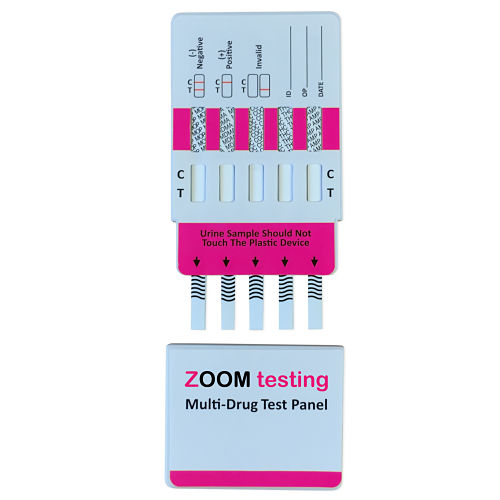
10 Panel Drug Test with Spice and Nicotine – £8.99 | The only UK multi-panel test screening for synthetic cannabis (K2/Spice), ketamine AND nicotine simultaneously | Results in 5 minutes | 99% accurate
Ketamine in the UK: From Fringe to Mainstream
Ketamine was developed in the 1960s as a surgical anaesthetic and remains in clinical use today, particularly in emergency medicine and veterinary practice. Its dissociative effects – the feeling of detachment from one’s surroundings and body that users describe as a “k-hole” at higher doses – made it a fixture of UK rave and club culture from the 1990s onwards. For many years it was seen as a niche substance associated with specific subcultures. That is no longer an accurate characterisation.
Survey data from the Crime Survey for England and Wales consistently shows ketamine as one of the most commonly used drugs among 16 to 24 year olds, with usage rates in that age group running at roughly four times the rate for the general adult population. Use has also spread beyond the traditional club scene into more everyday social contexts. The Office for National Statistics and drug harm reduction organisations have both flagged a rise in ketamine-related hospital admissions and presentations to treatment services over the past several years, including cases of ketamine-induced bladder damage – a serious and irreversible condition associated with heavy chronic use.
Ketamine was reclassified from Class C to Class B in the UK in 2014, meaning possession carries a maximum of five years in prison and supply up to 14 years. Despite this, it remains widely available and relatively affordable compared to cocaine, which contributes to its popularity among younger users.
For employers, the implication is straightforward but significant: if you are running a testing programme that does not include a ketamine panel, and you have a workforce that skews young or works in sectors where ketamine use is prevalent – hospitality, retail, creative industries, delivery, warehousing – you are very likely missing drug use that is actually occurring. A negative result on a standard 5-panel test that does not include ketamine tells you nothing about whether someone has used one of the most common recreational drugs among UK young adults.
What Ketamine Does to Workplace Performance
Understanding why ketamine matters in a workplace context requires a brief look at what it actually does to the user. In lower recreational doses, ketamine produces feelings of detachment, altered perception of time and space, mild euphoria, and impaired coordination. Reaction times slow. Cognitive processing, decision-making, and spatial awareness are all affected. Fine motor control is reduced. At higher doses, the dissociative effects intensify significantly.
The duration of acute impairment from a recreational dose is relatively short – typically one to two hours. However, residual effects on concentration, coordination, and cognitive function can persist for considerably longer. And unlike many other substances, heavy regular ketamine use produces a distinctive pattern of tolerance and dependency that can affect baseline cognitive function even when the user is not actively intoxicated. The bladder damage associated with chronic heavy use is a separate and serious health concern that is beginning to present as an occupational health issue in some workplaces.
For safety-critical roles – operating machinery, driving vehicles, working at height, making time-sensitive decisions – the impairment profile of ketamine is a genuine workplace hazard. The fact that standard tests miss it entirely means that employers in those sectors who do not specifically include a ketamine panel are operating a testing programme that provides significantly less protection than they may believe.
Synthetic Cannabinoids: The Testing Blind Spot That Standard Cannabis Tests Cannot See
Synthetic cannabinoids are a family of man-made chemicals that act on the same brain receptors as THC – the active compound in natural cannabis – but are structurally unrelated to it. They were originally developed in research laboratories studying the endocannabinoid system, but the formulas were published and quickly exploited to create products sold, initially legally, as “herbal smoking blends” or “legal highs” under brand names including Spice, Mamba, Black Mamba, and K2.
The Psychoactive Substances Act 2016 banned the production, supply, and import of synthetic cannabinoids and most other so-called legal highs in the UK. They are no longer legal, but they remain widely available on the illicit market and are particularly prevalent in certain specific contexts: prisons, where they are extremely difficult to detect through mail screening; hostels and homeless populations, where their low cost and intense effects have made them a serious problem; and youth settings, where the mistaken belief that they are “legal weed” persists despite the change in law.
The critical testing issue is this: a standard cannabis test strip detects THC-COOH, a metabolite of delta-9-tetrahydrocannabinol, the active compound in natural cannabis. Synthetic cannabinoids do not contain THC. They produce completely different metabolites. A standard cannabis test, no matter how sensitive, cannot detect synthetic cannabinoid use – a person who has been using Spice heavily will test completely clean on a standard cannabis panel. This is not a limitation of sensitivity; it is a fundamental chemistry difference. The only way to detect synthetic cannabinoid use is a test that includes a specific synthetic cannabinoid panel.
The Effects of Synthetic Cannabinoids and Why They Are More Dangerous Than Natural Cannabis
Synthetic cannabinoids bind to the same cannabinoid receptors as THC but do so with much greater potency – often 10 to 100 times more potent than THC – and with full agonist activity rather than the partial agonism of natural cannabis. In practical terms, this means the effects are considerably more intense, less predictable, and more likely to produce serious adverse reactions even at modest doses.
Adverse effects reported with synthetic cannabinoid use include severe agitation, paranoia, psychosis, seizures, loss of consciousness, cardiovascular events, and acute kidney injury. Emergency admissions linked to synthetic cannabinoid use are substantially more serious on average than those linked to natural cannabis. The highly variable potency of street products – different batches may have dramatically different concentrations – makes dosing unpredictable and the risk of accidental overdose considerably higher.
For employers and parents, this risk profile underlines why detecting synthetic cannabinoid use matters. A workplace employee or young person using Spice is at significantly greater risk of an acute adverse event than one using natural cannabis, and yet they will pass a standard cannabis test entirely. The combination of greater harm potential and testing invisibility makes this a category of drug that deserves specific attention in any serious testing programme.
The 10 Panel Drug Test with Spice and Nicotine: Closing the Gap
The 10 Panel Drug Test with Spice and Nicotine (£8.99) is the only multi-panel test currently available on the UK market that simultaneously screens for synthetic cannabis (K2/Spice), ketamine, and nicotine alongside the core range of traditional substances. That combination makes it the most comprehensive rapid screening option for anyone whose primary concern is the gap between what standard tests detect and what is actually being used.
The full panel covers: amphetamines, benzodiazepines, cocaine, cotinine (the nicotine metabolite), ketamine, synthetic cannabis (K2/Spice), MDMA/ecstasy, methamphetamine, opiates/heroin, and traditional cannabis (THC). Results appear within 5 minutes using a standard urine cassette format, accuracy is 99%, and the test meets SAMHSA standards. Individual kits are foil-wrapped and shelf-stable for 12 to 18 months at room temperature.
The inclusion of cotinine – the metabolite that reveals tobacco and nicotine use – is relevant for a specific set of contexts. Healthcare employers, childcare settings, and some fire services have policies around smoking that may extend to candidates or current staff. Being able to screen for nicotine use at the same time as a comprehensive drug panel, in a single test, is a practical convenience that eliminates the need for a separate cotinine test.

10 Panel Drug Screen with Ketamine – £7.99 | Screens for ketamine, buprenorphine and methadone alongside the core substances | Results in 5 minutes | 99% accurate
Choosing Between the Two 10-Panel Options
With two 10-panel tests available, the choice comes down to what you need to detect and in what context.
The 10 Panel Drug Screen with Ketamine (£7.99) is the stronger choice for formal workplace testing programmes, particularly in safety-critical industries. Its panel – amphetamines, cannabis, cocaine, benzodiazepines, buprenorphine, ketamine, methamphetamine, morphine, opiates, and methadone – covers the substances most relevant to a general UK workforce with an emphasis on opioid variants, including buprenorphine, which is missed by most panels. At £7.99 it also offers better value for organisations running high-volume screening.
The 10 Panel Drug Test with Spice and Nicotine (£8.99) is the stronger choice when synthetic cannabinoids are a specific concern – in youth-facing contexts, custodial or residential settings, or any environment where Spice use is known or suspected – and when nicotine screening is also relevant. The trade-off is that it includes MDMA and methamphetamine in place of buprenorphine and methadone, making it slightly less comprehensive for opioid variant detection but more comprehensive for synthetic and party drug detection.
For organisations that want to cover both bases, running the two tests in combination – or selecting the appropriate one based on the specific role being screened – is entirely practical given the modest per-test cost of each.
Detection Windows for Ketamine and Synthetic Cannabinoids
Ketamine is detectable in urine for approximately 2 to 4 days following use in most individuals, though this varies with dose, frequency, and individual metabolism. Heavy chronic use can extend this window, and metabolites have been detected beyond 14 days in some studies of heavy users. For standard workplace screening, a 2 to 5 day detection window is a reasonable working assumption.
Synthetic cannabinoids are considerably more variable. Detection windows depend heavily on which specific compound was used, since the synthetic cannabinoid family contains dozens of distinct chemicals with different metabolic profiles. For most commonly encountered compounds, urine detection is possible for 2 to 3 days following single use, but some metabolites persist longer. The detection technology in rapid screening tests targets the most common synthetic cannabinoid metabolites, but given the constantly evolving chemistry of illicit Spice products, no rapid test can guarantee detection of every possible variant. A negative result significantly reduces the probability of recent use but, unlike a negative THC result for natural cannabis, cannot be taken as an absolute guarantee.
What Employers Should Do Now
If your current testing programme uses a standard 5-panel that does not include ketamine, and you employ anyone under 35 in any capacity, the most practical single step you can take is upgrading to a test that includes a ketamine panel. The 10 Panel Drug Screen with Ketamine at £7.99 does this at a cost premium of roughly £2 per test over a standard 5-panel – a minor outlay for a significant reduction in your testing blind spot.
If your workforce includes younger employees, works in or near a custodial or youth-facing environment, or if you have specific reason to be concerned about synthetic cannabinoid use, the 10 Panel Drug Test with Spice and Nicotine closes the additional gap that standard cannabis testing leaves entirely open.
In both cases, the same principles apply as throughout this series: a positive screening result is the start of a process, not the end of one. Confirmatory GC/MS laboratory testing is required before formal action, and a fair procedural framework must be in place. The value of these extended panels is in ensuring that your screening net is wide enough to catch what is actually being used.
The only UK multi-panel test screening for Spice, ketamine and nicotine in one – browse both 10-panel options at Zoom Health.
Featured in this article:
Related Articles
Anthony Cunningham – Health Writer & Editor
Anthony Cunningham, BA (Hons), MA, is a UK-based health writer and editor with over 20 years’ experience running Zoom Health, a trusted source for home health tests, preventive care, and wellness guidance. He creates clear, evidence-based articles using NHS, NICE, and WHO guidance. Where possible, content is reviewed by practising clinicians to enhance accuracy and reliability, helping readers make informed healthcare decisions.