About This Article
About This Article: Zoom Health has supplied home health products and hearing protection to UK customers for nearly 20 years. This guide draws on our experience helping thousands of people improve their sleep, protect their hearing, and find the right earplug for their needs. Always consult a healthcare professional if you experience ear pain, hearing loss, or recurring ear problems.
Published: 30 April 2026 | By: Anthony Cunningham
Travel fatigue is a real and well-documented phenomenon – and noise is one of its most significant drivers. A commercial aircraft cabin at cruising altitude generates 80 to 85dB of continuous engine and airflow noise. Airport concourses, busy transit systems and city centre hotels add further layers of noise exposure that accumulate across a journey and compound the physiological stress of travel itself. The solution most people reach for is noise-cancelling headphones – effective for active noise cancellation of low-frequency hum, but bulky, battery-dependent and impractical for sleeping. A well-chosen pair of earplugs is lighter, simpler, requires no charging, and in many travel scenarios performs as well or better than headphones at a fraction of the cost and weight.
The challenge with travel earplugs is that a single journey can present several distinct noise environments – the aircraft cabin, the hotel room, the transit system – each with different noise characteristics, different duration demands and different social contexts. Understanding which earplug is best suited to each scenario is more useful than looking for a single “best travel earplug”.
The Three Travel Noise Scenarios
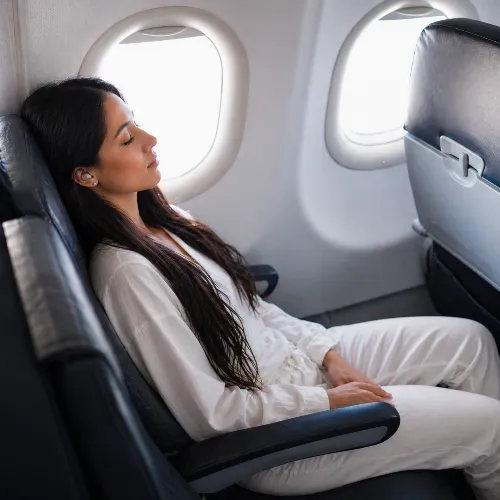
The aircraft cabin presents sustained low-to-mid frequency noise at 80 to 85dB for the duration of the flight. The priority is comfort across several hours, including the possibility of sleeping in an upright or reclined seat position with the head resting against a window or headrest. An earplug pressed between the ear and seat padding during sleep needs low outward pressure to remain comfortable. NRR 28 to 32dB is more than adequate for aircraft cabin noise – higher attenuation is unnecessary and the comfort trade-off with firmer foam is not worth making in this context.
The hotel room presents intermittent noise – traffic, other guests, air conditioning cycles, unfamiliar building sounds – that is particularly disruptive because it is unpredictable and the brain is already in an unfamiliar acoustic environment. Hotel sleep is frequently lighter and more disturbed than home sleep even without exceptional noise, so a snoring partner or thin walls can push disruption above what would be tolerable at home. NRR 30 to 35dB is appropriate here, and comfort across a full night’s sleep is the primary priority.
Transit and waiting environments – airports, train stations, underground systems – present high-energy but temporary noise exposure where situational awareness matters for safety and navigation. Moderate attenuation of 20 to 28dB is appropriate, allowing meaningful noise reduction without the isolation that would cause you to miss a departure announcement or a platform change.
Our Top Picks for Travel Earplugs
Best for Flights: Mack’s Slim Fit Foam Earplugs
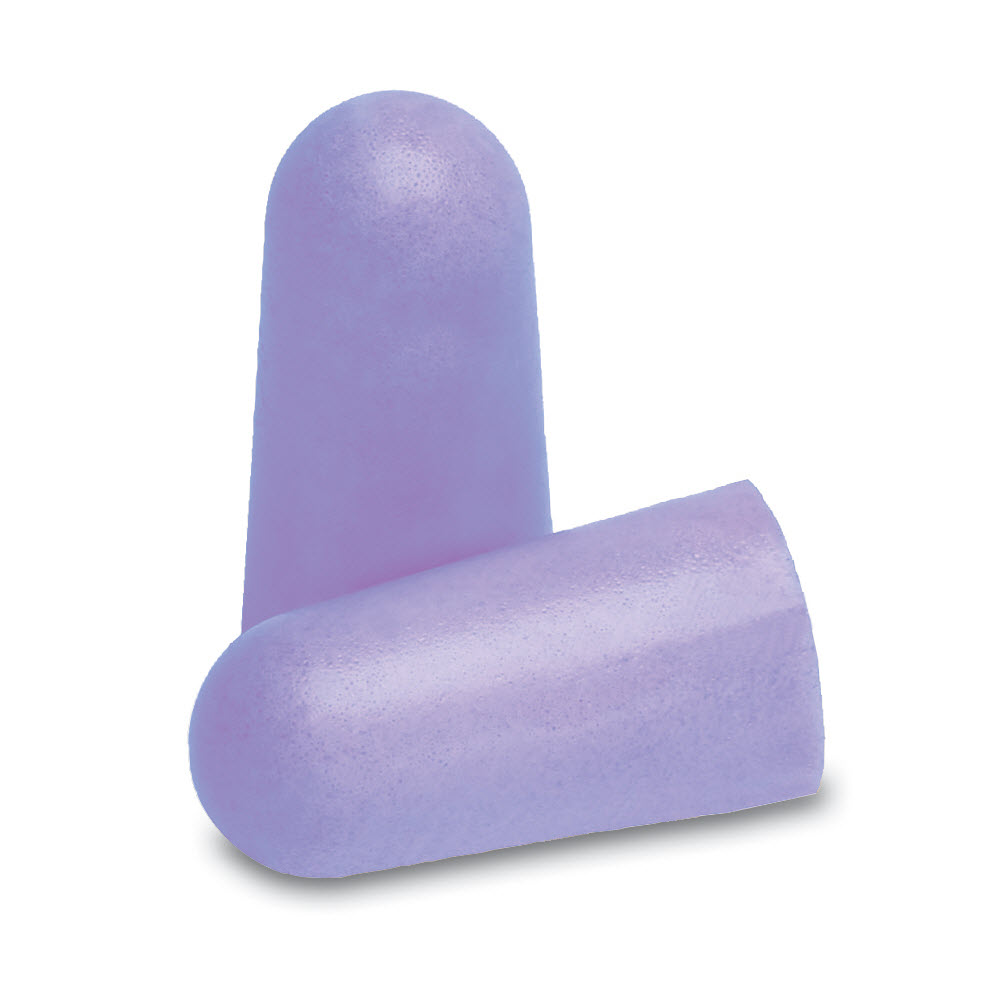
The Mack’s Slim Fit Foam Earplugs are my top choice specifically for in-flight use. The super low-pressure slow-release foam exerts minimal outward force against the ear canal wall, which makes them significantly more comfortable when the ear is pressed against a seat headrest or window during cabin sleep – a scenario that causes pressure discomfort with higher-outward-force foams. The slim profile sits unobtrusively in the ear without protruding, and the NRR 29dB rating is precisely the right level of attenuation for a cabin environment – enough to make engine noise manageable and sleep achievable, without the over-isolation of higher-rated options. The eco organza storage bag makes them the best-packaged disposable foam earplug in our range for travel – easy to locate in a bag or washbag without unwrapping individual packaging.
NRR 29dB | Ultra low-pressure foam | Slim profile | Organza storage bag | Buy from Zoom Health – from £3.49
Best for Hotel Sleep: Moldex Pura Fit Earplugs
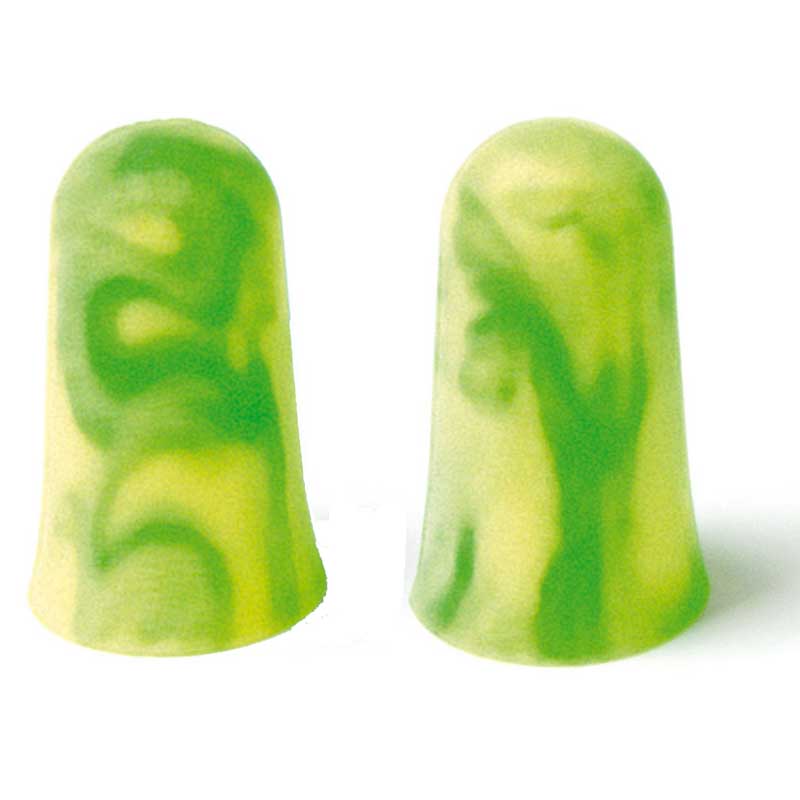
For hotel room sleeping – where the noise environment is less predictable and the need for full-night comfort is paramount – the Moldex Pura Fit is the strongest choice. The anchoring taper keeps the earplug in position through the restless sleep that often accompanies unfamiliar hotel beds, and the super-soft low-pressure foam provides the all-night comfort that makes the difference between an earplug you keep in until morning and one you remove at 3am. At SNR 33dB it provides meaningful attenuation against city noise, thin hotel walls and inconsiderate neighbouring guests. The biodegradable paper pouch packaging is also the most travel-friendly of our disposable options – compact, lightweight and recyclable rather than adding plastic to a travel bag. I carry these on every trip I take.
SNR 33dB | Anchoring taper | All-night comfort | Biodegradable packaging | Buy from Zoom Health – from £2.99
Best for Transit: Moldex Mellows Earplugs
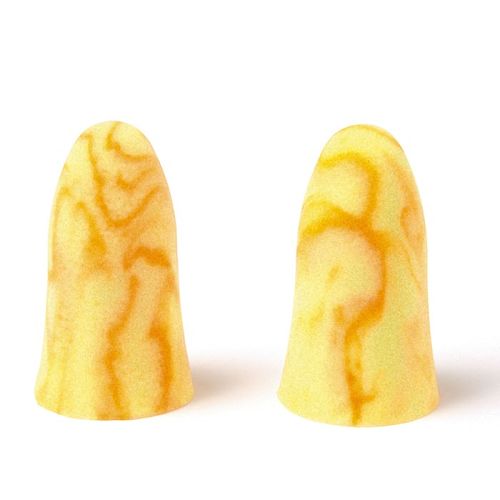
For airports, metro systems, busy train stations and city transit – environments where noise reduction aids comfort and reduces fatigue but situational awareness remains important – the Moldex Mellows at SNR 22dB hit the right attenuation level. They reduce the ambient roar of a busy airport concourse or underground station to a comfortable background level while leaving you fully able to hear departure announcements, platform changes, and conversations with travel companions or staff. The extra-soft, extra-light foam makes them comfortable for extended transit wear across a full travel day, and their small profile means they sit discreetly in the ear without drawing attention. For business travellers who want to reduce the fatiguing effect of transit noise across a long journey day without isolating themselves from their environment, these are a particularly smart choice.
SNR 22dB | Awareness-preserving | All-day transit comfort | Small profile | Buy from Zoom Health – from £1.99
Best All-in-One Travel Option: Noise-x Natural Wax Earplugs
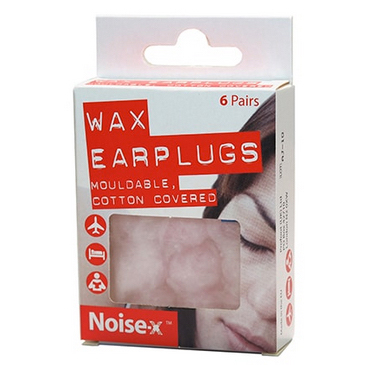
If you want a single earplug solution that travels well across all three scenarios and suits the specific demands of travel above all else, the Noise-x Natural Wax Earplugs are a compelling choice. Mouldable wax earplugs sit at the canal entrance rather than inside it – no compression, no expansion, no technique to master – which makes them significantly easier to use in the conditions travel presents: on a darkened aircraft, in an airport bathroom, with cold or slightly clumsy hands after a long journey. The custom-fit moulding means they adapt to your specific ear each use, and the carry case that comes with each pack keeps them clean in a travel bag without the debris accumulation that loose earplugs collect. At SNR 20dB they sit at the lighter end of the attenuation range, but for the majority of travel noise environments – particularly hotel room sleeping and cabin noise – 20dB is entirely adequate. Their natural materials also mean there is no foam degradation, no expansion timing to manage, and no technique barrier for first-time earplug users who encounter them mid-journey.
SNR 20dB | No insertion technique | Custom-fit moulding | Carry case | Natural materials | Buy from Zoom Health – from £3.49
What to Pack: A Practical Travel Earplug Kit
My recommendation for frequent travellers is to carry two types rather than one. A pack of the Mack’s Slim Fit or Moldex Pura Fit for flight and hotel sleeping – where comfort across extended wear and meaningful attenuation are the priorities – and a pack of the Moldex Mellows or wax earplugs for transit use, where awareness matters as much as attenuation. The combined weight and volume of two small earplug packs is negligible in any travel bag, and having the right tool for each environment removes the compromise of trying to make a single earplug work for scenarios with different requirements.
A Note on Ear Pressure During Flights
Earplugs do not prevent the ear pressure changes associated with aircraft ascent and descent – these are caused by the equalisation of pressure between the middle ear and the cabin environment, which occurs through the Eustachian tube rather than the ear canal. If you experience significant ear discomfort during pressure changes, swallowing, yawning or chewing gum are the most effective responses. Earplugs may slightly modify the sensation of pressure change but should not be relied upon as a solution for significant pressure discomfort – if this is a persistent issue for you, consult your GP before flying.
Try Before Your Next Trip
Our Men’s Earplugs Sample Pack and Women’s Earplugs Sample Pack both include the Moldex Mellows, Pura Fit, Mack’s Slim Fit and Noise-x Wax earplugs alongside 11 other options – an excellent way to test each recommendation in your own environment before committing to travel quantities.
Travel better with the right earplugs
Try all the options in our Women’s Earplugs Sample Pack or Men’s Earplugs Sample Pack – 15 pairs each, including all the travel recommendations above.
About the Author
Anthony Cunningham – Health Writer & Editor
Anthony Cunningham, BA (Hons), MA, is a UK-based health writer and editor with over 20 years’ experience running Zoom Health, a trusted source for home health tests, preventive care, and wellness guidance. He creates clear, evidence-based articles using NHS, NICE, and WHO guidance. Where possible, content is reviewed by practising clinicians to enhance accuracy and reliability, helping readers make informed healthcare decisions.