About This Article
About This Article: Zoom Health has supplied home health products and hearing protection to UK customers for nearly 20 years. This guide draws on our experience helping thousands of people improve their sleep, protect their hearing, and find the right earplug for their needs. Always consult a healthcare professional if you experience ear pain, hearing loss, or recurring ear problems.
Published: 10 April 2026 | By: Anthony Cunningham
Yesterday on Day 7 I made the case for the Moldex Contours Small as the solution for men with narrower ear canals who have never quite found a comfortable foam earplug. Today on Day 8 I want to cover the Moldex Contours Regular – and shift the focus to a different but equally common male earplug experience: the man who has always used standard cylindrical foam earplugs, finds them adequate but not particularly comfortable, and has simply never questioned whether something better might exist. The Contours Regular is sized for average ear canals, which makes it the most directly relevant Moldex option for the majority of men in this series. It is included in both our Men’s Earplugs Sample Pack and our Women’s Earplugs Sample Pack, where I covered the sizing comparison in detail in Day 9 of the women’s series.
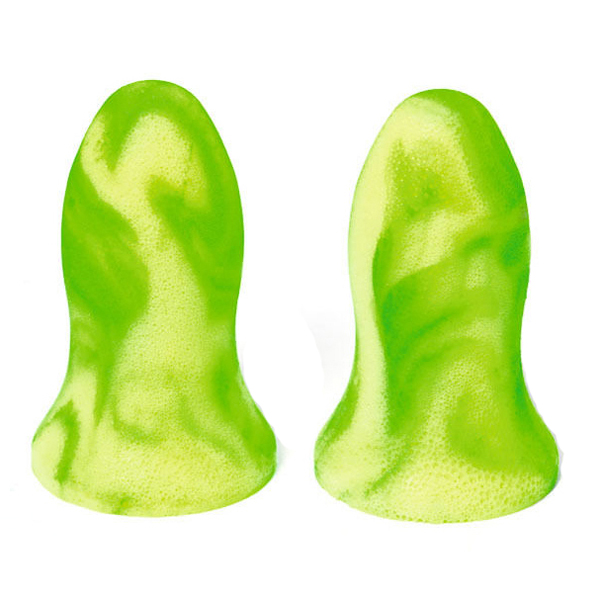
Moldex Contours Regular Earplugs – available from Zoom Health
Buy Moldex Contours Regular Earplugs
Available individually from Zoom Health: Moldex Contours Earplugs – Regular. Or try them alongside 14 other pairs in our Men’s Earplugs Sample Pack.
The Default Earplug Problem
Most men who use earplugs regularly settled on a product years ago – often whatever was cheapest, most visible in a pharmacy, or handed out at work – and have used the same thing ever since without revisiting the decision. This is understandable. Earplugs are a low-cost consumable, changing them feels like unnecessary effort, and if the current option is broadly adequate there is little obvious incentive to explore alternatives. The result is that a large number of men are using earplugs that are adequate but not optimal – providing some noise reduction, some of the time, with a level of comfort they have simply normalised.
The Moldex Contours Regular challenges that default position directly. It does not just offer a different size or shape – it represents a fundamentally different approach to how a foam earplug achieves its seal. Trying it back to back with the cylindrical options from Days 1 to 3 is one of the most instructive comparisons in the sample pack, because the difference in wearing experience is often immediately apparent rather than subtle.
Why Anatomical Design Matters for Average-Canal Men
As I explained on Day 7, the Contours’ anatomical shape is pre-designed to follow the natural profile of the ear canal rather than using a geometric approximation. For men with average-sized canals – the target audience for the Regular – this means the earplug arrives at the correct seated position more naturally than a cylinder or taper that needs to expand and fill gaps to create a seal.
The practical consequence is a more consistent seal with less insertion effort. Where a cylindrical earplug requires precise compression and careful placement to achieve its rated performance, the Contours Regular’s shape guides it towards the correct position more tolerantly – reducing the variation between a good insertion and a poor one. For men who use earplugs in workplace settings where consistent protection matters, that reduction in insertion variability has real safety implications. A poorly inserted earplug that delivers 15dB instead of 35dB in a 90dB environment leaves a man significantly under-protected without any obvious indication that the seal has failed.
The Foam That Changes the Comfort Baseline
The super-soft, ultra-light PU foam in the Contours Regular is noticeably different from the polyurethane foam used in the 3M and Howard Leight earplugs covered earlier in this series. The key difference is the outward pressure it exerts once expanded. Standard polyurethane foam – even in softer formulations – pushes outward against the ear canal wall with a force that men often experience as a gradual pressure build-up during extended wear. The Contours foam exerts significantly less of this outward force, sealing against the canal wall without the sensation of pushing against it.
For men who wear earplugs during long working shifts, overnight, or across extended travel, this matters more than it does for occasional use. The discomfort that causes men to remove earplugs before the job is done – or to sleep with them out rather than in – is almost always related to accumulated pressure rather than an initial fit problem. The Contours Regular’s low-pressure foam removes that accumulation almost entirely, which means earplugs that stay in for the duration rather than being quietly removed an hour in.
SNR 35dB Across Both Sizes
The Contours Regular carries the same SNR 35dB rating as the Small – confirming that the anatomical design delivers consistent attenuation across both sizes when correctly fitted. At 35dB it sits comfortably above the Laser Lite at 32dB and the Yellow Neons at 33dB, and just below the joint-highest options at 37dB. For the full range of occupational and domestic noise reduction needs a man is likely to encounter – workshops, commuting, sleeping, studying, live music – 35dB is entirely adequate and provides meaningful headroom above most common noise sources.
The Contours Regular vs the Rest of the Pack at This Point
Eight days in, it is useful to see how the Regular sits relative to what has come before. The EARsoft Classic is the reliable standard – the benchmark everything else is measured against. The Yellow Neons improve on it with a tapered shape suited to long shifts. The 3M 1100 adds firmness for working-conditions insertion. The Laser Lite and Max Lite add T-shape handling advantages. The MAX adds bell-shape stability and maximum attenuation. The Contours Regular adds something none of those offer: an anatomically derived shape with ultra-low-pressure foam that fits average ear canals more naturally than any geometric design. Each earplug in the pack solves the problem from a different direction – and the Contours Regular’s direction is the one most likely to convert a man who has tolerated standard foam earplugs into a man who genuinely prefers them.
My Verdict
The Moldex Contours Regular is the earplug in this series most likely to change the mind of a man who considers himself an earplug agnostic – someone who uses them when necessary but has never found one he actively prefers. The anatomical fit, low-pressure foam and SNR 35dB performance combine into a product that feels qualitatively different from the geometric foam options, in a way that is immediately noticeable rather than marginal. If you have worked through Days 1 to 7 and found the 3M and Howard Leight options broadly adequate but not particularly comfortable, Day 8 is where the series takes a meaningful turn. The Contours Regular is also included in our Women’s Earplugs Sample Pack.
Tomorrow on Day 9 the series introduces the only earplug unique to the men’s pack: the Bilsom 303L SuperSoft Large – a large-format earplug designed specifically for men who have always found standard earplugs too small, and the one part of the collection with no equivalent in the women’s series.

The Men’s Earplugs Sample Pack – 15 different pairs to help you find your perfect match
Not sure which earplug is right for you?
Try all 15 pairs in our Men’s Earplugs Sample Pack and find your perfect match.
This is Day 8 of our 15-day series reviewing every earplug in the Men’s Earplugs Sample Pack.
About the Author
Anthony Cunningham – Health Writer & Editor
Anthony Cunningham, BA (Hons), MA, is a UK-based health writer and editor with over 20 years’ experience running Zoom Health, a trusted source for home health tests, preventive care, and wellness guidance. He creates clear, evidence-based articles using NHS, NICE, and WHO guidance. Where possible, content is reviewed by practising clinicians to enhance accuracy and reliability, helping readers make informed healthcare decisions.