About This Article
Zoom Health has over 20 years’ experience supplying earplugs and hearing protection products in the UK. This first-hand review examines the comfort, ease of use and noise reduction of 3M E-A-R Push-Ins earplugs in everyday noisy environments.
Published: 6 September 2023 | Last Updated: 17 October 2026 | By: Anthony Cunningham
Hearing protection is crucial for anyone who works in loud environments or attends concerts and other noisy events. Earplugs are an easy, affordable way to protect your hearing from excessive noise exposure. 3M’s E-A-R Push-Ins are reusable foam earplugs designed for comfort and high noise reduction. In this review, we’ll cover the key features and benefits of the Push-Ins earplugs based on hands-on testing in various noisy settings.
Overview of 3M Push-Ins Earplugs
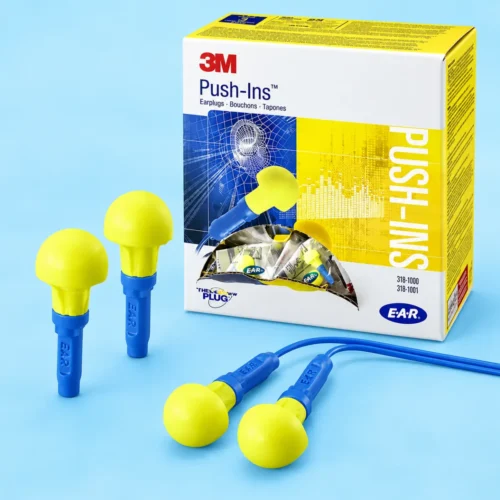
The 3M Push-Ins have a simple yet effective design. Foam tips insert into the ear canal and form a seal. Behind the tip, a short stem allows easy insertion and removal. The foam is tapered to match the shape of the ear canal. This helps provide a secure, comfortable fit. An ergonomic shape and smooth surface finish make them easy to insert and remove without irritation.
The Push-Ins are commonly listed with a noise reduction rating (NRR) of 30 dB. NRR is a US rating and should not be confused with the single number rating (SNR) used for hearing protection in the UK and Europe. Actual noise reduction depends on the specific product, correct fitting and the individual wearer. These earplugs may be suitable for noisy environments such as construction sites, workshops and industrial settings, but the appropriate protection must be selected according to the noise exposure and the manufacturer’s guidance.

Testing the 3M Push-Ins Earplugs
I tested the 3M Push-Ins earplugs in various high-noise environments to assess comfort, ease of use, and noise blocking ability. Tests included:
- Using power tools and machinery in a home workshop
- Attending live rock concerts
- Riding public transport and motorcycles
- Working out in a noisy gym
In all these challenging tests, the Push-Ins performed exceptionally well. Insertion and removal were quick and easy, without the plugs getting stuck or impacted. The tapered foam tips sealed securely without needing to be jammed into the ear canals. This provided excellent subjective noise reduction, although, like other foam earplugs, they also reduced the volume of sounds I wanted to hear.

3M Push-Ins earplugs are also available in a corded version, which many people may prefer, depending on the application in which the earplugs are being used.
Comfort
Comfort is critical for hearing protection that needs to be worn for hours at a time. The 3M Push-Ins have a clever design intended to maintain comfort during extended wear. The smooth foam has no seams or edges that could irritate the ear canal. The flexible stem section makes the earplugs straightforward to handle and insert.
During long periods of wear, the Push-Ins didn’t cause any discomfort or itching. The foam tips remained comfortable while chewing or talking. This helped prevent fatigue and maintain a consistent seal during my tests. For safety-critical jobs, reliable comfort is a major advantage, although individual fit and comfort will vary.
Noise Reduction
With a stated NRR of 30 dB, the 3M Push-Ins offer significant potential noise reduction across frequencies when fitted correctly. Subjectively, they blocked noise extremely well in all tests. Power tools and heavy machinery sounded much quieter and less harsh. Concerts were noticeably quieter, although the foam earplugs also changed the balance and clarity of the music.
The tapered foam plugs seemed particularly effective at reducing lower-frequency noise during my tests. Machinery rumbles and concert bass came through more softly. However, this was a subjective observation rather than a laboratory measurement of frequency-specific attenuation. For industrial or construction work, users should consult the manufacturer’s attenuation data and follow workplace hearing protection requirements.
Important: Choosing and Fitting Hearing Protection
A stated noise reduction rating does not mean that every wearer will experience that exact reduction in noise. Earplugs must fit correctly and form a reliable seal. For occupational use, select hearing protection based on the assessed noise exposure, the manufacturer’s UK or European attenuation information and applicable workplace safety guidance.
Do not assume that earplugs with a high published rating are automatically sufficient for every environment above 100 dB. Particularly loud activities may require additional protection or other measures to reduce exposure.
Value
3M Push-Ins offer great value. Their convenient stem design makes them particularly easy to handle, and they provide substantial noise reduction without the expense of custom-moulded earplugs. For infrequent use, the Push-Ins are reasonably priced for the quality.
However, the foam tips should not be assumed to last for years. Reuse and replacement must follow the manufacturer’s instructions for the particular product. Earplugs should be replaced when they become dirty, damaged, worn or no longer provide a reliable fit. This is especially important where effective hearing protection is essential.
Featured Product: 3M E-A-R Push-Ins Earplugs
3M E-A-R Push-Ins combine soft foam tips with a convenient insertion stem, making them straightforward to fit without rolling the foam first. Find out more about the 3M E-A-R Push-Ins Earplugs available from Zoom Health.
Conclusion
The 3M E-A-R Push-Ins deliver impressive noise blocking in a comfortable, practical design. They’re easy to use and maintained a reliable seal during my testing. Strong attenuation makes them versatile for both work and recreation, provided they are suitable for the noise exposure and fitted correctly. For anyone seeking affordable hearing protection that is quick to insert and remove, the Push-Ins are well worth considering. They’ve become my go-to ear protection for reducing loud noise, although users who want to preserve the detail of live music may prefer specialist musicians’ earplugs.
About the Author
Anthony Cunningham, BA (Hons), MA, is a UK-based health writer and editor with over 20 years’ experience running Zoom Health, a trusted source for home health tests, preventive care, and wellness guidance. He creates clear, evidence-based articles using NHS, NICE, and WHO guidance. Where possible, content is reviewed by practising clinicians to enhance accuracy and reliability, helping readers make informed healthcare decisions.