About This Article
Zoom Health has supplied health and first aid products to UK customers for nearly 20 years. This article traces the origins of the foil blanket and its use after endurance events.
Published: 29 April 2023 | Last Updated: 25 September 2026 | By: Anthony Cunningham
The emergency foil blanket, also known as a space blanket or emergency blanket, has become a ubiquitous item in emergency equipment, first aid kits and outdoor gear. But how did this simple yet effective tool come to be?
The origins of the foil blanket can be traced back to NASA and the space race of the 1960s. NASA first developed emergency blankets in 1964, drawing on reflective material used to protect spacecraft and their occupants from extreme temperatures. Made of a thin layer of plastic or polyester film with a metallic coating, the blankets are lightweight, waterproof, and reflect radiant heat back towards the person using them.
The technology behind the foil blanket was soon put to use beyond space travel. Manufacturers adapted the reflective film into compact rescue blankets, making it practical to carry in an emergency kit. NASA has documented how these commercial blankets later became familiar at marathon finish lines.
Emergency responders and outdoor enthusiasts also began incorporating foil blankets into their gear. The blankets were valued for their compact size and ease of use. Their reflective surface helps reduce radiant heat loss, while the sheet can offer some protection from wind and rain.
Since then, the foil blanket has become a staple in emergency kits for hikers, climbers, and outdoor adventurers. They are also commonly found in first aid kits and the boots of cars, where they can be used to help individuals stay warm and dry in case of a breakdown or other roadside emergency.
The foil blanket’s use is not limited to outdoor emergencies. Reflective materials have also been used in medical settings to help reduce heat loss around surgery. A foil blanket is a temporary measure, not a treatment for hypothermia: someone who may have hypothermia needs urgent medical help. See the NHS guidance on hypothermia.
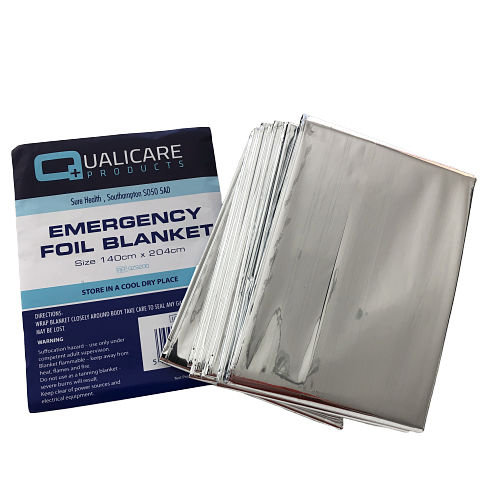
Featured Product: Emergency Foil Blanket
A compact blanket can be kept with outdoor or first aid supplies. See Zoom Health’s Emergency Foil Blanket for the product details.
Use of Foil Blankets at the London Marathon
At the London Marathon, runners can lose warmth quickly once they stop moving. The familiar sight of a runner wrapped in silver foil illustrates one of the blanket’s most practical uses: providing a light, portable layer immediately after strenuous exercise.
At marathon finish lines, foil blankets help runners retain warmth after they stop. This can be particularly useful while they are waiting outdoors, especially in wind or rain. NASA describes their adoption at long-distance races as one of the uses of its reflective technology.
A foil blanket is made from thin plastic film with a metallic coating. It reflects radiant heat towards the person using it and provides a barrier against wind and rain. It works best when wrapped around the person; it does not generate heat or replace dry clothing, shelter or medical care when those are needed.
Foil blankets are used after other endurance events too. Their low weight and small packed size allow organisers to have them ready for large numbers of finishers.
From NASA’s 1960s reflective film to today’s emergency kits and race finish lines, the foil blanket has endured because it is simple to carry and quick to use. Its role is to help limit heat loss while more suitable clothing, shelter or medical assistance is arranged.
About the Author
Anthony Cunningham, BA (Hons), MA, is a UK-based health writer and editor with over 20 years’ experience running Zoom Health, a trusted source for home health tests, preventive care, and wellness guidance. He creates clear, evidence-based articles using NHS, NICE, and WHO guidance. Where possible, content is reviewed by practising clinicians to enhance accuracy and reliability, helping readers make informed healthcare decisions.
Medical Disclaimer
This article is for general information only and is not a substitute for professional medical advice, diagnosis or treatment. If you have concerns about your health or symptoms, speak to your GP or another qualified healthcare professional. In an emergency, seek urgent medical help.