About This Article
About This Article: Zoom Health has supplied home health products and hearing protection to UK customers for nearly 20 years. This guide draws on our experience helping thousands of people improve their sleep, protect their hearing, and find the right earplug for their needs. Always consult a healthcare professional if you experience ear pain, hearing loss, or recurring ear problems.
Published: 12 April 2026 | By: Anthony Cunningham
Nine days into this series, every earplug we have covered has been framed around maximum protection – blocking out as much noise as possible in the loudest environments. Day 10 deliberately breaks that pattern. The Moldex Mellows carry an SNR of just 22dB – the lowest rating in the entire Men’s Earplugs Sample Pack. And I want to make the case that for a significant proportion of men reading this series, the Mellows will turn out to be the earplug they actually use most. The reason comes down to a use case that earplug marketing almost entirely ignores: the modern male knowledge worker trying to concentrate in a noisy open-plan office. I covered the general low-SNR argument in Day 10 of the women’s series – today I want to anchor it specifically in the male workplace experience.
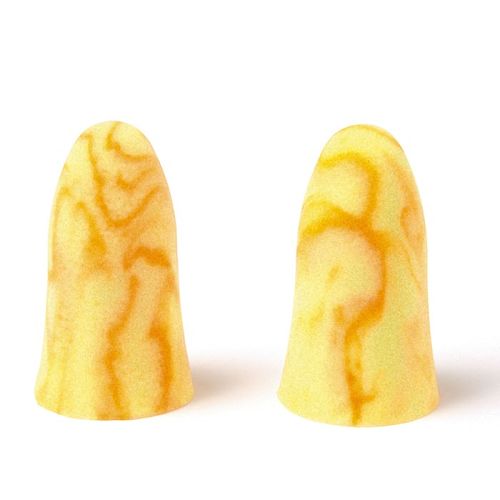
Moldex Mellows Soft Foam Earplugs – available from Zoom Health
Buy Moldex Mellows Earplugs
Available individually from Zoom Health: Moldex Mellows Soft Foam Earplugs. Or try them alongside 14 other pairs in our Men’s Earplugs Sample Pack.
The Open-Plan Office Problem
Open-plan offices have become the dominant workplace design over the past two decades, and the research on their effect on cognitive performance is consistently negative. Background noise – colleagues on calls, keyboard clatter, impromptu conversations, air conditioning – creates a constant low-level cognitive load that fragments concentration and degrades performance on tasks requiring sustained attention. For men doing writing, coding, analysis, design or any other work that demands focus, the modern open-plan environment is genuinely hostile to productivity.
The conventional response is noise-cancelling headphones – which work well but carry social costs. Headphones signal unavailability conspicuously, can feel isolating worn all day, and make it difficult to hear a colleague approaching or a phone ringing. An earplug that reduces the ambient noise level enough to improve concentration without creating complete isolation is a more versatile and less socially loaded solution – and the Mellows are precisely that earplug.
Why 22dB Is the Right Number for Office Use
A typical open-plan office registers between 55 and 70dB depending on occupancy and activity level. With SNR 22dB of attenuation, effective noise exposure drops to between 33 and 48dB – noticeably quieter, distractions significantly reduced, but not silent. Critically, at these attenuated levels you remain fully able to hear a colleague speaking directly to you at normal volume, respond to your name being called across the room, and pick up on the ambient cues of a working environment that tell you when something needs your attention.
Compare this with inserting a 37dB earplug in the same office: effective exposure drops to between 18 and 33dB – approaching the threshold of hearing for normal conversation. You have created the acoustic equivalent of working alone in a soundproofed room, which eliminates distraction but also eliminates awareness. For most office environments that level of isolation is disproportionate and practically disruptive. The Mellows solve the problem at the right level of attenuation rather than the maximum available level.
Designed to Let You Communicate
The Mellows have a specific acoustic characteristic that makes them particularly valuable in a workplace context: they provide low noise reduction in the medium and lower frequencies where speech typically sits. This is a deliberate design choice by Moldex rather than a limitation. The result is an earplug that attenuates the higher-frequency ambient noise that drives distraction – air conditioning hum, keyboard noise, distant conversations – while preserving the speech frequency range more than a flat-attenuation earplug would. You hear the office less, but you hear people talking to you more clearly than a higher-rated earplug allows.
Our customer Jason, who reviewed the Mellows, captures this precisely: he describes them dampening noise enough to allow him to work more quietly while keeping his senses about him – which is the exact balance a knowledge worker in an open environment needs. That he rates them as the best earplugs he has tried, having clearly sampled multiple options, is a meaningful endorsement from someone who understands what he is comparing them against.
All-Day Wearability: The Comfort Argument for Regular Office Use
An earplug used in an office needs to be comfortable for hours at a stretch – far longer than the typical intermittent use that industrial hearing protection involves. The Mellows’ extra-soft, extra-light foam and low-pressure tapered design make them among the most comfortable earplugs in the pack for sustained wear. Unlike several of the higher-attenuation options that build pressure discomfort over a working day, the Mellows can be worn from the start of a working session to the end without the gradual soreness that causes men to remove earplugs before the task is complete.
The 100% PVC-free foam is also relevant for daily use – men who wear earplugs every working day are in significantly more contact with the foam material than occasional users, and a non-irritating, skin-friendly formulation reduces the risk of sensitivity reactions that accumulate with repeated exposure.
Beyond the Office: Other Use Cases for Lower Attenuation
The office is the most obvious context for the Mellows, but not the only one. Men who attend sporting events and want to take the edge off crowd noise without losing the atmosphere. Men who travel frequently by train or plane and want to reduce travel fatigue without complete isolation. Men who work in light industrial environments where some situational awareness is required for safety alongside noise reduction. In all of these scenarios, the Howard Leight MAX at 37dB over-solves the problem in a way that creates new inconveniences, while the Mellows’ 22dB hits the right level of attenuation for the task.
My Verdict
The Moldex Mellows are the most underestimated earplug in the Men’s Earplugs Sample Pack. Men who work in knowledge-intensive roles in open-plan environments, who attend live sporting events, or who travel regularly and want reduced noise without isolation will find them the most practically useful earplug in the collection for those specific contexts. The 22dB SNR is not a weakness – it is the right answer to a different question than the one most earplug marketing asks. Both our Men’s Earplugs Sample Pack and our Women’s Earplugs Sample Pack include the Mellows because that question is one that men and women alike regularly need answered.
Tomorrow on Day 11 the series continues with Moldex and the Pura Fit – super-soft foam, biodegradable packaging, and an SNR that bridges the gap between the Mellows and the maximum-attenuation options we covered in the first week.
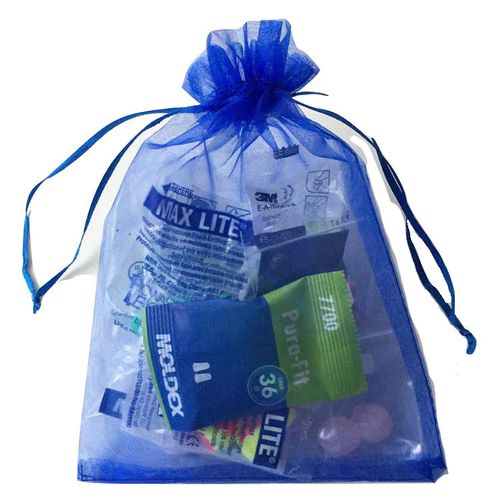
The Men’s Earplugs Sample Pack – 15 different pairs to help you find your perfect match
Not sure which earplug is right for you?
Try all 15 pairs in our Men’s Earplugs Sample Pack and find your perfect match.
This is Day 10 of our 15-day series reviewing every earplug in the Men’s Earplugs Sample Pack.
About the Author
Anthony Cunningham – Health Writer & Editor
Anthony Cunningham, BA (Hons), MA, is a UK-based health writer and editor with over 20 years’ experience running Zoom Health, a trusted source for home health tests, preventive care, and wellness guidance. He creates clear, evidence-based articles using NHS, NICE, and WHO guidance. Where possible, content is reviewed by practising clinicians to enhance accuracy and reliability, helping readers make informed healthcare decisions.