About This Article
Zoom Health has supplied home health tests to UK customers for nearly 20 years. This guide draws on our experience helping thousands of people understand their blood type and why it matters for medical safety, blood donation, and emergency preparedness. Always consult a healthcare professional for medical advice.
Published: November 2017 | Last Updated: November 2025 | By: Anthony Cunningham
What Makes B Positive Blood Unique?
Your blood type is inherited. Like eye colour, blood type is passed genetically from your parents. Your blood group, whether it is type A, B, AB or O is based on the blood types of your mother and father.
The B Positive blood type is comparatively rare. In the UK, 1 in 13 blood donors has the B Positive blood type. As a percentage of the population, 8% in the UK will have this blood type.
Having B positive blood means that your red blood cells have B antigens and your plasma has anti-A antibodies. This makes it important to ensure that if you ever need a blood transfusion, you receive blood that is compatible with your blood type.
B Positive Blood Type Compatibility
Who Can Receive B Positive Blood?
If you are a blood donor with B positive blood, your blood can be received by people with B positive and AB positive blood types. This makes your donations valuable for approximately 11% of the UK population who share these blood types.
Blood Donation Compatibility Chart
If you have B positive blood, you can donate to:
- B positive recipients
- AB positive recipients
If you have B positive blood, you can receive blood from:
- B positive donors
- B negative donors
- O positive donors
- O negative donors (universal donor)
Understanding your compatibility is crucial for medical safety. NHS Blood and Transplant maintains strict protocols to ensure blood type matching during transfusions, as receiving incompatible blood can cause serious complications.
Health Considerations for B Positive Blood
While being B positive may seem like a disadvantage due to its rarity, it also has some advantages. Studies have shown that people with this blood type are less susceptible to certain infections, such as cholera and E.coli. However, they may be more prone to developing autoimmune disorders, such as multiple sclerosis.
Important Note: Blood type associations with health conditions are based on population studies and do not predict individual health outcomes. Your blood type is just one of many factors that influence your health. Always discuss any health concerns with your GP or healthcare provider.
Why Knowing Your Blood Type Matters
There are lots of ways to find out your blood type. The importance of knowing your blood type is to stop the risk of receiving an incompatible blood type if a transfusion is needed. If the wrong blood types are mixed, it can cause a clumping of blood cells that can be potentially fatal.
Key Situations Where Your Blood Type Is Essential
- Emergency medical treatment: In accidents or sudden illness requiring transfusions, knowing your blood type saves critical time
- Planned surgery: Hospitals need to know your blood type before any surgical procedure
- Pregnancy: Blood type compatibility between mother and baby is monitored throughout pregnancy, particularly regarding Rh factor
- Blood donation: Understanding your type helps you know who benefits from your donations
- International travel: Carrying a card with your blood type can be vital in countries where you may not speak the language
- Organ transplantation: Blood type matching is crucial for successful transplants
According to NHS guidance on blood transfusions, medical staff will always test your blood type before any transfusion, but having this information readily available can speed up emergency treatment.
How to Find Out Your Blood Type
If you do not know your blood group, you can contact your local doctor’s surgery or blood donation group to make an appointment and try to find out. (Note: Your doctor may not be willing to give you a blood test when there is no medical need to carry one out.)
Testing Your Blood Type at Home
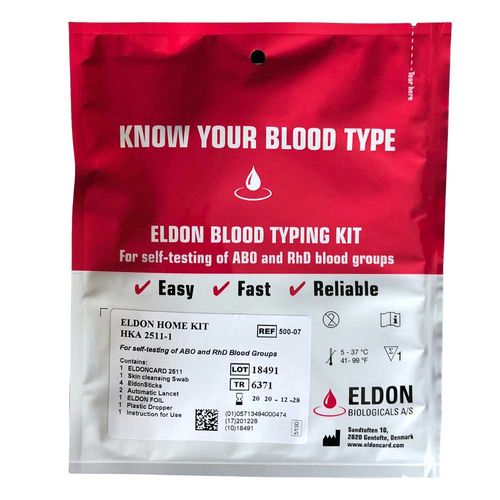
The easiest way to find out your blood group is by taking a test at home. We suggest the Eldon blood typing kit for this purpose. As well as being an inexpensive kit, this product also produces results within minutes. Also, you can test at home as soon as the packet from Zoom Health pops through your letterbox, no waiting for days or weeks for a surgery appointment!
How Home Blood Type Testing Works
- Use the lancet provided to obtain a small blood sample (typically 4 drops)
- Place blood samples on the test card in designated areas
- Add the testing reagents to each blood sample
- Wait for the reaction (usually 1-2 minutes)
- Compare the results against the colour chart to determine your blood type
The test identifies both your ABO blood group (A, B, AB, or O) and your Rh factor (positive or negative), giving you your complete blood type.
What Customers Say
★★★★★ Sophie — July 2015
“I decided to get one of these for every member of my family; knowing your blood group is so important. Not only was it fairly painless and easy to do this test, but this company provides very detailed instructions so that it is almost impossible to mess up. The information that you get could be lifesaving for you or another person.”
★★★★★ Anonymous — November 2024
“Efficient delivery, and process as described. Very pleased. Would definitely recommend this service if you want to know your blood group.”
★★★★★ Ash L — April 2015
“This home blood test kit was really simple to use. The little blood pricking tool that comes with the kit is fairly painless to administer and makes a tiny hole. Great kit for the money and came next day.”
The Importance of B Positive Blood Donation
As someone with B positive blood, you are part of a relatively small donor group. While B positive is not as rare as B negative (which affects only 2% of the UK population), maintaining adequate supplies of B positive blood is essential for the NHS.
NHS Blood Donation welcomes donors from all blood types, but those with less common types like B positive play a crucial role in ensuring patients receive compatible blood when needed.
Consider Becoming a Blood Donor
If you have B positive blood and are eligible to donate, your contributions help patients with B positive and AB positive blood types. One donation can save up to three lives. Visit the NHS Blood and Transplant website to register as a donor or find your nearest donation centre.
B Positive Blood Type FAQs
How common is B positive blood in the UK?
B positive blood is found in approximately 8% of the UK population, making it one of the less common blood types. This means roughly 1 in 13 people have B positive blood.
Can two B positive parents have a child with a different blood type?
Yes, depending on the specific genes each parent carries. Two B positive parents could have children with B positive, B negative, O positive, or O negative blood types. Blood type inheritance follows specific genetic patterns involving ABO and Rh genes.
Is B positive blood in high demand for donations?
B positive blood is needed regularly by the NHS to treat patients with B positive and AB positive blood types. While not as universally needed as O negative blood, maintaining adequate supplies of all blood types, including B positive, is essential for patient care.
Does my blood type affect my diet or health?
While some sources suggest blood type diets, there is limited scientific evidence supporting different dietary requirements based on blood type. Your overall health depends on many factors beyond blood type. Always consult healthcare professionals for personalised dietary and health advice rather than relying solely on blood type.
What should I do if I need blood but don’t know my type?
In emergency situations, hospitals will quickly test your blood type before any transfusion. In true emergencies where there’s no time for testing, O negative blood (the universal donor type) may be used temporarily until your blood type is confirmed.
Taking Action: Know Your Blood Type Today
Understanding your blood type is a simple but important step in taking charge of your health. Whether you discover you’re B positive through GP testing, blood donation, or a home test kit, this knowledge provides valuable information for medical emergencies, planned procedures, pregnancy planning, and blood donation opportunities.
For those who prefer the convenience and speed of home testing, reliable kits are available that provide accurate results within minutes. Knowing your blood type today means being prepared for tomorrow’s health needs.
Find Out Your Blood Type at Home
Discover your complete blood type (ABO and Rh factor) in minutes with an easy-to-use home test kit. Fast UK delivery and clear instructions included.
About the Author
Anthony Cunningham — Health Writer & Editor
Anthony Cunningham, BA (Hons), MA, is a UK-based health writer and editor with over 20 years’ experience running Zoom Health, a trusted source for home health tests, preventive care, and wellness guidance. He creates clear, evidence-based articles using NHS, NICE, and WHO guidance. Where possible, content is reviewed by practising clinicians to enhance accuracy and reliability, helping readers make informed healthcare decisions.
You May Also Like
Explore more articles on blood types and health testing: